Spelling in AMI albums


When looking for spelling practice in the AMI albums, look for the following concepts:

  • phonograms (booklets, cards)
  • the word "dictation" in any follow-ups or extensions (think anything with a word list, including the phonogram cards and word study)
  • (or turn any/all word lists into dictation games)
  • function of words 
  • word study
  • let the children come up with words on their own - dictate to each other
  • note typically mis-spelled words in their writing - cover those needed rules through games or direct instruction

Doesn't feel like much, but it is powerful.

The adults are responsible for ensuring all the areas have been introduced and are being utilized.


Snake Games, Part 2


There are only THREE snake games:
As started in first post, when it says gray with red binding,
actually DO that. Everything shows up nicely on GRAY. 

  1. Addition Snake Game
  2. Subtraction Snake Game
  3. Negative Snake Game


(for the first Montessori Nugget on snake games, visit this Montessori Nugget from last June)

Addition and Subtraction are done in primary or very early elementary (can be continued through lower elementary as practice is needed).

Negative Snake Game is an elementary material when we are preparing the children to work with truly negative numbers (in a way, subtraction is already "adding a negative" but with the negative snake game, we can actually get an answer below zero).

Each Snake Game has verification steps.

The verification step 2 of the addition snake game has the child grouping his original snake by lengths of bead bars and multiplying each group to see if his golden snake matches. (details are in the album)

Presumably, you can do that work with all of the snake games in the appropriate places.

Some people are calling this a separate snake game: Multiplication Snake Game. It's not a different snake game. It's a verification method on the addition (and again, presumably the other snake games).


:)


Elementary Geography: Human Geography


There is a chapter WAAAAAY way at the end of the Elementary Montessori Geography album (AMI - I'm not sure where it is in other elementary options)

Oh, those chapters at the ENDs of the albums are sly little creatures ;) Because they almost always have something for the youngest elementary children that builds into the later more complex work for the older elementary children - and yet, we don't get to them, because, well, they're at the end of the album, and shouldn't that be for the older children?

Interesting thing - all those math skills that are allegedly missing from the albums? Many of them are found right HERE in this section! Reading maps, using graphs in various forms, some introduction to statistics.... Yep. All here ;)


There are two sections with Human Geography
1) Interdependence of Human Beings in Society
       This one could potentially begin in primary, but officially could start with the Fundamental Needs of Man and stem from there. We talk about the people in the process of making things (whereas so many other resources focus on the process of making things, but less on the people themselves). Books, videos, card material (available for purchasable download or can be teacher-designed) - the materials are simplistic enough, thus this whole area is SO easily overlooked!

NOTE! This is NOT the interdependencies from the Biology Album ecology chapter! (which should also be introduced earlier rather than later - another "back of the album - early work" chapter ;) )

2) Economic Geography
      This area include the study of natural resource, study of consumption, comparison of production and consumption, imports and exports, volume of world trade, world commerce.
Materials needed: study resources, possibly the internet, and the economic geography stamps (the linked ones correlate with the AMI albums)


From the Introduction to Human Geography: 

Here with the interdependencies is a prime place to emphasize that Montessori is not so much a method of education only – but a way of looking at life and interacting with it.

Many of the following activities seem very, very simple – and they can be easily overlooked. I urge you: DO NOT MAKE THIS MISTAKE.

Emphasize the connections between all humans – past, present and future. All those who came before us left us many gifts (and us adults will add “and many problems”). By focusing on these gifts, and passing them on, along with new gifts that have their foundation on the past gifts, we will pass fewer problems along to future generations.

Gratitude.

Respect.

Encouragement.

Joy.

We are all here together. Now. We have come from a common past that has taken many branches. Establish in your children the above listed traits, and they will have the tools they need to promote healthy relationships everywhere life takes them.

Lower Elementary: Interdependencies
Upper Elementary: Economic Geography
FOLLOW THE CHILD, regardless of age – ages are guidelines ONLY. 
       

Fifth Great Lesson: Story of Numbers


The Fifth Great Lesson is the Story of Numbers. This story does not open up a new album area so much as introduce the child to the history of mathematics through the development of number usage. It ties together the child's previous and current studies with human development, further establishing and solidifying the experience of cosmic education.

The materials are a set of 8 charts in "half-size" (assuming you are using full-classroom size charts), with various cultures and time periods represented. The charts are used during the story to highlight various aspects.

It is perhaps not as "fantastical" as the first couple of stories, but really ties together cosmic education for the children and should come early on in their elementary experience, and repeated at various times and levels with new information as the children do some of their own research. This story helps them to gain appreciation for the gifts of our ancestors, the developments of civilization and communication (even through numbers) through time, and responsibility to pass on these gifts.

We hope that the children will have a strong foundation for how mathematics (and the mathematical mind of the human being) connects us to one another: past, present and future.


  • General search for Great Lessons on Montessori Nuggets
  • God With No Hands
  • Coming of Life
  • Coming of Human Beings
  • Communication in Signs
  • Numbers
  • Fourth Great Lesson: Story of Communication in Signs


    The Story of Communication in Signs is the fourth Great Lesson - it is found in the Language album. This story does not open up a subject album as such, because the children have been using language their entire lives - and developing language skills throughout their primary years and early elementary months.

    Some children may hear this story before they do the "key lesson" on the Hand Timeline; while others may use the Hand Timeline first, then hear this story - the ideal is to do the Hand Timeline first, followed by the Story of Communication in Signs. The story should be modified accordingly.

    Our goal is appreciation for written communication.

    • Materials: The only materials are a set of 8 impressionistic charts showing some of the writing styles through time - the charts are optional during the telling of the story. If they are distracting, we keep them aside and use them for follow-up; if they enhance the telling, then they are used during the story. Using 2-3 is generally most helpful. 
    • Timing: 5th or 6th week of the school year (repeated whenever the children like)

    Most children love to copy the charts and highly appreciate books and videos that correspond with the topics introduced in this story. 


    Bells and Tonebars


    Due to their expense and the excuse by some adults that they have no musical talent, the bells are often overlooking or intentionally passed over in the Montessori homeschool - and in new or small Montessori classes/schools.

    I can't do much for the price on the bells...

    black notes in the back to hold their places,
    but the movable brown bells are not in place yet. 
    But I can say this: as a *sensorial* experience for the children, the adult does not have to know a lick of music or have iota of musical talent. The adult can be entirely tone deaf and still provide a rich experience for the children. 

    I can't emphasize that point NEAR enough.

    The control of error is in the child's ear - and it is the child's ear that needs to be trained. The adult can also learn from this material and let the children help be a control of error.


    When in doubt, the black/white bells (that sit in the back and should NEVER be moved) can be numbered in pitch order, underneath their bases - so the adult can quickly put those ones back in place if they get out of order.

    Only the brown ones should be moved and it is a matching exercise to the non-moved black/white bells.

    The work of the child?

    • matching single pitches
    • listening to single pitches
    • listening to steps
    • grading in various stages (from simple to more complex)
    • naming the notes
    • additional naming systems
    • repeat all with the sharps/flats
    • composing music
    • playing written music

    But even if all they do is LISTEN while striking and dampening - their ears are being trained. 

    We always begin and end our bells work with playing the C-Major scale up and down - talk about ear training! This could be heard by the children several times a day and they will start picking up on the steps between the notes, just through consistent exposure. 


    As for the money, there are a variety of cheaper options. The concern with the cheaper options: 

    • you'll want C to C (or G to G if that is all you can find)
    • you'll want the sharps/flats or you won't get from the material what the children need to get - and what any musically-needy adults need to get, sensorially-speaking. 
    • experientially, the children will be able to do SO much more with a full range of notes. 
    • however, if you have older children already and you know you are moving into the tone bars, you might be able to leave out the sharps/flats for now. 


    I paid $350 for the set photographed, but through a company that was closing out of selling Montessori materials. They DID sell the bells for $500. Not perfect (if right next to each other, some of the bells touch each other and ding when the next one is struck - I keep meaning to widen the bases a bit), but certainly better than Nienhuis price. 
    Adding sharps and flats
    These are on the bell boards, but fully cover it,
    so you can't see the spaces I painted on. 
    If you can find a school selling theirs for a newer set, perfect!


    The elementary tone bars definitely have more inexpensive options, particularly picking up a Suzuki tone bar set. This range is 2 octaves and you can do ALL the same work as with the bells, except the matching - unless you purchase an additional set in one octave specifically for matching (still ends up cheaper than the bells alone). 

    For primary, they really should be housed in a way that only the pitches differ - not the appearance. 
    For elementary, they CAN remain looking different, but it is so nice when they are the same size (more concentration on the part of the children). 


    Some ideas here on the music materials: 


    Research on Cursive Handwriting

    Some links to research on cursive handwriting:

    What Learning Cursive Does to Your Brain

    Cursive Benefits Go Beyond Writing

    Brain Research and Cursive Writing

    Should Schools Still Teach Cursive?

    Study: Learning Cursive in First Grade Helps Students

    Edited to add a new one: 
    Biological and Psychological Benefits of Learning Cursive


    Each one of these studies focuses on learning cursive in approximately 2nd-4th grade (ages 7-9). The naysayers to cursive typically are the ones not realizing that the sensitive period for languages is 0-6 years of age, thus we should be giving the children the keys (muscle memory of the letter shapes, sounds of the letters) before age 6, at which time they receive all they need to read/write in cursive AND in print (because print just "happens" with children who start with cursive).

    Then, we can spend those elementary years working on composition skills and pursuing SO many other interests pertinent to the elementary age - the second plane of development.


    Montessori Articles:
    Why Cursive First? (fantastic bullet-pointed list)

    Should We Still Teach Handwriting in the Montessori Classroom?
    (read the comments on this one for sure!)


    There are plenty more, very excellent, articles - and quite a few not so excellent ones (both Montessori and non-Montessori). But these ones hit the main ideas.


    Montessori vs Better Late than Early


    I really like how the author of this post really gets down to the fundamental of Montessori: providing the rich environment and showing the "why"
    Another post of the same author's - equally balanced:

    To emphasize her points in Montessori terms - that rich environment is one which provides the "keys". We don't "worry" about mastery of math facts or of reading by a certain age - but we do utilize those natural ebbs and flows within a child's development to provide corresponding sets of keys, such that the child can take them in most deeply at certain times in life --- then USE them when he, the individual, is ready to do so.

    So we provide the keys to reading and writing and mathematics (among others) - during a time when the child is particularly attuned to absorbing certain information (sensitive periods) -- and then the child can "read" or "have those facts memorized" when it works for him.

    This is very different from those who are strong proponents of "Better Late than Early" who see Montessori only as an "Enforced Early Academics".

    Montessori is about rich environment, sensory exploration, feeding a child's interests --- providing keys for the fun of learning. REAL life experiences above all else.

    The academics come naturally and without fight or harm, when the keys are in place - and on a child's own timing.


    Adult Planning in Montessori


    Montessori practice is built on a tripod: the prepared environment, the prepared child and the prepared adult (see also spiritual preparation).

    If any one of these legs are not in place, the tripod will fall.


    The albums, with a *proper* scope and sequence *guide*
    are the adult's tools for planning. 
    There is a general impression by the general public that Montessori is so entirely child-led that the adult is not allowed to have any planning in place.

    This is simply not reality - at least not for an authentic Montessori environment.

    We adults cannot plan for a child's every interest or mood - but we do need to have the big picture so that we can follow the particular interests when appropriate.

    It is the responsibility of the adult to lay the environment - which is a planning process in itself. The adult is planning what foundational experiences the child will have. Some of those experiences do not involve materials - or many materials - or use the same materials as already used, but in a different way.

    Yes, many times a child will ask a question or pinpoint an interest - but more often than not, the adult is the one presenting new ideas to the child, providing the tools (the keys) - and it is the adult's responsibility to assure the keys are presented.

    The adult is responsible for having the big picture - the map - in place so that the adult can properly guide the child. Yes, the child has freedom at all ages to stop and smell the roses, to dig deeply, to take a variety of paths (rabbit trails) --- but the adult knows the big picture and assists the child in digging deeper, in pointing a variety of key experiences (that all children need) and helping develop processes within the child (such as planning their time, planning their own projects, fueling creativity and responsibility) that allow the child to take greater ownership of their developmet and their work - as well as greater interdependence in the family and society at large. (think work plan development here)

    Children left without a prepared adult who has done some planning (knowing that the plan will need to be flexible) will end up with Lord of the Flies. Evil and crying and children ill-suited to interact with society, let alone become adults in it.

    We prefer Lord of the Rings around here ;)  Honesty, bravery, planning even without knowing where the journey would lead - in the end, all people working together to make it happen.


    Elementary Science Supplies

    Excerpt from related blog posts on "What Materials are Needed to have an Elementary Montessori Environment"? 
    Montessori Keys of the Universe Kit
    Science supply area (in elementary) - you want the generic supplies available, along with a few resources to generate ideas, so that if they have a question about something, they can work it out relatively quickly.

    Anyone using AMI-style elementary albums now have the option at Home Science Tools to purchase a kit for the geography and biology albums - with just about everything you need in one package!


    (I do not make any money when you purchase that kit - it is simply something I set up to make the obtaining of the needed materials easier for those who are using AMI elementary Montessori albums).

    Why have Work Plans in Elementary?


    Why do Montessori children have work plans? 


    To aid in the development of responsibility. 

    To aid the child in going deeper with their work. 


    If the work plans you are thinking of are going to minimize a child's depth and not aid in the development of responsibility - you're thinking of work plans that probably "dictate" rather than guide what is already in the child. As a primary child "plans" his day in his head, an elementary child plans his day, his week and eventually his month both in his head and on paper. So he is making a visual plan of what is in his mind - in a way that the adult can guide him in areas of weakness and further develop areas of strength.

    It becomes a contract - with the teacher, yes, but MOST importantly: with himself. He is committing to following through on his plan that HE developed with the adult to aid him in constructing himself.

    Click here for additional Montessori Nuggets on work plans.


    Benefit to a properly constructed work plan: the child will more effectively see the results of procrastination - or over-planning - helping him set realistic goals to achieve high standards.

    And the adult can help guide him away from any developing bad habits - just as we do at toddler and primary where we nix any bad behaviors in the bud before they become a habit. Now that the child's sense of organization is internalized, we need this external visual to aid us the adults in guiding the child's proper habit-formations.

    an early Montessori-homeschool work plan


    Dot Game in Primary Montessori Mathematics


    The dot game is a primary Montessori experience that parallels work with the stamp game, but comes after the child has done several addition problems with the stamp game.

    The dot game is only for addition.


    We don't use color. WHY NOT!? We've been teaching our children the colors for the place values - and elementary materials continue the colors, so why don't we have color here???

    1) The "color" that is visible focuses on the carrying over. This is becoming less concrete and more symbolic - so we want to reinforce the creation of ten-bars, carrying and....
    2) the comma.
    3) Most importantly though: this is where the children can really start seeing the place values specifically because of their place - not by their colors (which they will get again in future materials - it's not lost!), not by colored columns some people use for the stamp game paper (color also not necessary there since the color is in the squares and we want to focus on the zeroes for that work) and not by the shape of the objects contained in that place (i.e. the golden bead units, bars, squares, cubes). Right now we are looking at value based on place - only.

    One baby step along the way. We neither need to hand the child everything on a tri-colored platter, nor do we ignore their needs for visual aids.

    We give them just what they need when they need it.


    Third Great Lesson: Coming of Humans


    Human beings being creative on a beautiful day
    The story of the Coming of Human Beings is the third in sequence, coming a few days or a couple of weeks after the Timeline of Life - where a human shape appears at the very end. Now we are going to focus on that particular moment.

    The Black Strip (a key lesson, not a Great lesson) may or may not have been presented - depends on the children you have before you. The Hand Timeline follows the third Great Lesson on the coming of humans, but is not specifically a follow-up to it.


    • No materials
    • The focus is on the human connection itself - particularly on love; the children can look at their own arms and legs to see that they do not have specialized protection as animals do. 
    • Note: The two timelines called "First Timeline of Human Beings" and "Second Timeline of Human Beings" are follow-up work in the history album. They are not part of this Third Great Lesson. 
    Our Goal with the Third Great Lesson is a development of appreciation for all mankind. 


    Notes from the AMI History Album:

                3rd great lesson; can be presented as a shortened version and use different examples as appropriate but it must include the key elements of the story. There are no materials. Because this is another great lesson, we invite all the children who are new and other children are invited but have a choice. There are no suggested follow-ups after this one. Leave the children free to contemplate, discuss or pursue other topics. 


    Meher Montessori version of telling the story
    (I can only condone this video because the gentleman teacher is AMI-trained - I have not watched the entire video)


  • General search for Great Lessons on Montessori Nuggets
  • God With No Hands
  • Coming of Life
  • Coming of Human Beings
  • Communication in Signs
  • Numbers

  • Wooden Hierarchical Material - Number Cards


    This material is a clear indicator of the differences between primary and elementary, even with the same material. It is also a perfect example of how the outward appearance of Montessori changes with each plane of development - so for those who jump ship after primary because they instinctively know that the primary experience is not appropriate for their second plane child, here is just one teeny tiny example of how Montessori addresses those very needs. 

    At primary, the children can receive this presentation – it uses place-value colored number cards with spaces between the hierarchies, NO commas. These cards are available for download in a number of locations – free or for purchase – or can easily be handmade.
    DIRECT AIM: focus on place value and the new hierarchy (millions) - counting the zeroes. This age does not need the comma for this presentation. (they do get the comma with the dot game and can use the comma with the division with racks and tubes work)

    At elementary, the child should get this work again (or for the first time), because now, there is a new component: The Comma. The primary level colored cards can be used, just add a green comma after each number, such that when the cards are stacked in number formation, you have the following number:
    1, 111, 111 

    Those of you who have been following the recent blog posts and various discussions may recall one more aspect: some elementary albums describe the elementary number cards as being written in black (and still with a comma).

    FINAL RESULT in the Real World: 

    • Primary: colored, no commas 
    • Elementary: colored OR black numerals, with commas to match (either green or black)

    Homeschool option:
    Take the cards from the Elementary Bank Game cards if they are laminated, use a dry-erase marker to write in the comma for this presentation; then remove it for Bank Game work. 

    The Word Became Flesh

    From The Child and the Church by EM Standing and Others:


    Pg 144

    The other day I saw a painting and underneath was written “The Word Became Flesh.” Since I had been thinking about this mystery of learning a language, I took the phrase literally. This is what always happens with the education of children: “The word becomes flesh.”

    So the child master this language in a way peculiar to childhood. He takes; he constructs; he makes himself grow to a man without effort or fatigue merely by living. It is the child who produces this creation.

    So what the child “takes” does “become flesh” because language becomes incarnated in him. This is a matter of supreme importance: It is the Period of the Absorbent Mind.


    ~Maria Montessori (also in The Absorbent Mind, unedited versions)

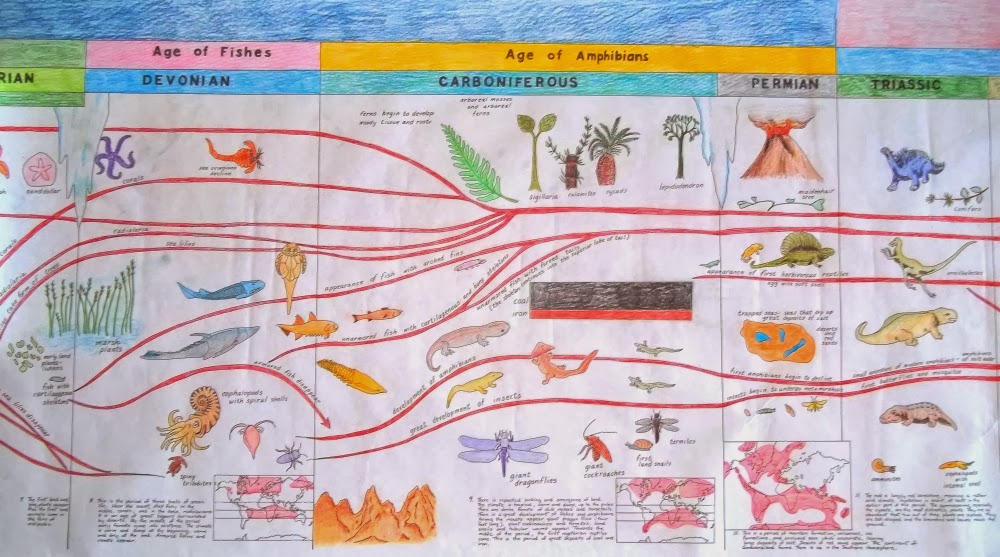
    Second Great Lesson - the Coming of Life - Timeline of Life

    Sample middle section of the AMI version of the Timeline of Life

    The Second Great Lesson tells the Story of the Coming of Life. Materials needed include 2 dinosaur charts and 1 Timeline of Life. The timeline begins with the earliest forms of life and ends with the coming of man (which is the next Great Lesson, so we don't dwell on it here). The key point to the story, whether you tell the Old Earth (evolutionary) version or adapt for a Young Earth or 6-Day Creation is this:

    Life provides the balance. 

    This story opens up the Biology album. There is also a follow-up work on the Timeline: a mute version.

    Goal: We hope for development of appreciation for ALL of life. 


    Neither the Control nor the Mute (also called Working) timelines should be entirely complete, leaving room for the children to add information through their own research - they should also not be presented in full detail, leaving details on the strips for the children to discover (they won't discover everything before they use the mute strip!). We hope that this work will entice some children to re-create the timeline for themselves and add in their own points of interest. Many children will do in-depth research on particular topics of interest; and some children will simply delve into the biology album.

    With the mute strip, each "era" is stored in its own color-coded pouch or envelope; the corresponding contents have colored dots or other coding on the back to indicate where they belong. One idea I have seen that I love, is that the mute pieces could have a tidbit of information about the image on the front side - just enough to entice the child to go explore for more information (and if they are not enticed, then they still have just a little bit more knowledge than they had before). 

    In lower elementary, present the version that suits your situation or family accordingly. In upper elementary, introduce other versions, just as we introduce other Creation stories in upper elementary.

    There are a variety of Timeline of Life options available for purchase, download or creation. Some will match up with some albums better than others.

    Old Earth:
    Young Earth: 
    • there was one, but I'm not pulling it up now - it didn't really correspond with the lesson, but could provide some good inspiration. I'll add it later if I find it again. 
    • Keys of the Universe is slowly in process of creating a 6-day creation set of albums with corresponding materials to support such families. 


    To date the only downloadable and printable option that matches AMI albums is offered at Garden of Francis and Keys of the Universe. Both complete and in sections for printing on various sized paper.


  • General search for Great Lessons on Montessori Nuggets
  • God With No Hands
  • Coming of Life
  • Coming of Human Beings
  • Communication in Signs
  • Numbers


  • Montessori Elementary - Writing Process

    The children at any level follow the same process from beginning to end of their writing, but the depth will vary dependent on their ages and experience.

    The language album does not specific an explicit writing process, but recently I had the opportunity to put together an outline for my son that indeed covers every situation and is perfectly in line with Montessori:
    1. get your ideas down on paper (wide variety of options - notecards, bubbles, lists, etc.)
    2. organize those ideas under main headings
    3. consider any other headings that should be included (look at "audience requirements") - edit as needed
    4. physically organize all these ideas in order, and begin writing on paper with complete sentences.
    5. Edit from there as needed.

    Montessori Lower Elementary and Upper Elementary


    The elementary Montessori materials center around sets of large impressionistic charts. These are the core material for the elementary age (where we had lots of trays for the primary child).

    It is that time of year that people have been facing the reality of creating these Montessori impressionistic charts by hand or purchasing sets. And the options grow each year.

    In reviewing many links lately to various Montessori Elementary Impressionistic charts, an overwhelming concern has arisen.

    So many of the advertised impressionistic charts are divided by "lower elementary" and "upper elementary". I just looked at a site a few minutes ago (the one that is prompting this Montessori Nugget!) - that specifically states that the geography album chapters 1, 2, and 3 are lower elementary and chapters 4, 5, and 6 are upper elementary. I verified that their chapter headings correspond with the AMI albums (although this is an AMS site).

    This is SO FAR from the truth! ALL SIX chapters are intended for BOTH ages! Not in entirety (each album page might cover 1-6 years of study alone, let alone an entire chapter).

    Montessori albums are NOT curriculum guides. They are organized in the way they are for the ADULT to find what they need in order to present to the children according to their interests. You don't just move through the album from page 1 to the end in exact order, with no regard for the child in front of you....

    The geography chapters in the AMI album:

    Chapter I: Creation of the Earth/Idea of the Universe -
    almost all of this chapter happens in lower; all should be repeated in upper, with extensions and final lessons

    • God with No Hands 
    • Experiments with God with No Hands 
    • Notes on the Story 
    • Follow-Ups to the Story 
    • Composition of the Earth 
    • Further Details of the Composition of the Earth 
    • Formation of the Mountains 

    Chapter II: Nature of the Elements -
    mostly lower elementary, but extensions/review into upper elementary

    • Three States of Matter 
    • Further States of Matter 
    • Different Ways of Combining 
    • Separation, Saturation, Super-saturation 
    • Attraction and Gravity 

    Chapter III: The Sun and the Earth -
    all of it at both ages in various depths of study

    • Rotation of the Earth and Its Consequences 
    • Time Zone Chart 
    • Earth as a Sphere and Its Result 
    • Tilt of the Axis 
    • Seasons and the Two Tropics 
    • The Zones 
    • Zones’ Work Chart 
    • Protractor Chart 
    • Seasons Work Chart 
    • Protection of the Atmosphere and the Rains 

    Chapter IV: The Work of Air - 
    all of it at both ages in various depths of study

    • Experiments Prelude to the Winds 
    • The Winds 
    • Land and Sea Breezes 
    • Changes in the Winds Caused by the Seasons 
    • Rains 
    • Work Chart of the Winds 
    • Ocean Currents Caused by Winds 
    • Wind as a Sculptor 

    Chapter V: The Work of Water - 
    all of it at both ages in various depths of study

    • The River 
    • The Rains 
    • Ocean Waves 
    • Ice 
    • Water Cycle 
    • Spread of Vegetation 
    • People in Different Zones 

    Chapter VI: Human Geography

    • Interdependence of Human Beings in Society  (SPECIFICALLY noted as lower elementary)
    • Economic Geography  (early stages are lower elementary; later stages upper)
    • Study of Natural Resources (this album page onward, typically upper elementary, but lower elementary for those interested - although the TOPICS can be introduced at the lower elementary level for each of the topics in the chapter)
    • What is Produced and Where 
    • Study of Consumption 
    • Comparison of Production and Consumption
    • Imports and Exports 
    • Volume of World Trade
    • World Commerce

    We could say that EACH CHAPTER covers the scope of SIX YEARS OF STUDY. Other studies are interspersed, chapters overlap within the one album, and the child has other personal studies of interest. Some topics just won't be touched in year 1, due to time constraints, but they COULD be done in year 1 if the child has interest. There is flexibility here - not a rigid set of "when" - we are not dictating which entire chapters are for a particular age. We have suggested ages, not dictated ages.


    So let's NOT ignore the primary Montessori principle of "follow the child" when we are planning which lessons to give. Not a free-for-all following, but an honest exploration of interests and expansion of experiences to discover new interests. 


    Great Lessons - Materials


    Within AMI (American Montessori Internationale), the following is a description of the materials for the 5 core Great Lessons to establish Cosmic Education in the elementary Montessori environment.


    God with No Hands

    • 4 impressionistic charts
    • materials for 6 demonstrations
    • NOTE: There used to be a 5th chart (solar system) which has been pulled to use at another time (a follow-up telling of the story)
    • NOTE: There used to be far more demonstrations (experiments is a misnomer in this case) which were pulled out to use as follow-ups, thus allowing the story to focus on the core keys, with plenty left for re-tellings and review - going deeper and encouraging a return to the Great Lesson. 


    Coming of Life

    • 2 impressionistic charts
    • Timeline of Life (a mute version of the Timeline of Life is a follow-up work)


    Coming of Human Beings

    • No materials
    • The focus is on the human connection itself - particularly on love; the children can look at their own arms and legs to see that they do not have specialized protection as animals do. 
    • Note: The two timelines called "First Timeline of Human Beings" and "Second Timeline of Human Beings" are follow-up work in the history album. They are not part of this Third Great Lesson. 


    Communication in Signs

    • 8 impressionistic charts showing the changes of writing styles through time and civilizations


    Numbers

    • 8 impressionistic charts showing the changes of numbers through time and civilizations


    For further Montessori Nuggets on the Great Lessons: