More words are phonetic than just CVC words - consonant-vowel-consonant (like cat, bat, hit, bit, sit, rot, and the like). We don't need to limit the children to such words.
"Pumpkin" is phonetic - technically, so is the word "phonetic".
In Montessori, with the approach that Montessori herself discovered with the children, that Muriel Dwyer summarized in her booklet on the exploration of reading and writing with children, and that AMI and others still teach in their training programs, the children are given 40-44 "keys" to their English language (the number varies in other languages), through playing sound games thoroughly,
then they learn the written representation of those sounds through the sandpaper letters (individual letters on pink/blue backgrounds according to vowel or consonant; double/triple letters on green background - taught all together, not all individuals then all double/triple - and in cursive so the children know the entire *sound*)...
Now the children have all that they need to WRITE (an easier task than reading) - they write with the movable alphabet, while their hands are continuing to strengthen and develop writing skills with the sensorial materials, the metal insets and more. And then can write their OWN ideas. They don't need pictures or objects or adult lists of words to create. They can write what they want.
Because they have been given the keys they need. And only the keys they need, include time to explore their own interests and have LOTS of real life experiences that they want to write about. To explore, to learn --- and to one day, on their own, to discover for themselves:
they can READ!
This was Montessori's experience - and this is the experience of all those who follow in her footsteps - provide the keys, follow the child's genuine needs/interests with lots of real life experiences - and observe.
Showing posts with label language. Show all posts
Showing posts with label language. Show all posts

Montessori Nomenclature Cards - what are they FOR!?

Nomenclature is always READING PRACTICE on FAMILIAR CONCEPTS in primary. We give vocabulary with the picture-only cards after they have had real experience with the items represented in the pictures. Then we add the words as they are learning to read, to give them familiar items to match up with the sounds they are learning (these sounds they should already be writing - remember, the child should write before reading); then we add the definitions as they become stronger readers, to give them more for reading practice on definitions they already know.
To back up a step, we are reading those definitions (via the booklets) or at least describing the terms in their context of real life experience. When the children start reading, they find familiarity in the definitions with what they already know.
Nomenclature cards are not teaching tools. They are review of concepts and reading/vocabulary practice.
Thus the child can move into whole reading rather quickly, because of a foundation of a variety of real life experiences, with sound vocabulary and other rich spoken language experiences provided from the beginning of his life, exploring the sounds of his language with the sound games and all the sandpaper letters, then the movable alphabet; freed from the tedium of step-by-step systems, he has the keys to explore his own language, other languages, and indeed the whole world around him.
Maria Montessori called the sensorial materials "keys of the world" - indeed all that observed and tested in all areas of the infant, toddler and primary (3-6, preschool and kindergarten), are keys of the world.
The Word Became Flesh
From The Child and the
Church by EM Standing and Others:
Pg 144
The other day I saw a painting and underneath was written “The
Word Became Flesh.” Since I had been thinking about this mystery of learning a
language, I took the phrase literally. This is what always happens with the
education of children: “The word becomes flesh.”
So the child master this language in a way peculiar to
childhood. He takes; he constructs; he makes himself grow to a man without
effort or fatigue merely by living. It is the child who produces this creation.
So what the child “takes” does “become flesh” because language becomes incarnated in him. This
is a matter of supreme importance: It is the Period of the Absorbent Mind.
~Maria Montessori (also in The Absorbent Mind, unedited versions)
Montessori Elementary - Writing Process
The children at any level follow the same process from beginning to end of their writing, but the depth will vary dependent on their ages and experience.
The language album does not specific an explicit writing process, but recently I had the opportunity to put together an outline for my son that indeed covers every situation and is perfectly in line with Montessori:
The language album does not specific an explicit writing process, but recently I had the opportunity to put together an outline for my son that indeed covers every situation and is perfectly in line with Montessori:
- get your ideas down on paper (wide variety of options - notecards, bubbles, lists, etc.)
- organize those ideas under main headings
- consider any other headings that should be included (look at "audience requirements") - edit as needed
- physically organize all these ideas in order, and begin writing on paper with complete sentences.
- Edit from there as needed.
Great Lessons - Materials
Within AMI (American Montessori Internationale), the following is a description of the materials for the 5 core Great Lessons to establish Cosmic Education in the elementary Montessori environment.
God with No Hands
- 4 impressionistic charts
- materials for 6 demonstrations
- NOTE: There used to be a 5th chart (solar system) which has been pulled to use at another time (a follow-up telling of the story)
- NOTE: There used to be far more demonstrations (experiments is a misnomer in this case) which were pulled out to use as follow-ups, thus allowing the story to focus on the core keys, with plenty left for re-tellings and review - going deeper and encouraging a return to the Great Lesson.
Coming of Life
- 2 impressionistic charts
- Timeline of Life (a mute version of the Timeline of Life is a follow-up work)
Coming of Human Beings
- No materials
- The focus is on the human connection itself - particularly on love; the children can look at their own arms and legs to see that they do not have specialized protection as animals do.
- Note: The two timelines called "First Timeline of Human Beings" and "Second Timeline of Human Beings" are follow-up work in the history album. They are not part of this Third Great Lesson.
Communication in Signs
- 8 impressionistic charts showing the changes of writing styles through time and civilizations

Numbers
- 8 impressionistic charts showing the changes of numbers through time and civilizations
For further Montessori Nuggets on the Great Lessons:
- General search for Great Lessons on Montessori Nuggets
- God With No Hands
- Coming of Life
- Coming of Human Beings
- Communication in Signs
- Numbers
Cosmic Education: Language and Geography
The cosmic education of elementary Montessori does not allow us to study just one subject in isolation.
The geography album encompasses "earth sciences" - geology, physics, and the like. Some very few children do not simply jump at the opportunity to repeat the demonstrations they are allowed to do (the volcano being the one almost all children want to do!) following presentations from the geography album. The reasons may be varied: adult level of trust (children sense it even if the adult appears to be trusting of the child's abilities), lack of space, environmental expectations just aren't there, adult enthusiasm, materials not readily available, adult hasn't explicitly stated "Would you like to do this?"
By simply using the language album, and following it accordingly, the children working with the grammar box materials are introduced to simple experiments. By following these commands which correspond with the grammar boxes and filler boxes, the child will strain then filter starch-water and sugar-water, after mixing up solutions and discovering the terms "in suspension", then letting it all settle out (or does it all settle out ;) ).
Thus the reluctant-in-science child who is more of a language-child has now experienced some of the science experiment processes. Now those geography presentations present something to the child that he CAN DO. And he is much more likely to DO them. Or at least be open to the idea. ;)
 |
| Straining starch-water and sugar-water |
 |
| comparing pure cocoa with cocoa-sugar |
 |
| creating an emulsion |
Grammar Boxes - Question from a child
An older child (age 8) is working with a set of grammar box material, organizing it and checking it for accuracy; preparing to make sure there are sufficient materials to perform all the commands or otherwise fulfill each sentence - in preparation for a group of younger children coming in.
He asks, "Mama, why are these so simple???? The reading is simple, the tasks are simple. They are kind of fun, but why so simple!? This work could not be appropriate for someone my age." (use a dramatic 8-year-old voice for the italics)
"Remember that this work is intended for incoming elementary children - 6 years old. Or children just learning to read."
"Oh! So they should all be done by the time they are my age." (statement, not a question)
"Yes."
He then later articulated what was being taught with the material and is putting together his own "extra challenge" version of the work at a higher reading level. "Just for fun," he says.
These activities are interesting, but definitely move away from an older child's needs in regards to movable pieces, vocabulary development and complexity of the activities. Older children who still need it can zip through this work, then develop their own extensions. They simply won't stay with it the way a 6 year old would.
He asks, "Mama, why are these so simple???? The reading is simple, the tasks are simple. They are kind of fun, but why so simple!? This work could not be appropriate for someone my age." (use a dramatic 8-year-old voice for the italics)
"Remember that this work is intended for incoming elementary children - 6 years old. Or children just learning to read."
"Oh! So they should all be done by the time they are my age." (statement, not a question)
"Yes."
He then later articulated what was being taught with the material and is putting together his own "extra challenge" version of the work at a higher reading level. "Just for fun," he says.
- synonyms
- parts of speech
- expansion of vocabulary
- spelling notes
- definitions
- experiments
- interacting with people
- interacting with objects
- rules (and permission to break some at appropriate moments)
Wow.
 |
| sample verb commands - separate from the filler boxes themselves |
These activities are interesting, but definitely move away from an older child's needs in regards to movable pieces, vocabulary development and complexity of the activities. Older children who still need it can zip through this work, then develop their own extensions. They simply won't stay with it the way a 6 year old would.
Learning to Read - the Montessori Way

Many questions have come in lately asking about this particular article, in comparison to albums purchased online and to Montessori's own writings on learning to read:
HomeSchool.Com - Montessori Language Arts at Home
Overall, this article is a great overview. But it does need two clarifications:
Maria Montessori did NOT develop the pink/blue/green series. She developed a whole language approach that, while sequenced, is laid out entirely differently.
Also, the children when first working with the movable alphabet, do not write on paper. This is a separate development at a separate time, and generally is done when the child is comfortable with spelling.
There are currently three relatively well-known Montessori series for learning to read in the English language:
- AMI (99% match to what Maria Montessori developed)
- Muriel-Dwyer (very similar to AMI)
- Pink/Blue/Green series (complete departure from the first two styles)
Each one has its benefits and drawbacks for any given situation (homeschool, classroom, special needs, need for the adult to "feel" in control, etc). So select what works best for you, but do research all the possibilities so as to make an informed decision.
Montessori Scope and Sequence: Elementary
The following links take you to a general scope and sequence for AMI elementary albums.
These Montessori scope and sequences -
These Montessori scope and sequences -
- follow ages 6-12
- do not include remedial (bridge) work
- are not set in stone - follow the children before you!
- are general (they do not include every single exercise with an album page that might start in year 1 and extend to year 4 or 5) - so when you see a range of 1-3, figure that the album page probably starts in year 1 (or 2 at the latest) and should generally be done by year 3. It could be earlier, but it shouldn't be much later, because the age ranges are pretty generous already. If you want the detailed version that contains every exercise and follow-up, in both Word and Excel formats (easily adapted for personal use), you will find them at Garden of Francis (for elementary) and Garden of Francis (for primary)
The years you see noted in "start" and "end" refer to the year in Montessori elementary - year 1 is the equivalent of age 6, through year 6 which is the equivalent of age 11-12.
The last math work may or may not be completed in elementary and may extend into early adolescence. The other albums are typically easily completed in a 6 year elementary cycle.
Looking for detailed scope and sequence that includes every single exercise of the album page and more specific guidelines and ages? Check with your album provider. Or join us at Keys of the Universe.
Or looking for primary Montessori album scope and sequences? Those are trickier. Presentations that are introduced at age 3, might have extensions that go through age 4, 5, and 6 - so you'll want a very detailed one that includes all exercises for each album page. Ask your album provider for a scope and sequence to correspond with that album set.
Or some general ages are included here in various Montessori Nuggets.
Or some general ages are included here in various Montessori Nuggets.
Social Studies in Montessori
Where is "social studies" in Montessori?
Montessori sure does shake things up! History is obvious, but let's discuss the other albums first.
Our geography at primary is what we expect (maps, countries, capitals, flags), along with a great deal of cultural experiences.
Our geography at elementary is what most schools consider "earth science" - physics, geology, chemistry and the like - including climactic zones (and which people and animals live where). AND it then adds in Economic Geography - how people connect with one another, most particularly in regards to the earth itself: source of our food, economic interactions and taxes. Within economic geography is where we get into community helpers that many schools make their entire 1st grade curriculum.
Montessori, utilizing the precepts of cosmic education, emphasizes the link between the land (geography) and the people - who lives where, how they live and interact with one another and their environmental surroundings and the changes that take place... starting to sound like ecosystems in Biology, huh? ;)
Within the language album, we look at the history and development of languages, literature, and modes of communication. We look at the biographies of authors, their times and lives, to provide us deeper insight into their choice topics, their writing styles, their beliefs - their inner souls.
Within Mathematics and Geometry, we'll have the usual mathematical skills, but also have the Story of Numbers and various Geometry stories. These stories place mathematics and geometry in the context of history and within daily life - why are these subjects necessary and useful? How can we utilize these skills to be service to *people.*
Art and music are relatively obvious - these areas are not just about skills, but appreciation for the work of others. We study the history of artists and musicians in the same way we study authors - in the same way we study all of history: as a gift.
History is the most obvious as far as social studies. Montessori provides a framework within which to study history, not from any one resource (i.e. a textbook), but from a variety of sources utilizing one's own developing reasoning skills to sort bias from fact and create one's own view of history, within the framework of gratitude for the gifts given us by those who came before us and responsibility to those who are with us now and those who will come after us - how shall we hold dear and develop the gifts we have been given? How shall we then pass on these gifts that are a living heritage from ancient times to the present.
So you can see that social studies - the study of society, its people, its functionings and even the study of ourselves, truly is cosmic education, utilizing every aspect of a child's life, even outside these academic albums.
Remedial Mathematics and Remedial Language
Montessori remediation is a bridge.
In our society, we think of remediation in a negative light. The child is deficient in some way, his previous experience was impoverished, whatever conclusion one reaches - it is always negative.
In Montessori, it is a simply a bridge to assist the children getting from where they are now to where they need to be at a particular plane of development.
Children new to Montessori at elementary and in need of reading and math skills? They need some mathematics and language skills to entirely gain from cosmic education, but they should still participate in all other aspects of the environment, including the Great Lessons. They should NOT be held back from any other area just because math, reading and writing skills aren't where they could be.
Many times those other experiences are exactly the path they need back into mathematics and language arts.
Give them cosmic education. We fill their other needs so that they are not paralyzed, and we provide experiences that provide an impetus for utilizing those mathematics and language skills.
Meet them where they are.
Follow the child.
Know where the child is and should be (plane of development characteristics, human needs and tendencies - other theoretical aspects) - so that you can follow the child appropriately.
Montessori remediation is a bridge.
Remediation album pages are found at the end of the appropriate albums so that the teachers and parents don't START there; but if you find a child isn't able to keep up with the early mathematics work or is not reading or is not writing well, then you refer to the remedial mathematics or the remedial language sections for JUST and ONLY what the child needs. BUT KEEP COSMIC EDUCATION GOING.
(so many teachers keep the child separated, so this last line cannot be over-emphasized!).
Remediation = Bridge.
Cosmic education - happens for the 2nd plane child no matter what.
:)
In our society, we think of remediation in a negative light. The child is deficient in some way, his previous experience was impoverished, whatever conclusion one reaches - it is always negative.
In Montessori, it is a simply a bridge to assist the children getting from where they are now to where they need to be at a particular plane of development.
Children new to Montessori at elementary and in need of reading and math skills? They need some mathematics and language skills to entirely gain from cosmic education, but they should still participate in all other aspects of the environment, including the Great Lessons. They should NOT be held back from any other area just because math, reading and writing skills aren't where they could be.
Many times those other experiences are exactly the path they need back into mathematics and language arts.
Give them cosmic education. We fill their other needs so that they are not paralyzed, and we provide experiences that provide an impetus for utilizing those mathematics and language skills.
Meet them where they are.
Follow the child.
Know where the child is and should be (plane of development characteristics, human needs and tendencies - other theoretical aspects) - so that you can follow the child appropriately.
Montessori remediation is a bridge.
Remediation album pages are found at the end of the appropriate albums so that the teachers and parents don't START there; but if you find a child isn't able to keep up with the early mathematics work or is not reading or is not writing well, then you refer to the remedial mathematics or the remedial language sections for JUST and ONLY what the child needs. BUT KEEP COSMIC EDUCATION GOING.
(so many teachers keep the child separated, so this last line cannot be over-emphasized!).
Remediation = Bridge.
Cosmic education - happens for the 2nd plane child no matter what.
:)
Grammar Boxes - Colors
Why did Dr. Montessori choose the colors for the grammar boxes? Why don't they match the grammar symbols like they do in primary?
Because if they matched, it becomes a mindless matching activity.
So why use color at all? To aid the child in sorting the multitude of cards into the proper compartments. Also to show during transposing that the "verb" just became a "noun" - without the color, the incongruence wouldn't show up as clearly; the grammar boxes "game" would be less fun, fewer patterns would be noted, and the fullness of the activity would be lost.
All reasons and many more riches are described in The Advanced Montessori Method available free online via Google Books.
Please do not change what Maria Montessori developed - when we don't understand the true depth, we can inadvertently take away the true beauty in the experience.

Because if they matched, it becomes a mindless matching activity.
So why use color at all? To aid the child in sorting the multitude of cards into the proper compartments. Also to show during transposing that the "verb" just became a "noun" - without the color, the incongruence wouldn't show up as clearly; the grammar boxes "game" would be less fun, fewer patterns would be noted, and the fullness of the activity would be lost.
All reasons and many more riches are described in The Advanced Montessori Method available free online via Google Books.
Please do not change what Maria Montessori developed - when we don't understand the true depth, we can inadvertently take away the true beauty in the experience.
Grammar Boxes - when to present
This Montessori Nugget is previously discussed over at Montessori Trails.
Grammar Box Order of Operations:
NOTES:
1) There is no *ONE* right way – just as there is no identical child or experience.
2) There are many wrong ways:
NOTES:
1) There is no *ONE* right way – just as there is no identical child or experience.
2) There are many wrong ways:
- --don't follow the child
- --insist on waiting far too long (if it accidentally happens, it's fine)
- --insist on presenting too much too fast (unless the child is asking and is obviously capable)
- --requiring copywork of this material
- --following any one procedure for all children
4) The enclosed is based on a child starting
in 1st grade at age 6, with primary experience. New children at older ages will just work at
their own pace – pretty quickly through quite a bit of it; let them take their
time wherever needed.
4B) The enclosed is a guideline - it is a general guideline so should be flexible enough for most situations. If it doesn't fit for you, adjust it. It's ok :)
5) FOLLOW THE CHILD
Oral and reading introduction as given in primary is ideal - all parts of speech, only receiving an explanation of function, not the name of the part of speech.
If the child is young enough, consider giving the primary style presentations first with the child doing an oral activity followed by the same activities in reading. We hope the children have done sentence analysis in primary as well, but it is not absolutely necessary.
ELEMENTARY - in no particular year, though suggestions noted - just start as soon as possible and move forward:
5) FOLLOW THE CHILD
Oral and reading introduction as given in primary is ideal - all parts of speech, only receiving an explanation of function, not the name of the part of speech.
If the child is young enough, consider giving the primary style presentations first with the child doing an oral activity followed by the same activities in reading. We hope the children have done sentence analysis in primary as well, but it is not absolutely necessary.
ELEMENTARY - in no particular year, though suggestions noted - just start as soon as possible and move forward:
First - Oral Presentation of the Noun
Second - Grammar Box 2: the article
Second - Grammar Box 2: the article
PARALLEL
– keep the initial introduction of grammar boxes in order of one another; otherwise the
exercises and personal work can overlap or keep cycling through:
Continue to utilize filler boxes in
Box 2
Definite and Indefinite
Noun Number
Noun Gender
Classification of Nouns: Common and
Proper
Grammar Box 3 (could be introduced
before the above noun items)
Adjective Command Cards and Classification
Comparison of Adjectives
Grammar Box 4 – Verb
Verb Commands and Synonyms
Grammar Boxes 5, 6, 7, 8, 9
follow each with appropriate command cards if available for that box
After Grammar Box 7:
Personal Pronouns
|
The above is likely to be year 1, if you
started at the beginning of the year and have a child who plugs right along in
this and other work; it is very possible and highly likely there is additional
work to do in the above areas in the 2nd year. Just pick up where
needed; everything reviews on previous knowledge, and all past presentations
are available to the child (this may need to be reminded to them).
The following is almost always 2nd year,
could be end of the first year – and runs parallel with the above if the child is still working with the above ---
Begin
these at the appropriate age, regardless of the above work, just after introducing the noun:
Classification of Nouns: Concrete and Abstract
(age 7-7 1/2)
Classification of Nouns: Material and Collective (age 7-7 1/2)
Classification of Nouns: Classification of Abstract (age 7-7 1/2)
Classification of Nouns Chart (all work with other classification of nouns - this is a consolidation)
WHENEVER READY: (could be any year, any age)
Classification of Nouns: Material and Collective (age 7-7 1/2)
Classification of Nouns: Classification of Abstract (age 7-7 1/2)
Classification of Nouns Chart (all work with other classification of nouns - this is a consolidation)
WHENEVER READY: (could be any year, any age)
Additional Grammar Symbols
Generally, verb tenses will be done in the 3rd
year; with some children starting some of the work in the 2nd year. Try
to assure this work is at least presented in the 3rd year, and the children may need to finish working in their 4th year. The only real pre-requisite here is that the child has done work with the personal pronouns.
VERB TENSES: (personal pronouns should be done; all grammar boxes are likely presented, even if the child is still working with them)
VERB TENSES: (personal pronouns should be done; all grammar boxes are likely presented, even if the child is still working with them)
- Simple Tense: Present
- Simple Tense: Past
- Auxiliary Verbs
- Simple Tense: Future
- The Perfect Tenses
- The Infinitive and Moods
- Negative Form of the Verb
There is a lot going on in Language and in all
the areas. Overlapping with the grammar boxes is Word Study; and you may or may
not work with the earliest presentations in Logical Analysis before finishing
up grammar. Follow the child on this overlap. There is plenty of time for
Logical Analysis in 3rd year and higher, but strong readers who are
also adept at the grammar box work, may appreciate the extra challenge of the
Logical Analysis work mixed in.
If the children have needed to do remedial
language, the grammar box work will pick up orally while they are working with
remedial language; but you might wait until they are comfortably reading to start the
boxes themselves; sometimes the short phrases of the grammar boxes are a nice
little encouragement to work on reading skills; so introduce them slowly,
closely observing if they are a help or a hindrance until the child is
comfortably reading.
(the child does not have to read these cards
out loud – he just has to GATHER the materials – reading aloud is best for a
struggling reader AFTER he has proven he knows what the card says (“get a
pencil” for example – he brings the pencil, you say “yes” and he then reads the
card))
FOLLOW THE CHILD.
Follow the child's interests and abilities. The child is using interjections and conjunctions every day, why wait until age 7 or 8 to introduce them? Why turn a fun interesting game such as the grammar boxes into a tedium of a series of exercises that may or may not be beneficial or any longer enjoyable because they are presented as such?
We want the children to LOVE language, to PLAY with language, to EXPLORE with language.
EXPLORE!
Have fun with it!
Grammar Boxes - Word Order
What about the order of the compartments? It really does not matter. Some people seek to have them "in order that we speak our language" - but look at these two sentences:
the brown dog ate his bone.
the brown dog ate his bone in the large yard.
the dog that is brown ate his bone in the yard that is large.
the dog that is brown ate his bone in the yard that is large.
The first sentence has 2 nouns. So where should the nouns section go in the box? Towards the beginning or towards the end?
The second sentence has three nouns - and three adjectives (brown, his, large) - so where shall we place the adjective? In front of the noun? Ok, that makes sense, but the children are still going to be going back and forth for the nouns, since there are articles throughout the second sentence; prepositions that could be at the beginning or middle; etc.
As the sentences add parts of speech, there is more and more complexity with word order. See the third sentence. The adjectives are coming after the nouns they describe. Hm.
The boxes are a storage and display - an organizer, but NOT for the order in which we speak.
We want the children to explore language - their own language which has already been given as a gift to them in infancy and toddlerhood; that they have striven to learn, to perfect, to master and to share. Even if we *could* hand them the boxes in order, should we? It would be less of a puzzle, less of a game, and more of a mindless matching activity. Indeed that has been the experience of many teachers when doing the noun/adjective/article box with the box in English order: article, adjective, noun. It became mindless. The children didn't have to *think*.
Now, at this age, we are not really looking to just hand them their language - they already have it! Now we are looking to examine it, to explore it, to play with it. So we hand it to them "messed up" - with colors that don't match the symbols they've learned; with transposing and making silly sentences; learning all sorts of play on words (the push cart, push the cart); developing poetical skills as they mix up the sentences and find what still makes sense, what makes sense but with a different meaning and what is entirely non-sensical.
We are also training their ears to truly *hear*.
It is impossible to create the boxes "in the order that we speak" - so don't try! Just play along with the language games and enjoy the company :)
Grammar Boxes - Emphasis - Writing
From AMI Montessori Training Notes:
The grammar boxes provide for a manipulative activity – they are not a written exercise. Repeat: They are not a written exercise. That is the fastest way to kill the fun that the children should have with this material.
The grammar boxes provide for a manipulative activity – they are not a written exercise. Repeat: They are not a written exercise. That is the fastest way to kill the fun that the children should have with this material.
Now, if the child chooses to write them out and illustrate them - GREAT! Do NOT make it a requirement or a chore, but if this is their way of extending the work, go for it. There are plenty of other places for writing practice in this area that can provide feedback on what the child has understood - and since this is primarily a lower elementary activity, there is plenty of time for assimilation.
Keep it fun and interesting - humorous in a healthy manner. And you will have a child with a life-long love of language.
Grammar - Verb
But
what about the red ball? (roll it around) It scoots around until someone stops it.
This red ball
symbolizes energy – movement – that force in nature. Dr. Montessori took a red
ball as the symbol for the part of speech that represents movement – action. We
know that part of speech is the verb. In our grammar symbols, the symbol for the
verb is a red circle – the two-dimensional representation of this red ball.
The
work we’re going to do with the elementary grammar boxes center around these two most
important parts of speech: the noun and the verb. The other parts of speech
have a relationship to the noun and to the verb. That relationship is
determined by the noun and the verb. We’re going to help the children recognize
the importance and the significance of these two parts of speech, and help them
see the relationship that the other parts have to the noun and the verb.
Grammar - Nouns
 In
her book that is not yet translated into English, Psycho-grammar, Dr.
Montessori asks us to take a different approach to this role of language. Connect it to history and tell a story:
In
her book that is not yet translated into English, Psycho-grammar, Dr.
Montessori asks us to take a different approach to this role of language. Connect it to history and tell a story:
In
the universe we have the force of energy and of matter. She symbolized matter
by referring to the noun – the name of things – and the enduring history that
nouns have. They are probably one of the oldest parts of speech.
We know that things in the environment had to be named, so that people could communicate about those things. And in most cases, the names of things, once given, have stuck – they’ve stayed with those objects.
Well, because of the enduring nature
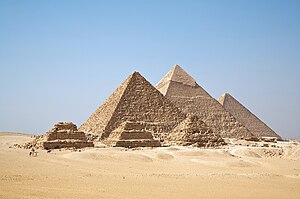
of nouns and names, she took the pyramid as the symbol for this part of speech.
The pyramid is one of the oldest, most enduring buildings on earth. They have
lasted for years and years and years. The pyramid is a building that is stable
on its base - they seem to stand eternally. Now, this pyramid will stay
anywhere it is put – until it is moved elsewhere, where it will sit until I
move it again. (when presenting this story, the adult will actually move and place the pyramid).
In the grammar symbols, we use an equilateral triangle (each
face of the pyramid).
Language - Nomenclature Materials
 Oh the cards... so many cards!
Hint: You don't have to have every "stage" for every subject. You might only have spoken and 3-part for some topics; you might go to the definition stage with a few subjects; and a few others you will take into elementary.
Wonderful news: The *children* can make them too! Do not feel like you need to make something on the parts of an engine if you'd rather eat worms. Provide tools (books, photos, people who do like engines; and blank card material) and let the child HAVE AT IT.
But don't limit to "parts" - it could be naming objects in a group; setting up classification groups to sort out (kingdoms of living things), or other ideas of the child's --- and at elementary don't forget to include any local education requirements (from you or from the state).
So what are the stages?
Follows is the clearest lay-out I can provide for the NOMENCLATURE - with some homeschooling tips thrown in for the fun of it :)
Yes, there are other card materials; but here I focus on the 3-part, 4-part, definitions - nomenclature. Parts of; types of; sorting/classification.
You want something "new" for each album page (not necessarily new topic - but some card set that corresponds with each album page).
This includes spoken language nomenclature and classification; reading classification; scientific classification, nomenclature --- primary AND elementary.
***IMPORTANT NOTE*** Never give the child information with a card you have not provided in some manner in real life. In the case of some things that might need to be a 3-d artificial figure of an object or it might be a video (which are ok in limited form) - but do not introduce new terminology with a picture card if at all possible.
SPOKEN:
- Cards: Just images of the items at hand - we want as much hands-on experience first. In a classroom, these are the same size as the later control card, but there is no name written in.
- Booklets: You read these to the child. To be used as controls later.
Play games with these cards too! The child doesn't just lay them out and name them. Play games similar to I Spy or Go Fish or I Spy Sounds - get creative!
READING - PRIMARY - Also known as Reading Classification:
- Cards - step 1: image, title, control with both image and title - this transitions from spoken into reading ---- when the children work with these, they already knows these terms and this is a way to discover that they can read. One baby step at a time (read about familiar concepts - then later they will read about new concepts!). **This is the commonly known 3-part card set-up.**
- Books: same as from spoken, whether homeschool or full classroom
- Cards - step 2: image, title, definition with word in red, control card (the control card can be another card with all the information OR can be the booklet - in either homeschools or classrooms). This set could be referred to as 4-part cards, if you like.
- Cards - Step 3 - definitions: Create an additional set of 4-part cards, but the definition card has a blank space where the name of the item should fit; there is an additional "slip" that has the name, written in red, that is placed ON the definition card (it fits onto the blank space). Tip for homeschoolers: just replace the original definition card.
- Cards - Step 4 - Definition strips: Add to the previous set, a set of strips (just print the same definition cards again and cut into strips by lines). The child is helped by using incomplete phrases. (homeschool hint - if they don't get to this stage, that's fine; just move into the elementary version below)
READING - ELEMENTARY:
- Start with the same style of cards/booklets: image, title, full definition WITHOUT the word (like a dictionary definition) and generally a bit more technical on the information provided, more complex vocabulary; but still keep it basic so the children is enticed to explore further and add to the definition himself.
- Cards - Elementary Definitions: Now we'll cut up those definitions by complete phrase (no hints now!). They will need to be reformatted to make this work.
- Could have the definition card set with the blank word as above; but I see this in very few classrooms. Homeschool tip: just use the primary set.
- Children at this age, could be given the booklet and they could make their own 3-part cards. Or (homeschool tip) have elementary children make the material for the primary children, especially if the elementary children are older already - it removes tedium and adds joy when they are creating something *real* for someone else who looks up to them.
HOMESCHOOL:
Covers primary and elementary homeschooling; suggestion-only to minimize what is made, space and money used. Mix and match these cards at varying times.
Covers primary and elementary homeschooling; suggestion-only to minimize what is made, space and money used. Mix and match these cards at varying times.
- image
- title (could fit on the image card, or lay below it)
- definition without the word at all (not even a blank space) - match with the title card
- booklet (invite the elementary child to explore their experiences and resources to expand on the primary booklet) - use as the control
- definition in one form of strips (or perhaps some of your definitions are by phrase; others are by line)
This layout utilizes the booklet as a control; you may prefer to still have the control card of image/title.
Cursive or Print - 3
“Hand·writ·ing: 1. writing done with pen or pencil in the hand; script. 2. A style or manner of writing by hand, esp. that which characterizes a particular person; penmanship.”[1]
Not only is cursive easier for young children to learn, but by learning it young, they will not have to unlearn print in order to learn handwriting later in childhood, when they are already burned out from school as well as moved out of the sensitive period for order and language. On the other hand, print can be learned at any time, as it is indeed “all around us.”
 In addition to these factors, today as even in Dr. Montessori’s time it is observed that
“it is impossible to forge a person’s handwriting.”[3] Handwriting is an art form in itself. Examples of this art form can be seen in older texts with fancy first letters of chapters and sections, the variations from culture to culture of creating various letters of the alphabet, particularly capitals. Handwritten letters and cards are still cherished by many, much more than easily written (and usually error-ridden) e-mails that fly around the planet in the billions or trillions each day.
“Even though we all use the same alphabet, the motions we make are so individual that
each one has his own particular style of writing,
and there are thus as many forms of writing as there are men.”[4]
Cursive or Print - 2
“Hand·writ·ing: 1. writing done with pen or pencil in the hand; script. 2. A style or manner of writing by hand, esp. that which characterizes a particular person; penmanship.”[1]
In today’s world, many people have chosen to forgo handwriting (cursive) altogether because we are so surrounded by print, print is standardized (everyone can read it), etc. But this is a mistake. We are surrounded by print because of the beginnings of the loss of handwriting; standardization of print only detracts from individuality. Group cohesion within a society is excellent, however each person must be an established individual in order to contribute the greatest amount to group dynamics. The number of font choices available in computer writing programs testifies to the need for expressing individuality. The issue of handwriting is only a sign of the times, rather than the deep-seated issue itself, however the issue can become a heated discussion among educators and parents.
Dr. Montessori has encouraged the use of cursive from some of her earliest work with special needs children, finding that curved lines are easier for the child, not because of the child’s experience with a curved horizon as Seguin and Itard put forth, but because curved connected lines are truly easier and more natural for the child:
“the straight line (of print) is unique in that it follows the shortest distance between two points. Every variation from this means that a line is not straight. The countless variations are therefore easier to make than the single stroke which is the standard of perfection.”[2]
Dr. Montessori describes children tracing curved, connecting lines and loops in the sand with a stick, and the artwork and scribbles of the youngest children of then and today still testifies to the fact of curved connected lines being easier for the child to recreate.
She also describes how children with weak hands will tire after drawing a row of straight lines and the straight lines look more and more like the letter c by the end of the line.
Subscribe to:
Posts (Atom)