Showing posts with label table of contents. Show all posts

Biology - Table of Contents

Biology experiences should begin in primary with caring for plants and some experimentation. It is an environmental thing, rather than an explicit area of the classroom.

If this experience is missed, it is OK to pick up in elementary, just consider some of the environmental factors from the primary list below.


PRIMARY - Keys of the World:


Exercises of Practical Life

Care of Self
How to Wash Hands
Add outdoor care of self - when to wash hands and the like

Care of the Environment
How to Care for Plants
How to Dust Leaves
Raise herbs
Gardening – inside and out
How to Arrange Flowers
How to Make Lemon Water
How to Wash Fruits and Vegetables
How to Peel & Cut Fruits and Vegetables
How to Compost
How to Recycle

Grace and Courtesy
Introduction to Grace and Courtesy
     Grace and Courtesy for the Outdoors
     Grace and Courtesy living creatures inside

Control of Movement
Walking on the Line
     Find lines outside
The Silence Activity
     Do it outside; be like plants and animals

Visual Art
Extensions of the work: Take art outside; incorporate plants and animals into art experiences, both inside and outside


Sensorial

Visual
Leaf Cabinet
Leaf Cards

Sensorial Aspects of the World (including plants and animals in the extensions)

Tactile
Sensitizing Fingers
Fabrics


Language

Spoken: Vocabulary Enrichment
Naming Objects in the Environment – including plants and animals
Collecting Classified Objects – including items used to care for certain animals or plants
Language of the Sensorial Materials – given orally now, written form later (leaf shapes, leaves in your local area, types of trees, etc, etc, etc)
Three Period Lesson
Classified Cards - Social
Related Objects Game - Presentations A & B
Description/Definition Game
Stories – Biological Classifications
    The Story of Living and Non-Living Matter
    The Story of Plants and Animals
    The Story of the Five Classes of Vertebrates
Sorting Game – Biology Classifications
Nomenclature Cards – Scientific
Life Cycles
Oral Language Games

Spoken: Language Development – all of these can and should include biological experiences
Storytelling
Reading and Books in the Library
Poems
Conversation
Conversation – More than one person
Question Game
Cultural Folders
Extension: fictional story telling
Land and Water Form Folders
Land and Water Form Outline Maps
Biome Folders
Art Folders
My State

Writing
Metal Insets (12 Stages) – introduce tracing the leaf cabinet insets


Reading Classification
Presentation I – Classifying the Environment
Presentation II – Cards with Labels
A. Social
B. Scientific
C1. Biology Classifications: Living and Non-Living
C2: Biology Classifications: Plant and Animal
C3: Biology Classifications: Five Classes of Vertebrates
Extension: Mix and sort - work up to 5 sets
Presentation III – Definition Stages

Children can also create posters or cards of the leaf cabinet; the parts of the animal puzzles and more.


Word Study
Compound Words
Animal Collectives
Animals and Their Young
Animal Sounds
Animal Homes
Animal Families

Language Extension
Who Am I?
Plant Study
Plant Experiments

You could also have parts of the animals or parts of the plants puzzles. We want them to have real experiences first (caring for animals; the plant study above) before introducing the puzzles, if at all possible. In practical use, the puzzles seem to lead to a better understanding of the real creature, developing a higher appreciation and enjoyment; rather than serving as a review alone. 


ELEMENTARY - Keys of the World:


BIOLOGY
Introduction to Biology
Use of the Microscope
1.  Botany
a.  The Plant
Basic Needs of the Plant
How Plants Grow Toward the Light
Plants Need Minerals

b.   The Leaf
Function of the Leaf
Parts of the Leaf
Varieties of the Leaf
Simple Classification of Leaves
Varieties of Leaves Depending upon their Functions
Follow-Ups to Studies on the Leaf

c.    The Root
Function of the Root
Parts of the Root
Cooperation of Leaves and Roots
Other Functions of the Root
Two Main Types of Roots
Other Sensitivities of the Root
Varieties of Roots
Follow-Ups to Studies on the Root

d.  The Stem
Function of the Stem
Kinds of Stems
Parts of the Woody Stem
Kinds of Tubes in the Woody Stem
How Water is Moved through the Stem
Varieties of Stems
Follow-Ups to Studies on the Stem

e.    The Flower
Function of the Flower
Parts of the Flower
Varieties of Flowers
Position of the Ovary
Specialization of Flowers to Ensure Pollination
Follow-Ups to Studies on the Flower
f.     The Fruit
Function of the Fruit
Kinds of Fruits
Parts of a Succulent Fruit
Kinds of Succulent Fruits
Another way to look at Fruits based on their Flowers
Kinds of Dry Fruits
Follow-Ups to Studies on the Fruit

g.   The Seed
Function of the Seed
Parts of the Seed
Kinds of Seeds
Seed Dispersal
Follow-Ups to Studies on the Seed

         Botany Command Cards
         Botany Nomenclature

2. Zoology
        Introduction to Zoology
        Story Material
        Activities Preparatory to Body Function Material
        Dissection of Animals
        Body Function Material

3. Classification
                Introduction to Classification
a.  Kingdom Vegetalia
Material Description
Classification of Kingdom Vegetalia:  First Method
Classification of Kingdom Vegetalia:  Second Method
Continuation of Presentation of Folders to the Family Level
Genera Level
Book Work
Geneaology of a Plant
Tree of Classification
b.   Kingdom Animalia
Material Description
Classification of Kingdom Animalia
Geneaology of an Animal
Tree of Classification

4. Ecology
        Introduction to Ecology
        Chart of Interdependencies
        Ecosystems


Geography - Table of Contents

Geography is another area that is interspersed among the primary albums. When pulled together, these presentations make for quite a lovely geography experience! We have sensorial aspects, language, people of the world by continent, country and region, globes, maps and more!

In elementary, it also encompasses the earth sciences and economics. Technically-speaking there is no official political geography section. We hope that the children have had the primary level experiences. We also incorporate Goings Out at the elementary age; practical life lessons in this area including reading and following maps of the local city, areas to visit (a map of the museum for example), and other practical mapping skills.

Through the child's study of history, mapping, graphing, coordinates, compass roses, and other experiences are incorporated in a "living" approach. Geography incorporates many of the "math skills" that seem to be lacking from the mathematics album (where we focus more on pure mathematics).

There is really little use for a geography program at elementary that is not, by nature, put into practical use immediately - either through Goings Out, re-creating maps on paper or three-dimensionally, including human geography (culture) or other practical purposes.


Primary:

Exercises of Practical Life
     The entire Exercises of Practical Life album really prepares for geography; including the cultural aspects. Art experiences, as well as cultural experiences should be incorporated starting around age 5. First the child is adapted to his own culture until 4 1/2 or 5; then we can start drawing in aspects of other cultures for the children to experience - think art forms/styles, table settings, objects around the environment that could be polished are perhaps from other cultures. Share stories.

Think cultural experiences.


Sensorial:

Tactile
Sensitizing Fingers

Sensorial Aspects of the World
Introduction to the Sensorial Aspects of the World
Sandpaper Globe
Continents Globe
World Puzzle Map
Continent Puzzle Map
United States Puzzle Map
Land and Water Forms
Oceans Globe
Flags
Climatic Zones Globe


Language:


Spoken: Vocabulary Enrichment
Language of the Sensorial Materials (games, card material)
Nomenclature Cards – Scientific (includes flags, countries/continents/oceans by name, etc)

Spoken: Language Development
Storytelling
Reading and Books in the Library
Poems
Conversation
Conversation – More than one person
Question Game
Cultural Folders
Extension: fictional story telling
Land and Water Form Folders
Land and Water Form Outline Maps
Biome Folders
Art Folders (cultural)
My State

Writing
Map Making

Reading Classification
Presentation I – Classifying the Environment
Presentation II – Cards with Labels
     A. Social
     B. Scientific
Presentation III – Definition Stages


Elementary: 

Geography

Introduction to Geography
        Practical Considerations for the Experiments
        Notes on the Experiments
        Command Cards
        Geography Nomenclature

Chapter I: Creation of the Earth/Idea of the Universe
        God with No Hands
                Experiments with God with No Hands
                Notes on the Story
                Follow-Ups to the Story
        Composition of the Earth
        Further Details of the Composition of the Earth
        Formation of the Mountains

Chapter II: Nature of the Elements
        Three States of Matter
        Further States of Matter
        Different Ways of Combining
        Separation, Saturation, Super-saturation
        Attraction and Gravity

Chapter III: The Sun and the Earth
        Rotation of the Earth and Its Consequences
        Time Zone Chart
        Earth as a Sphere and Its Result
        Tilt of the Axis
        Seasons and the Two Tropics
        The Zones
        Zones’ Work Chart
        Protractor Chart
        Seasons Work Chart
        Protection of the Atmosphere and the Rains

Chapter IV: The Work of Air
        Experiments Prelude to the Winds
        The Winds
        Land and Sea Breezes
        Changes in the Winds Caused by the Seasons
        Rains
        Work Chart of the Winds
        Ocean Currents Caused by Winds
        Wind as a Sculptor
  
Chapter V: The Work of Water
        The River
        The Rains
        Ocean Waves
        Ice
        Water Cycle
        Spread of Vegetation
        People in Different Zones

Chapter VI: Human Geography
        Interdependence of Human Beings in Society
        Economic Geography
                Study of Natural Resources
                Study of Consumption
                Comparison of Production and Consumption
                Imports and Exports
                Volume of World Trade
                World Commerce

Chapter VII:  Functional Geography
 (not an official section of the elementary album; utilized for those who need to verify learning for educational standards as well as those without any primary level experience - just a list of topics to be covered in other areas)


Theory - Table of Contents

Theory Album Tables of Contents: 
doing a puzzle without a frame
(tessellations, that is the point;
Montessori details without the "big picture"
 - not so much)

Primary:

  • Education as an Aid to Life
  • History of the Method
  • Human Needs and Tendencies
  • Four Planes of Development
  • The Absorbent Mind
  • Sensitive Periods
  • The Prepared Environment
  • Development of Movement
  • Development of Language
  • Observation
  • Normalization and Deviations
  • Preparation of the Adult
  • Independence
  • Freedom and Discipline
  • Three Levels of Obedience
  • Social Development
  • Errors and Corrections


  • Construction of the Human Being and the Human Tendencies
  • An Overview of the Four Planes of Development
  • The First Plane of Development:  The Child from Birth to Three Years of Age (The First Subplane)
  •  The First Plane of Development:  The Child from Three to Six Years of Age (The Second Subplane)
  •  The Second Plane of Development:  The Child from Six to Twelve Years
  • The Third Plane of Development:  The Young Person from Twelve to Eighteen Years
  • Cosmic Education
  • Imagination
  • The “Great Lessons” and the Key Lessons
  • “Going Out”
  • Practicalities of “Going Out”
  • The Upper Elementary Class (Nine to Twelve Years), adapted from a lecture by Miss Margaret Stephenson
  • Freedom and Responsibility
  • Recordkeeping
  • Parent Education
  • Running an Elementary Class
  • Planning the First Three Days 


Music - Table of Contents

Music in Primary begins with the sound cylinders in the Sensorial album, followed by the actual introduction of the bells. 


In the Exercises of Practical Life album, we have the section Control of Movement which introduces the Silence Game and Walking on the Line - these are foundational to so many other areas, and hearing the sweet tones of music is only one of those areas. 


In the Language album, we have language for the bells, rhythm exercises and class songs. 


In Elementary, we have an explicit music album and you will find the first sets of presentations duplicate those done at primary; while content is the same, we want to ensure the child has had sufficient experience before moving on. The presentations run a bit different, but are not actually all that different. We do not bore them, however - move at the child's pace! 


Primary: Keys of the World


Sensorial - Auditory:
  • Sound Cylinders
  • Introduction to the Bells
  • The Bell Cabinet

Exercises of Practical Life - Control of Movement:
  • Introduction to Walking on the Line
  • Walking on the Line
  • Introduction to the Silence Activity
  • The Silence Activity


Language - Musical Expression: 
  • Notation with the Bells
  • Note Names with the Bells
  • Staff, Ledger Lines, G-Clef
  • Note Names on the Numbered Staff Board
  • Note Names on the Unmarked Staff Board
  • Unmarked Staff Boards – Parallel Exercise 1: Matching Cards with Bells
  • Unmarked Staff Boards – Parallel Exercise 2: Nomenclature Cards
  • Unmarked Staff Boards – Parallel Exercise 3: Grading
  • Unmarked Staff Boards – Parallel Exercise 4: Descriptions/Definitions
  • Composing on the Bells
  • Reading Music
Language - Language Extension: 
  • How to Teach a Song
  • Clapping – Rhythm


Elementary: Keys of the Universe


Introduction to Music

Musical Bells
· Sensorial
o   Notes on the Musical Bells
o   How to Strike and Carry a Bell
o   Matching the Bells
o   Establishing Up and Down
o   High and Low Exercise
o   Grading the Bells
o   Whole Steps, Half Steps and the Tetrachord
o   Name Lessons with the Bells

· Notation
o   Introduction to the Musical Staff
o   Note Names on the Staff
o   Sharps and Flats
o   Naming Scales
o   Writing Music
o   Bass Clef and Its Notation
o   Pitch Dictation

· Listening
o   Introduction to Listening
o   Ways to Encourage Listening to Music
o   Rules for Large Group Activities

· Singing
o   Introduction to Singing
o   Steps to Teaching a Song
o   Singing with the Scale
o   Creativity with Lyrics
o   Singing in the Elementary Class

· Control of Movement
o   Introduction to Movement for Control
o   Exercises for Body Control
o   Exercises for Body Awareness
o   Exercises for Equilibrium
o   Silence Game

· Expression
o   Introduction to Movement for Expression
o   Different Ways of Moving
o   Accents
o   Dynamics
o   Tempo
o   Details of Music Writing

· Rhythm
o   Clapping Four Beat Measures
o   Clapping Names and Items in the Room
o   Introduction to Note Patterns
o   Naming and Notation of Note Values
o   Equivalence with Dotted Notes

Tone Bars
o   Introduction to the Tone Bars
o   Naming and Notation of the Tone Bars
o   Names of the Degrees of the Scale
o   Intervals
o   Sequence of Major Scales – Sharps
o   Sequence of Major Scales – Flats
o   Key Signatures
o   Transposition of Simple Songs
o   Minor Scales

History and Instruments
o   Lives and Music of Composers
o   Musical Instruments and the Orchestra


Exercises of Practical Life - Table of Contents

The Exercises of Practical Life lead a child through many facets of his daily life, prepare him for future work in every area of the children's house (casa), and build up independence. For more on the benefits of the exercises of practical life, see this Montessori Nugget.

This is the AMI core list for primary. It should be adapted for local customs and cultures; around age 4, the children can receive presentations on the practical life of other cultures.

Elementary children, middle school and older will receive a different form of practical life, but this list can set the stage for what to expect. Non-exhaustive ideas for the older child below.

PRIMARY: 

Preliminary Exercises
General Overview
How to Carry a Working Mat
How to Place a Pitcher
How to Carry a Tray
How to Roll a Working Mat
How to Put Down a Chair
How to Sit On a Chair at a Table
How to Fold Napkins
How to Pour Grain
How to Pour Water
How to Fold a Dust-cloth to Put Away
How to Fold a Dust-cloth to Dust

Care of Self
How to Wash Hands
How to Polish Shoes
Snap Frame
Hook and Eye Frame
Button Frame
Buckle Frame
Zipper Frame
Bow Frame
Lacing Frame – V Pattern
Lacing Frame – X Pattern
Lacing Frame – Linear Pattern
Safety Pin Frame

Care of the Environment
How to Dust a Table
How to Use a Dustpan and Brush
How to Sweep
How to Wipe Up a Spill
How to Dust Leaves
How to Polish Glass
How to Care for Plants
How to Polish Wood
How to Polish Metal
How to Wash a Table
How to Wash Cloths
How to Iron
How to Arrange Flowers
How to Make Lemon Water
How to Wash Fruits and Vegetables
How to Peel & Cut Fruits and Vegetables
How to Bake

Grace and Courtesy
Introduction to Grace and Courtesy
How to Walk Around A Mat
How to Introduce Yourself
How to Apologize
How to Observe
How to Draw Attention
How to Accept a Compliment
How to Blow Your Nose
Own Grace and Courtesy

Control of Movement
Introduction to Walking on the Line
Walking on the Line
Introduction to the Silence Activity
The Silence Activity

Visual Art
Introduction to Visual Art
Rubbings (Exploration of Texture)
Cutting - Snipping
Cutting - Lines
Advanced Cutting
Contour Drawing with Crayon (Exploration of Line)
Drawing with Colored Pencils
Cutting and Gluing (Exploration of Space)
Painting (Exploration of Color)
Sculpting (Exploration of Form)
Beginning Sewing
Sewing a Button
Advanced Sewing – Running Stitch
Sewing a Pillow (Student’s Own Presentation)


Elementary and Beyond: 
PRIMARY SET UP FOR POLISHING
There is no concise list. Elementary children will receive presentations based on home chores; classroom chores; what they need for Goings Out. And the process continues from there into adolescence which may include Grace and Courtesy on handling emotional situations and physical changes with grace.

Elementary practical life is also a bit more "real-life" without all the individual trays. The children can handle having a supply shelf with a stack of trays which they choose to collect their needed materials. 

Some ideas: 

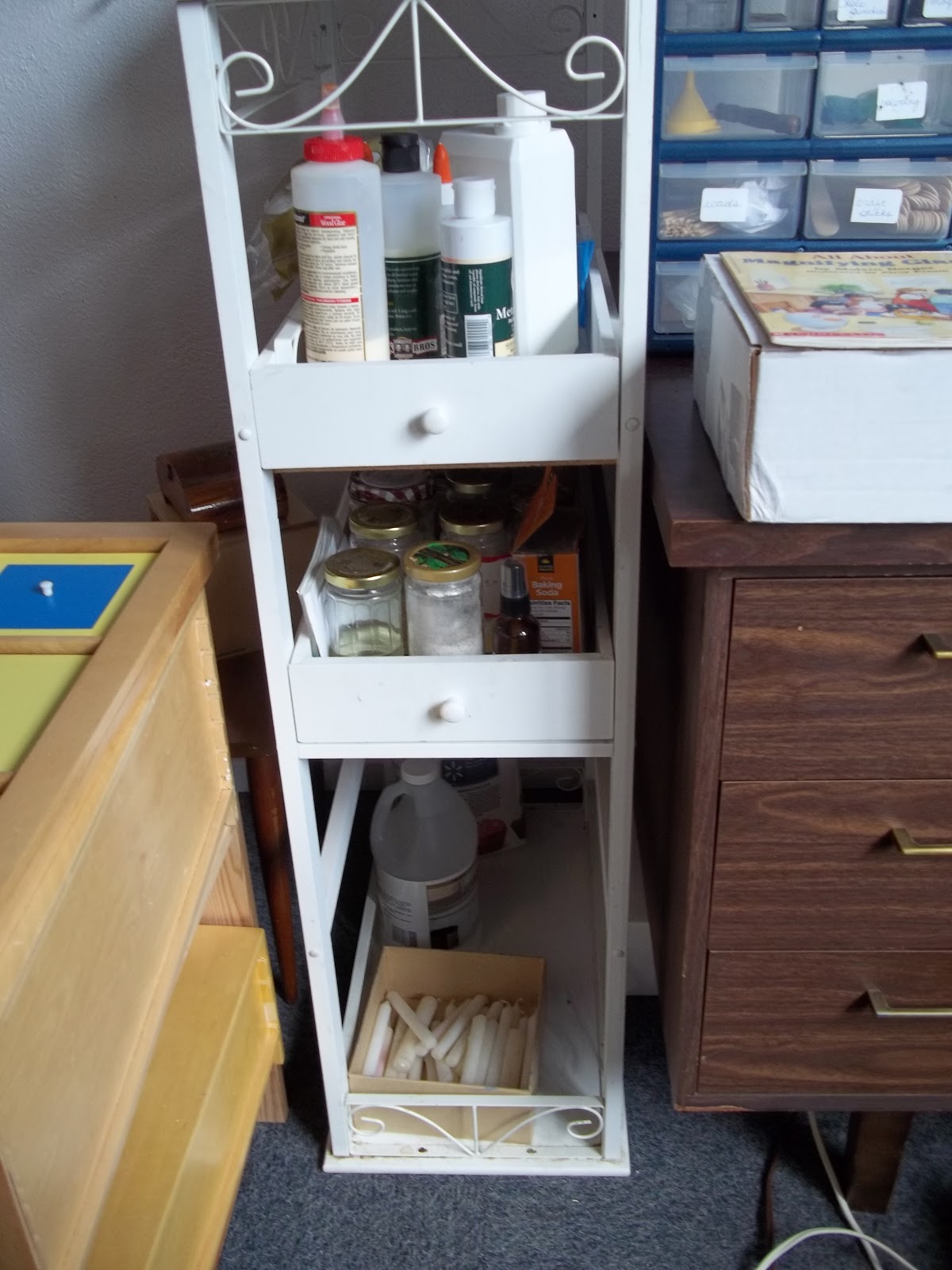
ELEMENTARY SUPPLY SHELF
This particular one has drawers that slide out. 
answering the phone
taking and giving messages
leaving messages

interviewing

map reading
asking for directions
public safety

utilizing public buildings

basic car maintenance 

snow and leaf removal

preparing and serving meals

how to strike a match
how to light a candle
(in primary you could add "how to snuff a candle")

Feel free to add more in comments below!