Showing posts with label art. Show all posts

Montessori Scope and Sequence: Elementary

The following links take you to a general scope and sequence for AMI elementary albums.

These Montessori scope and sequences -
  • follow ages 6-12 
  • do not include remedial (bridge) work
  • are not set in stone - follow the children before you!
  • are general (they do not include every single exercise with an album page that might start in year 1 and extend to year 4 or 5) - so when you see a range of 1-3, figure that the album page probably starts in year 1 (or 2 at the latest) and should generally be done by year 3. It could be earlier, but it shouldn't be much later, because the age ranges are pretty generous already. If you want the detailed version that contains every exercise and follow-up, in both Word and Excel formats (easily adapted for personal use), you will find them at Garden of Francis (for elementary) and Garden of Francis (for primary)

The years you see noted in "start" and "end" refer to the year in Montessori elementary - year 1 is the equivalent of age 6, through year 6 which is the equivalent of age 11-12. 

The last math work may or may not be completed in elementary and may extend into early adolescence. The other albums are typically easily completed in a 6 year elementary cycle. 

Looking for detailed scope and sequence that includes every single exercise of the album page and more specific guidelines and ages? Check with your album provider. Or join us at Keys of the Universe

Or looking for primary Montessori album scope and sequences? Those are trickier. Presentations that are introduced at age 3, might have extensions that go through age 4, 5, and 6 - so you'll want a very detailed one that includes all exercises for each album page. Ask your album provider for a scope and sequence to correspond with that album set.

Or some general ages are included here in various Montessori Nuggets.


Art Presentations in Elementary (and all ages)


Provide art experiences in the basic skills at primary and early elementary. Nothing fancy, but use *real* materials: real watercolors with good brushes to make small designs on small watercolor paper; rubbings; outlining, etc. (in primary, some albums have art in the Exercises of Practical Life and some have it in "Culture").

"The best for the youngest." Give the children the best materials possible and show them how to utilize and care for the materials during this time of formation.

By providing basic skills and assuring they are well learned, with good materials, they can then apply those skills to their later studies, interests and passions.

When studying an ancient civilization or another modern culture, or finding patterns in geometry or mathematics, or just illustrating a work in language, they will have the skills they need to reproduce anything they see.

There is no need to present every art form, if you have provided the very basics.

So we might not have a presentation on mosaics, or on pottery, but they can re-create these things because of the experiences they have had utilizing non-drying clay, cutting and gluing. They can learn from a crafter or a book or a video the additional skills they desire to reproduce an art form for which they might not yet have the skills.

If they have basic folding skills (folding napkins in primary, leading to folding paper - very, very basic), we won't have to present origami to them before they read Sadako and the Thousand Paper Cranes and teach themselves how to make cranes.

And they can create pyramids from paper folding when studying Egypt.

Basic plant skills or other basic art skills: they can re-create their version of the Hanging Gardens when learning about the 7 Wonders of the Ancient World.

They can study artists and art periods under the guise of history, creating timelines, and creating in the style of various artists.

They will extend their art skills in day to day life and studies, without art skills being a separate study.

And they will be able to express themselves when words are not enough - now or in the future, as they prepare for adolescence.


How many pyramid paper patterns can be designed?

Let the children discover this! You've given them the tools: how to fold paper, all the sensorial materials; you've given them the structure, now let them explore! :)


Embellishment - or Doodling?

When most of us went to school, if we drew on our mathematics or language or social studies work, we were punished for doodling.

But in Montessori, we encourage children to make their work in any subject a personalized work of art. When they have done real work that they care about, they want to take their paper representation of that work and embellish it.

Embellish as a Montessori term: encouraged doodling ;)

So your stamp game paper for primary?
There are 7 rows. Enough space for 2 problems (if doing using just 2 terms within a problem), and a row in between. The division paper is longer and turned horizontally, so there are 3 rows - enough for two problems written straight across with a doodle-row in between.
That extra row: is designed for embellishment ;)

Short and large bead frame paper? Embellish around the edges and in between problems to keep them separate.

The graph paper used in elementary for so many subjects? Yep! Embellish with borders and separators.

Think of all the art and geometry a child is getting just embellishing all those squares, let alone the unlined paper he also uses. Repeating shapes; something new in each square; alternating designs; varying the colors.

Children in Montessori classrooms leave behind veritable works of art when they leave a classroom, because they do SO much of it.

Art is an external expression of the inner soul. Let's encourage it, entice it, and build on those skills NOW at primary and elementary, so that the child has plenty of strong outlets in the hormonal and emotional adolescent years, when they CRAVE artistic expression of their very souls.


Montessori Colors - Art

So why is the pink tower pink and the brown stair brown and the red rods red and the number rods red and blue and the metal insets pink and blue - and all those other colors? I don't know why each one was initially chosen. 

Do they matter?

YES!

Can you change them up a bit - well, yes. But why re-think the wheel? There are SO many benefits to the colors as they are. Perhaps Dr. Montessori couldn't define why she made all choices; but she was a careful observer and the colors she chose that she never changed - she didn't change because they WORKED. She only changed if something wasn't working. 

Pink is a calming color - it brings the children into the primary environment at a very young age. It is attractive. If it is not attractive to boys, then we need to look at the programming done at home. At 3, pink is NOT a girl or boy color! If it's a girl color only, then the boys will never learn to write.... 

Because the sandpaper letters (used to introduce writing not reading) are pink too! Usually it is the consonants (the majority of the letters) but I've seen it reversed. Interestingly enough, the metal insets (used for.... drum-roll.... WRITING! -- the first time child a writes with a pencil and intended to focus on writing skills and letter-writing-directionality) are pink and blue too. The writing material coordinates. Hmm. And as it moves into reading, it becomes red and blue. I'm not sure why on that one. 

Why brown for the brown stair? Because it looks so nice coordinated with the pink cubes from the pink tower when doing extension work. If you're going to leave ONE thing natural, this would be it because it still goes along with the pink tower. But really - the solid smooth color is much better for the children than the grain of wood on this one (or the pink tower or red rods). 

Red rods? It stands out clearly against just about any material in the classroom - and since we use the rods as a measuring device, this would be a good thing! 

Oh, but the paint chips! Hint: I know Dr. Montessori originally said she allowed the children to be destructive - but then she spent some time in India. Under house arrest. Just because she was Italian. She went there for 2 weeks and came home something like FOUR YEARS later. Interesting how world history (World War 2 in this case) affects how we interpret someone's books on how we educate our children today. Yep. She changed her thinking AND her teaching on *anything* destructive. Kids like to knock their cups off their high chairs as babies - it can be cute in the moment but it leads to carelessness and destruction (and messes!) later, so we nip in the bud. 

The grain of the wood can detract from the visual impression of dimension that we are trying to emphasize with the children. Here is a YouTube video of a pink tower with the natural broad stair - beautifully done, but the knots on the broad stair didn't need to be there. 


Red fraction circles: the unit is red; the fraction circles and squares are dividing up a unit. 
Red and blue number rods - red is the unit; blue is a nice alternate color from the color wheel; it also avoids most color-blind issues. 

Place value for math and the colors of the number beads are rarely questioned - these seem to make natural sense for everyone. 


 Ask me about other colors!


Calligraphy


            Interestingly, Dr. Montessori adds a paragraph about calligraphy at the end of one her writings on the subject of the writing process. She writes, “We, instead, prepare a child indirectly not only for writing but also for calligraphy according to its two basic principles – beauty of form (by touching beautiful letters) and vigorous execution (by exercises in filling in figures).”[1]
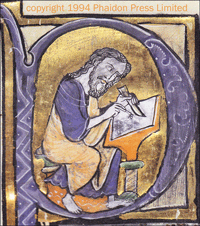
Picture (c) Phaidon Press 1994 Saint writing
Online tutorial for learning calligraphy
Calligraphy-skills.com

          These exercises are the typical metal insets, as well as the child utilizing all other metal materials for design work, including the various fraction materials of primary and elementary, other iron mathematics and geometry trays in elementary, even the geometric cabinet insets traced both with fingers and with the fingers. The botany cabinet insets are traced with a small utensil and can also be traced onto paper with a pencil and filled in. 

Instead of eventually "teaching" print, we teach calligraphy as an alternative writing form - for the history, the art, the beauty, the control - and many children consider calligraphy the "grown-up way of writing". They know they have reached a level of maturity in their writing, when they are privileged to learn calligraphy. 

What age? Some signs of readiness: 

  • marked decrease in control of handwriting; it becomes sloppy or careless
  • wanting to type everything on the computer (or other signs) in a way that suggests it is more about not caring about writing anymore, or a sense of laziness.  [2]
  • requesting the privilege to write like the grown-ups or some other privilege of maturity


[1] The Discovery of the Child. Chapter 15.
[2] NOTE: we're not saying 'no computer typing'; we're just saying that there may be something more behind the request. Ideally, save computer typing for middle or high school if possible. 

Handwork in Montessori

I like Margaret Homfray. I agree with so much of what she says in the videos that are posted on Google Videos. Remembering that in these videos she is focusing on the primary age, which is a different plane of development from elementary, she does present some really excellent information on the other ages.

She says something in one of her videos (sorry! I cannot remember which one! If you know which one it is, please send me the link so I can link to it and note the location of what she says) about the adolescent plane of development that is very striking.

Children are innately creative at the third plane of development. They want to create artistic ideas. They *SHOULD NOT* be hindered by the process of learning the artistic skills needed to express themselves and the turbulence inside them.

We have unruly teenagers because of the lack of emotional and *technical* preparation beforehand.


At primary, at elementary, children should be given the skills they need to be artistic at the adolescent age.

Yes, she says, girls AND boys should learn needlework. She explains that women historically did these things for the home; but the men (tailors, monks) did these things for the priests, for the kings, for the public offices.

If we give the children enough skills and exposure at the younger ages, anything they didn't learn but want to know can be readily picked up when needed. We don't have to teach everything, but to what should we have exposure in our homes and Montessori environments?

  • Knitting
  • Crochet
  • Needlework and/or embroidery
  • Cross-stitch (yes different from needlework)
  • Basic sewing skills: buttons, mending of various materials (mending leather is different from mending a hem) - think "what are basic repairs that can be made?" - children will take this further when needed
  • Drawing 
  • Painting
  • Origami
  • Clay
  • Music expression and enjoyment
  • Writing styles
  • Using hammer and chisel
  • At least 1 other sculpting technique (whittling, etc)
  • Weaving
  • From-Scratch Cooking
Most of these are covered in the primary art area (in the Exercises of Practical Life album in AMI) or in music (language and sensorial albums); but all skills should be developed as the child studies in the other areas:
  • re-creating the puzzle maps in a variety of media
  • design work with ALL the metal insets (typical insets; fractions; elementary plates, etc)
  • draw images of their work (golden beads lead to both geometry AND art; tower and stair in combinations are beautiful to draw and it covers mathematical principles)
  • salt-flour maps of various landforms (yes, they are doing art with the clay landforms in primary)
  • whittling (teach with soap bars)

In elementary, the children can be choosing works of art to re-create from other cultures and other time periods: 
  • pottery and painting styles come to mind
  • book-making
  • furniture styles
  • origami styles through the centuries
  • house styles - architecture - the Roman Arch for example
  • Calligraphy
  • Illumination
  • Sculptures
  • candles, soap, other common household goods - make them from materials as close to natural state as possible
  • textile creation; spinning thread and yarn; dying textiles, threads and yarns
  • beginning food preparation skills

Do not think *crafts* - think ART. Think beauty, aesthetics, function, style - and provide the very basic materials and simple presentation to get them started. 

Do not think *projects* - think inspiration. Give the basic material and simple presentations on how to use particular tools; then let them be inspired (it's ok to drop hints and there; and if something is a requirement for the child, imposed by the adult, then the adult should be right there with the child through the process). 


When we provide this foundation for our children, those emotional disturbances in middle school, when their brains need a rest and their hearts need an outlet, will be joyful exploratory years, in which the child comes to know himself and the world around him in a new way. And we adults come to see the wonderful creation that is this particular child. 

Nothing in a "Montessori" environment is learned in isolation. Everything connects in history, in mathematics, in practical life, in beauty. 

Are we starting to see how cosmic education works? 


Art in Montessori


The art experiences provided in each casa dei bambini will differ with culture, location, availability of materials, and decision of the directress. 

Materials could be chosen to represent various media or based on sensorial exploration of the various elements of art, but always the emphasis is on providing keys to further exploration and use, not to provide every single art experience possible, focusing on how to use the various media. 

First, the child is provided with keys to explore the elements of art. Later we name and use them in studying works of art by the children and by various masters of art.
  • color 
  • form 
  • line
  • shape 
  • texture 
  • space
  • value


It is nice to have high-resolution prints of sculptures in addition to actual three-dimensional items in the environment and other pieces of works of art. All works should be rotated with long enough time for the children to truly study the works, but with enough changing to see various works, yet not have a too-cluttered environment.

Art suggestions: 
  • Children seem to easily connect with the works of Picasso
  • Mary Cassatt has many works of children participating in practical life works. 

                
The direct aim of all art experiences in the casa is self-expression and the exploration of art elements. 

The children do not produce crafts as such and the directress does not present this, simply presenting how to use the materials directly, being careful to keep her own work as open-ended as possible. 

Children in the casa come in at varying stages of art development and abilities and each one should be respected and encouraged. 
  • When a child’s work is brought to the directress for display, the directress should avoid general praise, instead asking the child to tell her about his work or commenting on the child’s use of color, line or another element of art. 
  • The children have individual drawers or cubbies in which to place their works of art for later use, taking home, recycling or other use.

                
Materials: 
  • The art materials are generally stored on trays or in baskets in complete sets, 
  • except that paper and fabric are stored separately for choosing according to individual needs. 
  • As the children proceed in their refinement of movement, smaller tools should be provided. 
  • An art oilcloth or mat should be used to define the child’s work space on the table and is white or ideally off-white to not be a distraction – this could be made from a flexible cutting board. 
  • Some how-to-draw books are good for the older children; similar to recipe books, they provide step-by-step instructions to follow on the child’s own, and knowledge gleaned can easily be applied to other work outside the realm of the few books provided. These are best for elementary. 
HINT: Oilcloth as described in most Montessori trainings is a form of vinyl at the fabric store - NOT the fuzzy backed thin stuff called oilcloth at the fabric store. This stuff is a bit thicker, very easy to wash, no fuzzies and cuts very easily. You can almost always find it on the remnants racks in various colors; otherwise it is found in utility fabric and sometimes around home decor.