More words are phonetic than just CVC words - consonant-vowel-consonant (like cat, bat, hit, bit, sit, rot, and the like). We don't need to limit the children to such words.
"Pumpkin" is phonetic - technically, so is the word "phonetic".
In Montessori, with the approach that Montessori herself discovered with the children, that Muriel Dwyer summarized in her booklet on the exploration of reading and writing with children, and that AMI and others still teach in their training programs, the children are given 40-44 "keys" to their English language (the number varies in other languages), through playing sound games thoroughly,
then they learn the written representation of those sounds through the sandpaper letters (individual letters on pink/blue backgrounds according to vowel or consonant; double/triple letters on green background - taught all together, not all individuals then all double/triple - and in cursive so the children know the entire *sound*)...
Now the children have all that they need to WRITE (an easier task than reading) - they write with the movable alphabet, while their hands are continuing to strengthen and develop writing skills with the sensorial materials, the metal insets and more. And then can write their OWN ideas. They don't need pictures or objects or adult lists of words to create. They can write what they want.
Because they have been given the keys they need. And only the keys they need, include time to explore their own interests and have LOTS of real life experiences that they want to write about. To explore, to learn --- and to one day, on their own, to discover for themselves:
they can READ!
This was Montessori's experience - and this is the experience of all those who follow in her footsteps - provide the keys, follow the child's genuine needs/interests with lots of real life experiences - and observe.
Showing posts with label writing. Show all posts
Showing posts with label writing. Show all posts

The Montessori Phonetic Approach
From the Introduction to the Language Primary Montessori Album:
We provide the keys to reading, writing and spelling and the children learn spontaneously and joyfully. While we use a phonetic approach, we do not use it in a traditional manner – we use 42 sounds where a traditional phonetics approach uses 150 or more.
So yes, Montessori uses a phonetic approach to reading, writing, and spelling - but that is a huge difference between 150 and 42! Those long series of graded readers? Simply not necessary. Children go from little/no reading to 2nd grade reading level in no time, and within weeks are 5th grade and higher. If they are not, then a crucial key was missed (or too many unnecessaries were thrown in). Or there is another influence within the child (a particular developmental need that should be met another way).
Spelling in AMI albums
When looking for spelling practice in the AMI albums, look for the following concepts:
- phonograms (booklets, cards)
- the word "dictation" in any follow-ups or extensions (think anything with a word list, including the phonogram cards and word study)
- (or turn any/all word lists into dictation games)
- function of words
- word study
- let the children come up with words on their own - dictate to each other
- note typically mis-spelled words in their writing - cover those needed rules through games or direct instruction
Doesn't feel like much, but it is powerful.
The adults are responsible for ensuring all the areas have been introduced and are being utilized.
The adults are responsible for ensuring all the areas have been introduced and are being utilized.
Research on Cursive Handwriting
.jpg) Some links to research on cursive handwriting:
Some links to research on cursive handwriting:What Learning Cursive Does to Your Brain
Cursive Benefits Go Beyond Writing
Brain Research and Cursive Writing
Should Schools Still Teach Cursive?
Study: Learning Cursive in First Grade Helps Students
Edited to add a new one:
Biological and Psychological Benefits of Learning Cursive
Each one of these studies focuses on learning cursive in approximately 2nd-4th grade (ages 7-9). The naysayers to cursive typically are the ones not realizing that the sensitive period for languages is 0-6 years of age, thus we should be giving the children the keys (muscle memory of the letter shapes, sounds of the letters) before age 6, at which time they receive all they need to read/write in cursive AND in print (because print just "happens" with children who start with cursive).
Then, we can spend those elementary years working on composition skills and pursuing SO many other interests pertinent to the elementary age - the second plane of development.
Montessori Articles:
Why Cursive First? (fantastic bullet-pointed list)
Should We Still Teach Handwriting in the Montessori Classroom?
(read the comments on this one for sure!)
There are plenty more, very excellent, articles - and quite a few not so excellent ones (both Montessori and non-Montessori). But these ones hit the main ideas.
Montessori Elementary - Writing Process
The children at any level follow the same process from beginning to end of their writing, but the depth will vary dependent on their ages and experience.
The language album does not specific an explicit writing process, but recently I had the opportunity to put together an outline for my son that indeed covers every situation and is perfectly in line with Montessori:
The language album does not specific an explicit writing process, but recently I had the opportunity to put together an outline for my son that indeed covers every situation and is perfectly in line with Montessori:
- get your ideas down on paper (wide variety of options - notecards, bubbles, lists, etc.)
- organize those ideas under main headings
- consider any other headings that should be included (look at "audience requirements") - edit as needed
- physically organize all these ideas in order, and begin writing on paper with complete sentences.
- Edit from there as needed.
Learning to Read - the Montessori Way

Many questions have come in lately asking about this particular article, in comparison to albums purchased online and to Montessori's own writings on learning to read:
HomeSchool.Com - Montessori Language Arts at Home
Overall, this article is a great overview. But it does need two clarifications:
Maria Montessori did NOT develop the pink/blue/green series. She developed a whole language approach that, while sequenced, is laid out entirely differently.
Also, the children when first working with the movable alphabet, do not write on paper. This is a separate development at a separate time, and generally is done when the child is comfortable with spelling.
There are currently three relatively well-known Montessori series for learning to read in the English language:
- AMI (99% match to what Maria Montessori developed)
- Muriel-Dwyer (very similar to AMI)
- Pink/Blue/Green series (complete departure from the first two styles)
Each one has its benefits and drawbacks for any given situation (homeschool, classroom, special needs, need for the adult to "feel" in control, etc). So select what works best for you, but do research all the possibilities so as to make an informed decision.
Cursive or Print - 4
When choosing between print or cursive at any age, consider Montessori's own words in response to a popular method at her time of teaching capital print letters first:
The Discovery of the Child by Dr. Maria Montessori, chapter 14
This method for teaching one how to write illustrates the tortuous ways we follow in teaching because of our tendency to complicate matters. It resembles the tendency that we have to put a high value only on complicated things. ... Will not a child have to make an effort to forget printed, in order to learn cursive letters? And would it not be simpler to begin with the latter?
The Discovery of the Child by Dr. Maria Montessori, chapter 14
Calligraphy
Interestingly, Dr. Montessori adds a
paragraph about calligraphy at the end of one her writings on the subject of
the writing process. She writes, “We, instead, prepare a child indirectly not
only for writing but also for calligraphy according to its two basic principles
– beauty of form (by touching beautiful letters) and vigorous execution (by
exercises in filling in figures).”[1]
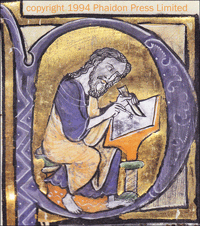 |
| Online tutorial for learning calligraphy Calligraphy-skills.com |
These exercises are the typical metal insets, as well as the child utilizing all other metal materials for design work, including the various fraction materials of primary and elementary, other iron mathematics and geometry trays in elementary, even the geometric cabinet insets traced both with fingers and with the fingers. The botany cabinet insets are traced with a small utensil and can also be traced onto paper with a pencil and filled in.
Instead of eventually "teaching" print, we teach calligraphy as an alternative writing form - for the history, the art, the beauty, the control - and many children consider calligraphy the "grown-up way of writing". They know they have reached a level of maturity in their writing, when they are privileged to learn calligraphy.
What age? Some signs of readiness:
- marked decrease in control of handwriting; it becomes sloppy or careless
- wanting to type everything on the computer (or other signs) in a way that suggests it is more about not caring about writing anymore, or a sense of laziness. [2]
- requesting the privilege to write like the grown-ups or some other privilege of maturity
[1] The Discovery of the Child. Chapter 15.
[2] NOTE: we're not saying 'no computer typing'; we're just saying that there may be something more behind the request. Ideally, save computer typing for middle or high school if possible.
[2] NOTE: we're not saying 'no computer typing'; we're just saying that there may be something more behind the request. Ideally, save computer typing for middle or high school if possible.
Cursive or Print - 3
“Hand·writ·ing: 1. writing done with pen or pencil in the hand; script. 2. A style or manner of writing by hand, esp. that which characterizes a particular person; penmanship.”[1]
Not only is cursive easier for young children to learn, but by learning it young, they will not have to unlearn print in order to learn handwriting later in childhood, when they are already burned out from school as well as moved out of the sensitive period for order and language. On the other hand, print can be learned at any time, as it is indeed “all around us.”
 In addition to these factors, today as even in Dr. Montessori’s time it is observed that
“it is impossible to forge a person’s handwriting.”[3] Handwriting is an art form in itself. Examples of this art form can be seen in older texts with fancy first letters of chapters and sections, the variations from culture to culture of creating various letters of the alphabet, particularly capitals. Handwritten letters and cards are still cherished by many, much more than easily written (and usually error-ridden) e-mails that fly around the planet in the billions or trillions each day.
“Even though we all use the same alphabet, the motions we make are so individual that
each one has his own particular style of writing,
and there are thus as many forms of writing as there are men.”[4]
Cursive or Print - 2
“Hand·writ·ing: 1. writing done with pen or pencil in the hand; script. 2. A style or manner of writing by hand, esp. that which characterizes a particular person; penmanship.”[1]
In today’s world, many people have chosen to forgo handwriting (cursive) altogether because we are so surrounded by print, print is standardized (everyone can read it), etc. But this is a mistake. We are surrounded by print because of the beginnings of the loss of handwriting; standardization of print only detracts from individuality. Group cohesion within a society is excellent, however each person must be an established individual in order to contribute the greatest amount to group dynamics. The number of font choices available in computer writing programs testifies to the need for expressing individuality. The issue of handwriting is only a sign of the times, rather than the deep-seated issue itself, however the issue can become a heated discussion among educators and parents.
Dr. Montessori has encouraged the use of cursive from some of her earliest work with special needs children, finding that curved lines are easier for the child, not because of the child’s experience with a curved horizon as Seguin and Itard put forth, but because curved connected lines are truly easier and more natural for the child:
“the straight line (of print) is unique in that it follows the shortest distance between two points. Every variation from this means that a line is not straight. The countless variations are therefore easier to make than the single stroke which is the standard of perfection.”[2]
Dr. Montessori describes children tracing curved, connecting lines and loops in the sand with a stick, and the artwork and scribbles of the youngest children of then and today still testifies to the fact of curved connected lines being easier for the child to recreate.
She also describes how children with weak hands will tire after drawing a row of straight lines and the straight lines look more and more like the letter c by the end of the line.
Cursive or Print?
Cursive is used for writing.
Print is used for reading.
Print is used for reading.
“Even though we all use the same alphabet, the motions we make are so individual that
each one has his own particular style of writing,
and there are thus as many forms of writing as there are men.”[4]
Writing - Montessori Nuggets on the Process
The writing process should be a joy, just as learning to read.
Some tidbits to help the process along:
 (do some of these look familiar ????)
Some tidbits to help the process along:
(do some of these look familiar ????)- writing precedes reading - it's just easier to put your own thoughts down with the sounds you know, than to interpret someone else's thoughts that you have to construct in your mind without perhaps being in the right "mindset" at the time. When a child has a reason to write, he will do it - have lots of life experiences so there are things to write about, introduce card-making and journaling with pictures - the writing will come. Then the child becomes interested in what others have written......
- the sounds help us to write, not the names of the letters - the names of the letters help us to tell someone else how to spell; they don't even help us to alphabetize!
- use the sounds to write - with the movable alphabet, a child's "spelling" is taken away quickly, so it is OK if they mis-spell at this stage. The *point* is to get the correct sounds. If you can sound out their words based on the sounds they have placed, *no correction is needed* until they are old enough to be writing on paper and have had sufficient experience with puzzle words, phonograms, and lots of reading and writing experience. This is NOT "inventive spelling" - this is getting them writing. If a word is not written in correct sounds, then point out to them, "Hm. This seems to say (and slowly say the word while pointing to the letters)" OR "Hm. I wonder if we could look at this one again. Say the sounds and see if that is what you wanted to write." Again, the words are cleared away quickly so the spelling errors will NOT be reinforced.
- children write based on their experiences - be sure to have lots of experiences to write about: a pet that came to visit; a pet they get to care for; a visitor; a visit elsewhere
- use wide vocabulary - a large vocabulary offers many choices for describing the same event. Instead of "he sat", a child could say, "the boy plopped down quickly" - yes a 4 year old can write that!
- begin with the cursive movable alphabet - when they've had sufficient work with the sandpaper letters and phonograms to start sounding out words - LET THEM! But do not require they write the letters with pencil on paper - this is a separate process.
- writing happens in stages, via a variety of preparations: sandpaper letters and phonograms give the sounds; work with knobbed cylinders, bell mallet and other materials encourages the proper writing grip; work with all the sensorial material gets them using the proper movements; work with the metal insets gives them actual writing with a pencil within the geometric shapes used in cursive writing (Montessori materials are not suited for starting with print) and lots of practice in controlling their movements while drawing those infinite straight lines within the metal inset shapes; further design work increases their skills and strength; exercises of practical life such as table washing and the layout of other material especially in order of use laid out on the tray should be encouraging the left to right movement of our writing system (if you are in a different writing culture, adapt your other Montessori materials layouts to suit your writing style!)
- second-plane children should be writing across all subjects - and they will be exposed to a variety of writing styles in their reading and their research. If they are not utilizing these experiences, they don't have enough of them - so get them reading and doing independent and small group research projects.
- second-plane children not yet writing? start them on cursive. Really. It's easier, it flows more naturally, it connects the letters within a word forming a distinct word; it has historical implications compared to both civilizations that used individual symbols (how long it took!?) and those that used a handwriting style (how much more quickly they could write!)
- all ages - let them doodle! We call it embellishment in Montessori circles. When their work is done, let them decorate and make it an art form for themselves.
- PENCIL GRIP: See the image above for the proper pencil grip. Children having a hard time? Have them pick up heavy-ish items with a small knob (think tip of the bell mallet, the knobs on the knobbed cylinders) with 2 fingers and thumb. Their touch should be light, not tight; the item should sway freely but be firmly in their grasp. This is why the Montessori bells are SO nice (see future nuggets). Practice this grip yourself. Watch videos of artists on YouTube - how they draw their pencil sketches. What grip do they use? Click here for a video from Dr. Steve Hughes. Skip to 32:00 for the section on the writing grasp.
- paint with small paintbrushes so the child is encouraged to use light-touch and proper grip
- encourage light touch
Writing Style in Elementary - see upcoming Nuggets
Reading - Montessori Nuggets on the Process
Learning to read should be a joy, not a chore. When children learn during the primary windows of opportunity (ages 3 1/2-5 1/2 or 7-9, though it can happen in between and after as well), the process goes much more smoothly.
Some tidbits to help the process along:
Some tidbits to help the process along:
- writing precedes reading - it's just easier to put your own thoughts down with the sounds you know, than to interpret someone else's thoughts that you have to construct in your mind without perhaps being in the right "mindset" at the time. When a child has a reason to write, he will do it - have lots of life experiences so there are things to write about, introduce card-making and journaling with pictures - the writing will come. Then the child becomes interested in what others have written......
- the sounds help us to read, not the names of the letters - the names of the letters help us to tell someone else how to spell; they don't even help us to alphabetize!
- children read silently until they are at least 7 - let them formulate what the words say, in their entirety (the entire passage, the entire phrase, the entire word)
- begin with commands - write out commands for the child to perform - make it a FUN GAME: you know they got it "right" because they'll obey the words as they read them. A first one might be "kiss mama" - a later one might be "share candy with sister"
- match labels with pictures/symbols/objects - then they check their work with already-labeled cards
- Adult read-aloud - allows the child to hear things again and again, shows pronunciation of words, inflection, voice tones, etc.
- All of this focuses on comprehension - whole reading
- children read-aloud below the child's reading level - a 7 year old reading at a middle school reading comprehension may only be able to read-aloud a "2nd grade" book. That is OKAY! An idea: think of "reading levels" in books as what a child should be able to comfortably read-aloud at that typical age - but reading aloud only after they have moved on in silent reading.
- Minimize technology - in normally developing children, technology is a hindrance. It breeds the idea that it is easier to do it this way, therefore why bother doing the perceived "hard way". A small selection of books on tape/CD are fine (and can be GREAT!) when properly balanced with other experiences; but that's it. The adult (parent or teacher) should be interacting with the child during read-alouds as well.
- Read with a purpose - whether it be entertainment, cooking, science experiments - but have the things the children read that are required by you or the local educational standards mean something to you and to them. Dick and Jane are cute from an adult nostalgic perspective. Not so with the little ones!
- Trust that your child can read. - when our trust fails, theirs fails. Let them know they CAN do it and provide them opportunities to do so. Especially boys - they need a purpose and they need complete faith from those around them. If a book is too hard and you don't have time to tell them every word, let them know: You may read this book, but I will only help you at the end of the chapter with what you were not able to figure out. It is *amazing* what they figure out when they are not allowed to use a crutch, yet know that help is available if/when they do need it.
- Tiny blips throughout the day - 4-8 5-minute blips of reading practice are worth far more than 1 30-minute block each day. This one most especially applies to all learners, particular those not in the "windows of opportunity". 3-5 minutes before breakfast; after morning chores; mid-morning; before or after lunch; mid-afternoon; late afternoon; just before evening chores. Even 2-4 minutes.
And all of that can be done without a curriculum! However, I know - something of a guide is so much easier for the adults to follow and ensure the foundation is laid, especially an easy-to-follow Montessori sequence that doesn't involve re-inventing the wheel with materials and colored sequences!
Keys of the World will soon be offering such an option. In the meantime, you may contact me for ideas on resources to use for your particular situation. Or visit this post on my personal blog for ideas.
Subscribe to:
Posts (Atom)