Showing posts with label great lessons. Show all posts

Fifth Great Lesson: Story of Numbers


The Fifth Great Lesson is the Story of Numbers. This story does not open up a new album area so much as introduce the child to the history of mathematics through the development of number usage. It ties together the child's previous and current studies with human development, further establishing and solidifying the experience of cosmic education.

The materials are a set of 8 charts in "half-size" (assuming you are using full-classroom size charts), with various cultures and time periods represented. The charts are used during the story to highlight various aspects.

It is perhaps not as "fantastical" as the first couple of stories, but really ties together cosmic education for the children and should come early on in their elementary experience, and repeated at various times and levels with new information as the children do some of their own research. This story helps them to gain appreciation for the gifts of our ancestors, the developments of civilization and communication (even through numbers) through time, and responsibility to pass on these gifts.

We hope that the children will have a strong foundation for how mathematics (and the mathematical mind of the human being) connects us to one another: past, present and future.


  • General search for Great Lessons on Montessori Nuggets
  • God With No Hands
  • Coming of Life
  • Coming of Human Beings
  • Communication in Signs
  • Numbers
  • Fourth Great Lesson: Story of Communication in Signs


    The Story of Communication in Signs is the fourth Great Lesson - it is found in the Language album. This story does not open up a subject album as such, because the children have been using language their entire lives - and developing language skills throughout their primary years and early elementary months.

    Some children may hear this story before they do the "key lesson" on the Hand Timeline; while others may use the Hand Timeline first, then hear this story - the ideal is to do the Hand Timeline first, followed by the Story of Communication in Signs. The story should be modified accordingly.

    Our goal is appreciation for written communication.

    • Materials: The only materials are a set of 8 impressionistic charts showing some of the writing styles through time - the charts are optional during the telling of the story. If they are distracting, we keep them aside and use them for follow-up; if they enhance the telling, then they are used during the story. Using 2-3 is generally most helpful. 
    • Timing: 5th or 6th week of the school year (repeated whenever the children like)

    Most children love to copy the charts and highly appreciate books and videos that correspond with the topics introduced in this story. 


    Third Great Lesson: Coming of Humans


    Human beings being creative on a beautiful day
    The story of the Coming of Human Beings is the third in sequence, coming a few days or a couple of weeks after the Timeline of Life - where a human shape appears at the very end. Now we are going to focus on that particular moment.

    The Black Strip (a key lesson, not a Great lesson) may or may not have been presented - depends on the children you have before you. The Hand Timeline follows the third Great Lesson on the coming of humans, but is not specifically a follow-up to it.


    • No materials
    • The focus is on the human connection itself - particularly on love; the children can look at their own arms and legs to see that they do not have specialized protection as animals do. 
    • Note: The two timelines called "First Timeline of Human Beings" and "Second Timeline of Human Beings" are follow-up work in the history album. They are not part of this Third Great Lesson. 
    Our Goal with the Third Great Lesson is a development of appreciation for all mankind. 


    Notes from the AMI History Album:

                3rd great lesson; can be presented as a shortened version and use different examples as appropriate but it must include the key elements of the story. There are no materials. Because this is another great lesson, we invite all the children who are new and other children are invited but have a choice. There are no suggested follow-ups after this one. Leave the children free to contemplate, discuss or pursue other topics. 


    Meher Montessori version of telling the story
    (I can only condone this video because the gentleman teacher is AMI-trained - I have not watched the entire video)


  • General search for Great Lessons on Montessori Nuggets
  • God With No Hands
  • Coming of Life
  • Coming of Human Beings
  • Communication in Signs
  • Numbers

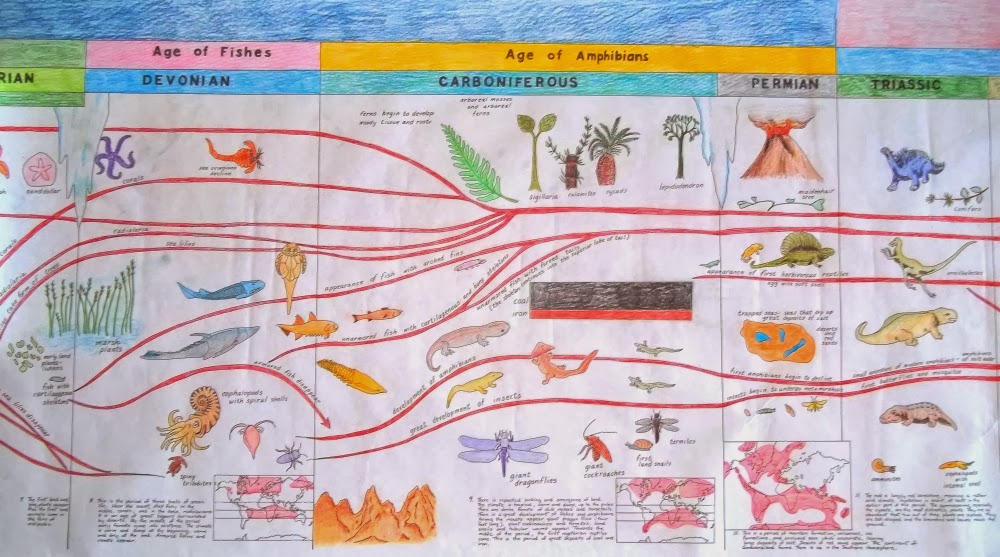
  • Second Great Lesson - the Coming of Life - Timeline of Life

    Sample middle section of the AMI version of the Timeline of Life

    The Second Great Lesson tells the Story of the Coming of Life. Materials needed include 2 dinosaur charts and 1 Timeline of Life. The timeline begins with the earliest forms of life and ends with the coming of man (which is the next Great Lesson, so we don't dwell on it here). The key point to the story, whether you tell the Old Earth (evolutionary) version or adapt for a Young Earth or 6-Day Creation is this:

    Life provides the balance. 

    This story opens up the Biology album. There is also a follow-up work on the Timeline: a mute version.

    Goal: We hope for development of appreciation for ALL of life. 


    Neither the Control nor the Mute (also called Working) timelines should be entirely complete, leaving room for the children to add information through their own research - they should also not be presented in full detail, leaving details on the strips for the children to discover (they won't discover everything before they use the mute strip!). We hope that this work will entice some children to re-create the timeline for themselves and add in their own points of interest. Many children will do in-depth research on particular topics of interest; and some children will simply delve into the biology album.

    With the mute strip, each "era" is stored in its own color-coded pouch or envelope; the corresponding contents have colored dots or other coding on the back to indicate where they belong. One idea I have seen that I love, is that the mute pieces could have a tidbit of information about the image on the front side - just enough to entice the child to go explore for more information (and if they are not enticed, then they still have just a little bit more knowledge than they had before). 

    In lower elementary, present the version that suits your situation or family accordingly. In upper elementary, introduce other versions, just as we introduce other Creation stories in upper elementary.

    There are a variety of Timeline of Life options available for purchase, download or creation. Some will match up with some albums better than others.

    Old Earth:
    Young Earth: 
    • there was one, but I'm not pulling it up now - it didn't really correspond with the lesson, but could provide some good inspiration. I'll add it later if I find it again. 
    • Keys of the Universe is slowly in process of creating a 6-day creation set of albums with corresponding materials to support such families. 


    To date the only downloadable and printable option that matches AMI albums is offered at Garden of Francis and Keys of the Universe. Both complete and in sections for printing on various sized paper.


  • General search for Great Lessons on Montessori Nuggets
  • God With No Hands
  • Coming of Life
  • Coming of Human Beings
  • Communication in Signs
  • Numbers


  • Great Lessons - Materials


    Within AMI (American Montessori Internationale), the following is a description of the materials for the 5 core Great Lessons to establish Cosmic Education in the elementary Montessori environment.


    God with No Hands

    • 4 impressionistic charts
    • materials for 6 demonstrations
    • NOTE: There used to be a 5th chart (solar system) which has been pulled to use at another time (a follow-up telling of the story)
    • NOTE: There used to be far more demonstrations (experiments is a misnomer in this case) which were pulled out to use as follow-ups, thus allowing the story to focus on the core keys, with plenty left for re-tellings and review - going deeper and encouraging a return to the Great Lesson. 


    Coming of Life

    • 2 impressionistic charts
    • Timeline of Life (a mute version of the Timeline of Life is a follow-up work)


    Coming of Human Beings

    • No materials
    • The focus is on the human connection itself - particularly on love; the children can look at their own arms and legs to see that they do not have specialized protection as animals do. 
    • Note: The two timelines called "First Timeline of Human Beings" and "Second Timeline of Human Beings" are follow-up work in the history album. They are not part of this Third Great Lesson. 


    Communication in Signs

    • 8 impressionistic charts showing the changes of writing styles through time and civilizations


    Numbers

    • 8 impressionistic charts showing the changes of numbers through time and civilizations


    For further Montessori Nuggets on the Great Lessons:

    First Great Lesson: God Who Has No Hands

    God with No Hands is a slightly modified version of Mario Montessori’s publication in Communications in 1958, originally told by Maria Montessori.

    The story is not meant to give just one idea of how creation came about; it is meant to contain some tidbits of factual information in a story format.

    One important aspect to think about is the language of the story. The language should not be the same as used in day-to-day speech. The descriptive language should be more dramatic, a bit more extraordinary.

    The tone of the story should arouse more than just the children’s interest but also his admiration and wonder if the idea of the universe has been presented properly to the children.

    The story can be told in one’s own words and the guide must be comfortable with the version of the story told; the children are sensitive to hypocrisy. The guide must love the story that is told; make the story your own; much practice allows for comfort in the telling.


    The story can be either told or read as the guide needs, but the tone needs to maintain enthusiasm and other aspects noted above. In the environment with children, throughout the following days, weeks, months and years, the guide can return to the story and recount specific sections, or fill in forgotten pieces.


    Our goal? We hope the children begin to feel appreciation towards creation and the Creator.


  • General search for Great Lessons on Montessori Nuggets
  • God With No Hands
  • Coming of Life
  • Coming of Human Beings
  • Communication in Signs
  • Numbers


  • Great Lessons and Key Lessons - some thoughts


    Some excerpts from an AMI theory paper on the Great Lessons and Key Lessons:


    Dr. Montessori believed that “our teaching must only answer the mental needs of the child, never dictate them.” The mental needs and the mental activity of the elementary-aged child hinge upon the newly evolving faculties of imagination and reason. Remember at this stage of development the powers of the human intellect are most keen. The child’s mind is sharp and energetic. It is ready for meaningful exploration and discovery.


    The framework for Dr. Montessori’s plan of education for the second plane child is cosmic education. In cosmic education, the universe, its composition and its inhabitants are opened up to the child. Within this framework, the child is able to spring into the grand and the mysterious, into the distant past and into the future. He is able to discover interdependencies as well as personal responsibility. Cosmic education serves up food for the imagination and food for the reasoning mind.


    We go from the theory of cosmic education to actual practice of cosmic education with a series of mystery stories. They are grand in scope, inspiring in vision, systematic in progression, colorful in detail and deeply personal in implication. These stories are told with the respect both they and their intended audience deserve.


    Each of the Great Lessons is an independent story, but after the first, each elaborates upon a theme set in the previous.


    God with No Hands: The first of the cosmic tales. It is the story of the creation of the universe with particular attention given to our sun and our planet. The elementary age child is attracted to the grand and the mysterious, so ideally on the very first day in the elementary environment, that child is presented with the story that contains all the seeds of human knowledge: coldness, darkness, fire, air, water, solid, liquid, gas; elemental obedience and the establishment of order. The child’s imagination allows participation. The story distills the unreachable into the understandable. This first great lesson begins to answer some of the children’s questions but more importantly it excites new ones. 

                The Coming of Life: This story follows within a week of the first. This story focuses on the development and refinement of earth’s flora and fauna.  It brings to the child’s attention the diversity, the beauty, and tenacity of life. The timeline that accompanies the story represents some of the biological and geological events that are part of earths’ history. It represents a few of the plants and animals that have graced our earth. At the end of the second story, the child is introduced to a very special life-form, whose story receives elaboration about a week later in the third Great Lesson: human beings.

                The Coming of Human Beings: Thus far, the child has been placed in contact with abiotic and biotic creatures of the world. Each element of creation, whether living or not, is subject to natural laws, to inner directives and universal order. Each contributes by its every existence to the contribution and continuation of life. This story becomes our story – the child’s story – with the third Great Lesson. The human being enters the scene with the very special attributes of reason and will – intelligence and love – with an ability to work with the hand in ways unknown to other animals and with the possibility of choice. Dr. Montessori said, “Something new came into the world with man, a psychic energy of life, different from any that had yet been expressed.” Human beings have used their intelligence, love and hands to continue their own story. Two of their major accomplishments, literacy and numeration, are introduced in the next two Great Lessons. Because they do not open subject areas in the same way as do the first three Great Lesson, you can wait a small number of weeks (2-3) before coming to these stories if the children are not yet ready.

                Communication in Signs: It takes the child on a journey through the development of our alphabet. Another week or two later, comes the fifth Great Lesson.
               
                Numbers: This story traces the history of the numerals we use.

                In both of the above last stories, connections are made between cultures of different times and places. The children are led to an appreciation of these two symbol systems that we usually take for granted, despite the fact that we ourselves use them more or less everyday. 


    Because the initial impression has been clear and uncluttered, the relationships and connections between them remain intact.


    A vision of the whole provides the child an orientation, a home base, within space, time and history. It is the nature of the human being to order the environment in a meaningful way. Great Lessons reveal to the child the importance of order and laws and directives within the cosmos and within the creations of human beings, for example the conventions of writing and arithmetic. In the elementary environment, the children are at work, physically and intellectually, creating their own body of knowledge.


                Repeat the stories every year or every few months. Yes, even into upper elementary. When the child does not want to repeat because they “know it all” invite them in with, “Let’s just see if perhaps there is something more here we didn’t see before.”


    Remember that we offer a colorful overview, not exhaustive information.

    Invite *all* elementary children to the Great Lessons.


    Older children (upper elementary) have their own work with the Great Lessons, so keep telling them. 


    KEY LESSONS:

    The Key Lessons are guideposts along the path of learning and discovery; supports here and there that follow up the Great Lessons and lead to deeper understanding and greater connections. They can be done in between the Great Lessons or at any point in time afterward. 


    The Lessons in the albums that are not Great Lessons or games or extensions are key lessons. Mario Montessori defined key lessons as lessons which “take up the detail item by item. Each gives some new information, presents new material, or shows another exercise in a progression which allows the mind to build up knowledge and to continue searching on its own for what it does not know.” Key lessons are those which are absolutely necessary for the child’s understanding – the (AMI) albums are filled with key lessons. 


    The albums are filled with key lessons and each album has a root in a Great Lesson. Each album takes up the details and clarifies or elaborates upon them. Besides the keys that we offer with materials, other key lessons are the short stories that the adult tells to illuminate a particular lesson already given. Some of the stories are in the albums, and others are developed by the adult, based on research as well as the principles of clarity and brevity. The key lessons are always ended with an indication that there is more to come – more to explore, together or individually.


    Key lessons are guideposts along the path of learning within cosmic education. You will use most of them with your children, but if a child has the understanding already, remember that the materials are tools to an end, not the end in itself. Key lessons do not open up new areas, but provide touch-points for discussions, deeper understanding and encouragement of further learning.