Showing posts with label first plane. Show all posts

Exercises of Practical Life - Table of Contents

The Exercises of Practical Life lead a child through many facets of his daily life, prepare him for future work in every area of the children's house (casa), and build up independence. For more on the benefits of the exercises of practical life, see this Montessori Nugget.

This is the AMI core list for primary. It should be adapted for local customs and cultures; around age 4, the children can receive presentations on the practical life of other cultures.

Elementary children, middle school and older will receive a different form of practical life, but this list can set the stage for what to expect. Non-exhaustive ideas for the older child below.

PRIMARY: 

Preliminary Exercises
General Overview
How to Carry a Working Mat
How to Place a Pitcher
How to Carry a Tray
How to Roll a Working Mat
How to Put Down a Chair
How to Sit On a Chair at a Table
How to Fold Napkins
How to Pour Grain
How to Pour Water
How to Fold a Dust-cloth to Put Away
How to Fold a Dust-cloth to Dust

Care of Self
How to Wash Hands
How to Polish Shoes
Snap Frame
Hook and Eye Frame
Button Frame
Buckle Frame
Zipper Frame
Bow Frame
Lacing Frame – V Pattern
Lacing Frame – X Pattern
Lacing Frame – Linear Pattern
Safety Pin Frame

Care of the Environment
How to Dust a Table
How to Use a Dustpan and Brush
How to Sweep
How to Wipe Up a Spill
How to Dust Leaves
How to Polish Glass
How to Care for Plants
How to Polish Wood
How to Polish Metal
How to Wash a Table
How to Wash Cloths
How to Iron
How to Arrange Flowers
How to Make Lemon Water
How to Wash Fruits and Vegetables
How to Peel & Cut Fruits and Vegetables
How to Bake

Grace and Courtesy
Introduction to Grace and Courtesy
How to Walk Around A Mat
How to Introduce Yourself
How to Apologize
How to Observe
How to Draw Attention
How to Accept a Compliment
How to Blow Your Nose
Own Grace and Courtesy

Control of Movement
Introduction to Walking on the Line
Walking on the Line
Introduction to the Silence Activity
The Silence Activity

Visual Art
Introduction to Visual Art
Rubbings (Exploration of Texture)
Cutting - Snipping
Cutting - Lines
Advanced Cutting
Contour Drawing with Crayon (Exploration of Line)
Drawing with Colored Pencils
Cutting and Gluing (Exploration of Space)
Painting (Exploration of Color)
Sculpting (Exploration of Form)
Beginning Sewing
Sewing a Button
Advanced Sewing – Running Stitch
Sewing a Pillow (Student’s Own Presentation)


Elementary and Beyond: 
PRIMARY SET UP FOR POLISHING
There is no concise list. Elementary children will receive presentations based on home chores; classroom chores; what they need for Goings Out. And the process continues from there into adolescence which may include Grace and Courtesy on handling emotional situations and physical changes with grace.

Elementary practical life is also a bit more "real-life" without all the individual trays. The children can handle having a supply shelf with a stack of trays which they choose to collect their needed materials. 

Some ideas: 
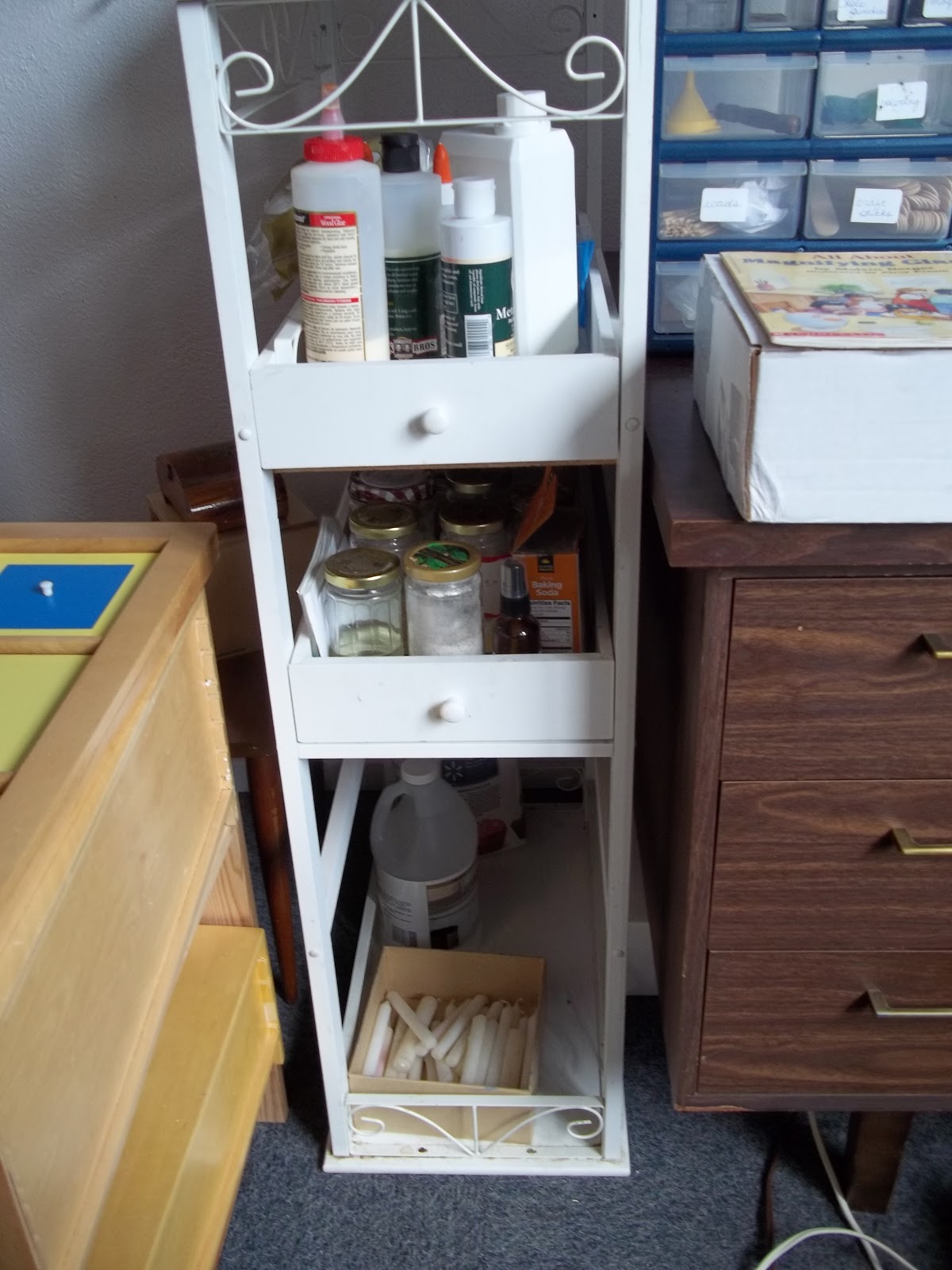
ELEMENTARY SUPPLY SHELF
This particular one has drawers that slide out. 
answering the phone
taking and giving messages
leaving messages

interviewing

map reading
asking for directions
public safety

utilizing public buildings

basic car maintenance 

snow and leaf removal

preparing and serving meals

how to strike a match
how to light a candle
(in primary you could add "how to snuff a candle")

Feel free to add more in comments below! 


Exercises of Practical Life - Characteristics of the Materials

            
Some of this applies more to classrooms; the lovely thing about practical life is that it starts in the home, so homes already have the natural lay-out they need to meet the child's needs in this area. Just have items out in the proper areas for the child to practice these skills (pouring happens in the kitchen or bathtub; shoe polishing can happen on the porch or balcony, etc). 
  • familiar to the child, having been seen at home and elsewhere.
  • culturally representative of all the children in the environment
  • presented in sequence of graded difficulty for each individual child (i.e. chopsticks and forks are present for a mix of children including western and oriental cultures, but the appropriate tool is presented first to the appropriate child, then switched as a later exercise for each child).
  • physically proportionate to child, sized such that they are maximally useful for him
  • somewhat fragile to encourage control of movement, yet functional and useful for the child.
  • Psychologically appropriate materials demonstrate an obvious use, as the three year old child does not have abstract thinking as such; toothbrushes should not be used in polishing as the tendency is to brush one’s teeth with it, for example.
  • maintained: clean, complete and intact.
  • attractive to the child, as an invitation to the will and an inspiration to act. 
  • can have embellishments such as functional decorations which serve to clarify use of the materials, i.e. a tiny embroidered shoe on the shoe-polishing cloths, or a leaf fabric as the duster handle for dusting leaves. 
  • Solid color fabrics and materials are preferred over prints unless the print directly relates to the activity, allowing the child to see the coordination of materials needed for a given work. Children associate these things - so learning to count with a seasonal item will lead to an irrational connection. 
  • independent sets of materials with all the needed materials together in one place so that the child can easily locate the needed materials and begin his work (most of us think of trays here - it doesn't have to be trays, but that's the idea ;) )
  • aprons should be sorted in such a way that the appropriate apron is easily located, either folded with the material, or hanging near the material with proper color- or print-coordination. 
  • Exceptions would include having only one area for all brooms, dustpans, hand-brushes, mops and such – with these materials, the child knows where to go for everything needed to clean up a mess.
  • one of each given work (not two trays of glass polishing)
  • but similar sets of materials, i.e. pouring of grain and of water; separate, similar polishing sets for wood, glass, and metal. 
  • Each set of materials should be differentiated from others in color, size, texture, shape or placement, so that the child can more easily identify which aprons and cloths, for example, go with which materials.
  • within a presentation, the items are color-coded to one another, aiding the child in knowing what belongs together. Everything does not have to be the same color, but there should be enough similarity for the child to readily recognize appropriate grouping. - so wood polishing on a wood tray, with a wood oilcloth ring, with a wood bowl to hold the cotton ball
  • The separation of objects from tools should reflect the natural set-up of the home life. For example, a shoe is not kept with the shoe polishing set, since shoes are naturally kept by the door or in a closet of some sort; fruits and vegetables are stored in a separate dish on the counter or in the fridge, not in the drawer at home with the peeling and cutting instruments. This more realistic set-up keeps the motivation for activity practical and more readily applicable to home-life.    
  • The exercises move from simple to complex on the shelves and in order of presentation - left to right and up to down (adjust for your culture's order of reading - this is an indirect preparation), i.e. pouring grain before pouring water, dusting a leaf before plant care, folding napkins before setting the table, using familiar objects before using less familiar ones. This is a key concept in the materials, above all others, in how the materials are laid out in the exercises of practical life as well as other areas in the room.
  • The materials should be displayed almost like a window display, attracting the interest of the child. All similar items should be together and in developmental sequence, for example all polishing should be together in order of developmental sequence, all pouring together, etc. and everything should be within the reach of the child’s eyes and hands.

Exercises of Practical Life - Results

           
Long-term results


The full cycle of activity should be presented to the child and the child will practice this cycle: 

  • beginning by gathering all the appropriate materials, 
  • then doing the activity itself and 
  • ending by putting away and cleaning up the materials and the work area. 
This process forms a logical thought process in the child’s mind, gives a form of organizations to the mind and models respect for the environment and other people.


            Another key concept, along with the movement from simple to complex, is the indirect preparation for other work, such as:

  • the refinement of muscular skills for use in writing, as well as 
  • development of the pincer grasp, 
  • muscular memory, 
  • precision, 
  • movement from left to right and top to bottom, and 
  • development of the mathematical mind. 

            The long-term results working with the exercises of practical life are largely social ones, outside of the direct/immediate aims of providing skills for care of self and the environment. 

  • The children use real objects and come to understand the products of society as well as his own and others’ customs and social habits, assisting in his process of adaptation. 
  • He develops a non-sexist perspective – this work is for everyone. 
  • He develops problem-solving skills, learning to organize materials and breaking down the work process into manageable parts. 
  • He creates a cycle of activity, internalizing the value of following through on commitments, promises and decisions and the value in finishing things: in the end result. 
  • He discovers comfort and ease in social situations not only from the direct lessons on grace and courtesy but in the natural social situations he finds himself in as he begins his work in the casa, waits his turn for desired materials, asks for help from the adult and from other children. 
  • He listens for instructions, a skill necessary later in life for all sorts of purposes. 
  • He comes to care for his environment, seeking out ways to improve upon it when necessary. 
  • He develops poise and grace, the ability to work alone, a good attitude towards work, working for his own satisfaction rather than to please an outer source. 
  • He does not see these activities as menial but important, even later in life. 
  • He develops strong work habits in planning, follow-through, completion and preparation for the next child to work, a preparation for future work of academic or financial sorts. 
  • He also develops trust in the adult, that the adult will show him something worthwhile.


            “These things (graceful movements, analysis and economy of movement, etc.) may seem to be complicated and difficult to teach, but there is an age when movements possess a fascinating interest, when muscles and nerves respond to exercise, and when a person acquires those habits which will mark him in future life as a cultured or uncultured individual. And this is the period of childhood.”[5]


[5] Maria Montessori. The Discovery of the Child. Fides/Ballantine. 1967. 88.

Exercises of Practical Life - Areas


Areas of Practical Life

The preliminary movements or exercises 
  • aid orientation to the environment, providing immediate functional independence
  • provide introductions to the aiding of smooth efficient functioning
  • first begun during phasing-in and are continued as long as needed for the child to acclimate to the environment and remind him of the proper procedures in the room
  • not complete activities in and of themselves, but are basic aids to more complex activities. 
  • Examples include such things as rolling a mat, folding napkins, putting down a chair, how to walk in the casa, and how to carry and set down various items.

            
Care of self 
  • help the child toward functional independence not only in caring for himself, but later in caring for the environment and other persons in it. 
  • build self-respect, confidence and true self-esteem
  • two levels of activity in care of self: the first level fulfills the inner need of the child and the second level responds to needs in the environment. There is great repetition at the first level and greater external action in the second level. 
  • The child at first must be quite egocentric in order to build himself up and will spend a great amount of time with repetitive individual work in washing his own hands, polishing shoes, using the dressing frames, and others, regardless of the any actual need for these tasks to be completed (i.e. the shoes are already polished but he polishes them anyway). As the child constructs himself and becomes competent at these skills, he will move on to fulfilling perceived needs of himself and others, new activities and eventually show others how to do these tasks  (i.e. washing his hands when dirty or showing another child with dirty hands how to wash).

            
Care of the environment 
  • build respect for the environment 
  • allow the child to participate in caring for the collective community since the establishment and maintenance of beauty and order are collective tasks: each child is responsible for the care of the environment. 
  • Again, the child functions at two levels in the care of the environment: first doing a task to satisfy the inner tendencies, later fulfilling external needs of self and the environment.

            
Lessons in grace and courtesy 
  • begin on the first day and continue throughout the child’s years in the casa. 
  • specifically focused on developing social skills and how to act harmoniously with others.
  • The children are given skills to show respect for others, provided words to communicate in specific situations and they learn to control their behavior in specific and general situations, leading to a strong sense of self-dignity. Lessons are given in meeting a new person, introducing friends, blowing one’s nose or sneezing, and how to walk around a mat, as some examples.

            
Control of movement 
  • walking on the line and the silence activity. 
  • Walking on the line begins very early and should be done several times a week to aid in the process of normalization. 
  • The silence activity is done later as it requires a certain level of normalization (any few children not yet ready can go for a nature walk with an assistant during this time). 
  • Walking on the line is a point of departure towards normalization, while the silence activity is a point of arrival.

      
Visual art skills
  • focuses on providing keys to visual through exposure to basic art skills exploring the elements of art. 
  • Activities provided could include cutting with scissors, basic sewing skills, color and media exploration, and others.


Exercises of Practical Life - Introduction


Introduction to the Exercises of Practical Life

Definition and Description

Emerson wrote, “Your actions speak so loudly I cannot hear what you say.” 


With no one is this truer than with young children, whose language is still developing yet whose visual acuity, particularly with detail, is astounding.

The exercises of practical life are all those works in the casa that can be seen elsewhere in the child’s life, such as home, family and friends’ homes, museums, stores and really everywhere. These include but are not limited to activities such as baking, cleaning, polishing, pouring, caring for plants, manners and civility, washing, and sewing. 

In The Discovery of Childhood, Montessori provides this non-inclusive list of ideas: 
  • locking or unlocking desks or doors, distinguishing the acts of holding a key horizontally, inserting it, turning it, and then drawing out the drawer or opening the door; 
  • opening a book correctly and turning the pages one at a time with a gentle touch; 
  • rising up from a chair and sitting down on it; 
  • carrying various things, stopping, and then putting them down; 
  • avoiding obstacles while walking around, that is, by not bumping into people or furniture…. 
  • the formalities of social life, such as greeting each other, picking up and presenting an object dropped by another, the avoidance of passing in front of another, giving way to others, and so forth.[1]
            On the surface these exercises seem mundane, insignificant, trivial, and some people consider them essentially useless as an area of children’s education. However one discovers something different when looking more in-depth at these exercises. The work in this area is the essential, simple, ordinary tasks that adults do to prepare, maintain, restore and beautify their environment, such as washing, sweeping, cooking, cleaning, flower arranging, grace and courtesy, plant care, and others. 


Children see these tasks on a continual basis, yet are rarely allowed a true opportunity to participate in the maintenance of their environment; toy brooms and vacuums do not really clean, nor do the typical toy spray bottles actually spray; smaller versions of real items are required with appropriate time and example. 


Children have a strong desire, a human tendency even, towards real work: work of value that displays the child’s importance and role in his world.

            The adult does these types of tasks every day whether desiring to or not; these activities serve an outer utilitarian purpose. The child on the other hand is seeking to fulfill an inner purpose: to participate in the world around him. To the child, these activities are not chores, but are tools on the path towards self-perfection and in many ways they are new to him: in the newness of his own life, as well as for others, the opportunity to fully participate. These are development activities based on the natural laws of development. “A child… does not become weary with toil. He grows by working and, as a consequence, his work increases his energy. A child never asks to be relieved of his burdens but simply that he may carry out his mission completely and alone.”[2]
            The familiarity of these tasks, even if from pure observation, is a good transition for new children into the casa dei bambini, serving as a link between home and the casa environment, providing security and comfort. The child will work with these materials, not only for his own tendencies towards exactness, maximum effort and others, but to learn how to care for his environment in the casa as well as at home and elsewhere.
            The child is attracted to these activities not only for their familiarity, but also for their simple, clear and concrete purpose; following a logical progression of movements; ability to observe the sequence with the focus primarily on physical analysis of movement (mental analysis is less readily observed but is also present); the exercises of practical life are demonstrated with actions and few words. These activities become an invitation to the will; they are interesting so the child will repeat them many times regardless of actual need for their completion, leading to the development of focus and concentration, which is important for learning just about anything. Concentration and repetition in this area then leads to coordination of movement, with the integration of the mind and body. The exercises of practical life develop the intellect in the areas of memory, concentration, sequence of events and purposeful work.

Purposes
            The main purpose of the exercises of practical life is the ultimate integration of mind and body, a point where the child has purposeful control of his movement and can focus his mental energies on a given task independently (utilizing concentration),. The child’s movement, the muscular activity of the body, will be directed by the intelligence. The coordination of his intelligence, knowledge given through the presentations and observation of others, allows the child greater control of his will: once he knows how to do something, the will wants to do what it already knows how to do, but in a more perfect way.  The integration of the mind and body lays the foundation for the intelligence. The adult provides the raw material in the environment, but the child must do the work of building up his own self utilizing the environment; by nature the child strives to be independent and the fundamental goal in life is to have functional independence, the ability to take care of oneself and one’s environment whenever needed.
            Other purposes include the development of the will, as a material is not always available, or a process has not yet been perfected; rather than be discouraged, the child’s will must develop patience and perseverance. The child utilizes these activities, which should be reflective of his culture, to adapt to his world and his culture, aiding in social development. These activities can and will be used elsewhere outside the casa so the building of community in other places increases with the child’s competence and desire to participate. Lastly, as noted earlier, the familiarity of these tasks provides a smoother orientation for the new child into the casa.
            
HISTORY: The first casa dei bambini had only sensorial materials and toys; the toys were soon left behind for the sensorial materials. The exercises of practical life began with Dr. Montessori’s doctor concern about hygiene. She gave them presentations on washing their hands and blowing their noses, for instance, which generated such strong responses in the children, such as clapping with joy and much repetition, that she found they pointed to a deeper aim or need of the children; thus she developed more practical life activities.
            She had found that for the child, the exercises of practical life are not only developmental (they can and desire to do these tasks), but they are creative, in that the child creates himself, and these exercises fulfill several of the human tendencies used for self-creation (exactness, self-perfection, work, repetition, manipulation, order, orientation). The child organizes his intelligence through purposeful activity; these exercises are called thus because the child repeats them over and over. All of these characteristics lead to concentration of the child on the work involved, which leads to competence and eventually application of the skill elsewhere within and outside of the casa, thereby leading to functional independence.             


[1] 88-89.
[2] Maria Montessori. The Secret of Childhood. Fides/Ballantine. 1966. 197.
[3] Maria Montessori. The Discovery of the Child. Fides/Ballantine. 1967. 86.
[4] Ibid. 87.

Language - Table of Contents

AMI Language Table of Contents for Primary and Elementary

Language progression from primary to elementary should be relatively smooth. The child's needs will change as the shift from first plane to second plane of development occurs. 

AMI Language does not utilize the pink/blue/green series. This system can have a very useful place, but many AMI trainers and teachers have found it to be too curriculum-like and binding rather than freeing. 

Please note: 
  • many of the presentations overlap in ages
  • most of the presentations contain multiple exercises and games that may extend anywhere from a month to 3 years' worth of presentations
  • variations are possible
  • Please see other Nuggets on Language for further details. 


PRIMARY:

Spoken: Vocabulary Enrichment - age 2.5/3 until forever ;) Many of these happen naturally in infancy and toddlerhood
Orientation Game
Naming Objects in the Environment
Collecting Classified Objects
Practical Life Objects
Parts of an Object
Language of the Sensorial Materials
Three Period Lesson
Cards for the following: Names and Qualities that do not change, Positive Qualities, Comparative Qualities, Superlative Qualities
Classified Cards - Social
Related Objects Game - Presentations A & B
Description/Definition Game
Stories – Biological Classifications
    The Story of Living and Non-Living Matter
    The Story of Plants and Animals
    The Story of the Five Classes of Vertebrates
Sorting Game – Biology Classifications
Nomenclature Cards – Scientific
Life Cycles
Oral Language Games

Spoken: Language Development - Age 2.5/3 for introduction with some exercises for 3.5/4/4.5
Storytelling
Reading and Books in the Library
Poems
Conversation
Conversation – More than one person
Question Game
Cultural Folders
Land and Water Form Folders
Land and Water Form Outline Maps
Biome Folders
Art Folders
My State

Writing
Sound Games (2.5, but really starts in infancy/toddler)
Sandpaper Letters (3-3.5 to begin)
Sandpaper Phonograms (3-3.5 to begin)
Movable Alphabet (3.5-4.5 - most children start around age 4; exercises into ages 4.5-5.5)
Metal Insets (12 Stages) (ages 3-3.5)
Small Metal Insets (3.5-4)
Map Making (4-5)


Writing - Art of Handwriting - Age 4-5, some are 4-4.5
Sand Tray
Chalkboards
Paper Material (10 stages)
Initial Strokes
Green Boards (Initial strokes)
Handwriting Charts – 5
Book Making (could really start at age 3 for very interested children)

Reading: Phonetic Reading - Age 4.5-5 - parallel with Phonograms below
(start here first, but then move on to phonograms while continuing here - follow YOUR child)
Phonetic Object Box
Phonetic Reading Cards
Phonetic Reading Commands
Phonetic Booklets
Rhyming Words

Reading: Phonograms - Age 4.5-5 - parallel with Phonetic above
Phonogram Object Box and Alphabet Boxes
Phonogram Shadow Box
Phonogram Booklets
Phonogram Cards
Phonogram Alphabet Exploration
Phonogram Commands
(the following is age 5-6)
Research
Spelling
Dictionary
Personal Dictionary

Reading: Puzzle Words - 4.5 or as comes up with movable alphabet; exercises for 5 year olds
Puzzle Words


Reading Classification - age 5 - basically reading, can encourage reluctant readers
Presentation I – Classifying the Environment
Presentation II – Cards with Labels
   A. Social
   B. Scientific
   C1. Biology Classifications: Living and Non-Living
   C2: Biology Classifications: Plant and Animal
   C3: Biology Classifications: Five Classes of Vertebrates
Presentation III – Definition Stages


Reading: Function of Words - Age 5-6
Article
Adjective
Logical Adjective
Detective Adjective
Conjunction
Preposition
Verb
Adverb
Logical Adverb
Continuation of Commands
Symbol and Phrase Game


Word Study - Age 5-6
Compound Words
Suffixes
Prefixes
Word Families
Adjectives
Singular and Plural
Synonyms
Antonyms
Homophones
Homographs
Animal Collectives
Animals and Their Young
Animal Sounds
Animal Homes
Animal Families
Contractions

Reading Analysis - Age 5.5+ (starts here and can continue into age 6 and 7 in elementary)
Simple Sentences Stage I
Simple Sentences Stage II
Simple Sentences Stage III

Musical Expression - Age 4-5
Notation with the Bells
Note Names with the Bells
Staff, Ledger Lines, G-Clef
Note Names on the Numbered Staff Board
Note Names on the Unmarked Staff Board
Unmarked Staff Boards – Parallel Exercise 1: Matching Cards with Bells
Unmarked Staff Boards – Parallel Exercise 2: Nomenclature Cards
Unmarked Staff Boards – Parallel Exercise 3: Grading
Unmarked Staff Boards – Parallel Exercise 4: Descriptions/Definitions
Composing on the Bells
Reading Music (age 4-6 and continues on)

Language Extension - Age ALL! ;) 
Who Am I?
How to Teach a Song
Clapping – Rhythm
Plant Study
Plant Experiments


ELEMENTARY: 


Chapter I: History of Language
        The Story of Communication in Signs
        The History of Written Language
        The History of Spoken Language

Chapter II: Grammar and Syntax 
        Introduction to Grammar and Syntax - Age: typically lower elementary, should be done within the space of 2 1/2 years for maximum benefit
                Introduction to Word Study
                        Suffixes
                        Prefixes
                        Compound Words
                        Word Families
                        Synonyms
                Parts of Speech
                        Introduction to Grammar Boxes
                        Introduction to the Noun
                        Oral Presentation of the Noun
                        Grammar Box II: The Article
                        Definite and Indefinite Articles
                        Noun: Number
                        Noun: Gender
                        Classification of Nouns:
                                Common and Proper
                                Concrete and Abstract
                                Material and Collective
                                Classification of Abstract Nouns
                                Classification Chart
                        Grammar Box III: The Adjective
                                Adjective Command Cards & Classification
                                Comparison of Adjective
                        Introduction to the Verb
                        Grammar Box IV: The Verb
                                Verb Commands and Synonyms
                        Other Grammar Boxes & Commands Cards
                        General Notes on the Grammar Boxes
                                Additional Grammar Symbols
                        Personal Pronouns
                Introduction to the Tenses of the Verb - Age: typically 7 1/2
                        Simple Tense: Present
                        Simple Tense: Past
                        Auxiliary Verbs
                        Simple Tense: Future
                        The Perfect Tenses
                        The Infinitive and Moods
                        Negative Form of the Verb

                Logical Analysis - Age: typically upper elementary; age 8+
                        Introduction to Logical Analysis
                        Logical Analysis: Simple Sentences
                        Logical Analysis: Simple Sentences with Extensions
                        Verbal and Nominal Predicates
                        Elliptical Sentences
                        Order of Sentences
                        Voice of the Verb
                        Transitive and Intransitive Verbs
                        Compound Sentences
                        Complex Sentences
                        Complex Sentences: Degrees of Dependence

Chapter III:
        Written Language Part I
        Written language Part II
        The Content of Children’s Work

Chapter IV: Spoken Language

Chapter V: Literature
        Introduction to Literature
        Literature II
        History of English Literature
        American Literature
        Children’s Literature
        Children’s Literature in the United States

Chapter VI: Style

Remedial Language - Age: entry into elementary if basic reading needs some practice.