Videos on the Great Lessons
Sample tellings of the Great Lessons! In video format!
Just sharing - these are not mine, but they are currently public. Please let me know if the links ever go down.
1st Great Lesson: Story of God Who Has No Hands
2nd Great Lesson: Story of the Coming of Life
3rd Great Lesson: Story of the Coming of Human Beings
4th Great Lesson: Story of Communication in Signs (Story of Language)
5th Great Lesson: Story of Mathematics (Story of Numbers)

Third Great Lesson: Coming of Humans
 |
| Human beings being creative on a beautiful day |
The Black Strip (a key lesson, not a Great lesson) may or may not have been presented - depends on the children you have before you. The Hand Timeline follows the third Great Lesson on the coming of humans, but is not specifically a follow-up to it.
- No materials
- The focus is on the human connection itself - particularly on love; the children can look at their own arms and legs to see that they do not have specialized protection as animals do.
- Note: The two timelines called "First Timeline of Human Beings" and "Second Timeline of Human Beings" are follow-up work in the history album. They are not part of this Third Great Lesson.
Our Goal with the Third Great Lesson is a development of appreciation for all mankind.
Notes from the AMI History Album:
3rd
great lesson; can be presented as a shortened version and use different
examples as appropriate but it must include the key elements of the story.
There are no materials. Because this is another great lesson, we invite all the
children who are new and other children are invited but have a choice. There
are no suggested follow-ups after this one. Leave the children free to
contemplate, discuss or pursue other topics.
Meher Montessori version of telling the story
(I can only condone this video because the gentleman teacher is AMI-trained - I have not watched the entire video)
General search for Great Lessons on Montessori Nuggets
God With No Hands
Coming of Life
Coming of Human Beings
Communication in Signs
Numbers
(I can only condone this video because the gentleman teacher is AMI-trained - I have not watched the entire video)
Wooden Hierarchical Material - Number Cards
This material is a clear indicator of the differences between primary and elementary, even with the same material. It is also a perfect example of how the outward appearance of Montessori changes with each plane of development - so for those who jump ship after primary because they instinctively know that the primary experience is not appropriate for their second plane child, here is just one teeny tiny example of how Montessori addresses those very needs.
At primary, the children can receive this presentation – it uses place-value colored number cards with spaces between the hierarchies, NO commas. These cards are available for download in a number of locations – free or for purchase – or can easily be handmade. DIRECT AIM: focus on place value and the new hierarchy (millions) - counting the zeroes. This age does not need the comma for this presentation. (they do get the comma with the dot game and can use the comma with the division with racks and tubes work)
At elementary, the child should get this work again (or for the first time), because now, there is a new component: The Comma. The primary level colored cards can be used, just add a green comma after each number, such that when the cards are stacked in number formation, you have the following number:
1, 111, 111
Those of you who have been following the recent blog posts and various discussions may recall one more aspect: some elementary albums describe the elementary number cards as being written in black (and still with a comma).
FINAL RESULT in the Real World:
- Primary: colored, no commas
- Elementary: colored OR black numerals, with commas to match (either green or black)
Homeschool option:
Take the cards from the Elementary Bank Game cards if they are laminated, use a dry-erase marker to write in the comma for this presentation; then remove it for Bank Game work.
Take the cards from the Elementary Bank Game cards if they are laminated, use a dry-erase marker to write in the comma for this presentation; then remove it for Bank Game work.
The Word Became Flesh
From The Child and the
Church by EM Standing and Others:
Pg 144
The other day I saw a painting and underneath was written “The
Word Became Flesh.” Since I had been thinking about this mystery of learning a
language, I took the phrase literally. This is what always happens with the
education of children: “The word becomes flesh.”
So the child master this language in a way peculiar to
childhood. He takes; he constructs; he makes himself grow to a man without
effort or fatigue merely by living. It is the child who produces this creation.
So what the child “takes” does “become flesh” because language becomes incarnated in him. This
is a matter of supreme importance: It is the Period of the Absorbent Mind.
~Maria Montessori (also in The Absorbent Mind, unedited versions)
Second Great Lesson - the Coming of Life - Timeline of Life
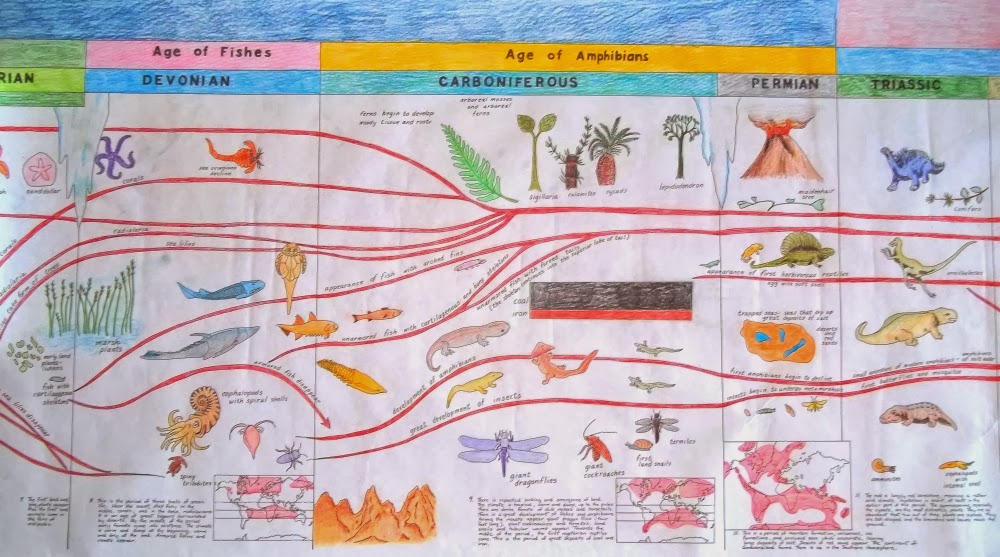 |
| Sample middle section of the AMI version of the Timeline of Life |
The Second Great Lesson tells the Story of the Coming of Life. Materials needed include 2 dinosaur charts and 1 Timeline of Life. The timeline begins with the earliest forms of life and ends with the coming of man (which is the next Great Lesson, so we don't dwell on it here). The key point to the story, whether you tell the Old Earth (evolutionary) version or adapt for a Young Earth or 6-Day Creation is this:
Life provides the balance.
This story opens up the Biology album. There is also a follow-up work on the Timeline: a mute version.
Goal: We hope for development of appreciation for ALL of life.
Neither the Control nor the Mute (also called Working) timelines should be entirely complete, leaving room for the children to add information through their own research - they should also not be presented in full detail, leaving details on the strips for the children to discover (they won't discover everything before they use the mute strip!). We hope that this work will entice some children to re-create the timeline for themselves and add in their own points of interest. Many children will do in-depth research on particular topics of interest; and some children will simply delve into the biology album.
With the mute strip, each "era" is stored in its own color-coded pouch or envelope; the corresponding contents have colored dots or other coding on the back to indicate where they belong. One idea I have seen that I love, is that the mute pieces could have a tidbit of information about the image on the front side - just enough to entice the child to go explore for more information (and if they are not enticed, then they still have just a little bit more knowledge than they had before).
With the mute strip, each "era" is stored in its own color-coded pouch or envelope; the corresponding contents have colored dots or other coding on the back to indicate where they belong. One idea I have seen that I love, is that the mute pieces could have a tidbit of information about the image on the front side - just enough to entice the child to go explore for more information (and if they are not enticed, then they still have just a little bit more knowledge than they had before).
In lower elementary, present the version that suits your situation or family accordingly. In upper elementary, introduce other versions, just as we introduce other Creation stories in upper elementary.
Old Earth:
- Azoka
- Albanesi
- Alison's
- Discovery Moments (is this website still available?)
- ETC Montessori
- Garden of Francis - download available
- Keys of the Universe - download available
- Montessori Services
- Moteaco (is this website still available?)
- Miss Barbara
- Nienhuis
Young Earth:
- there was one, but I'm not pulling it up now - it didn't really correspond with the lesson, but could provide some good inspiration. I'll add it later if I find it again.
- Keys of the Universe is slowly in process of creating a 6-day creation set of albums with corresponding materials to support such families.
To date the only downloadable and printable option that matches AMI albums is offered at Garden of Francis and Keys of the Universe. Both complete and in sections for printing on various sized paper.

Montessori Elementary - Writing Process
The children at any level follow the same process from beginning to end of their writing, but the depth will vary dependent on their ages and experience.
The language album does not specific an explicit writing process, but recently I had the opportunity to put together an outline for my son that indeed covers every situation and is perfectly in line with Montessori:
The language album does not specific an explicit writing process, but recently I had the opportunity to put together an outline for my son that indeed covers every situation and is perfectly in line with Montessori:
- get your ideas down on paper (wide variety of options - notecards, bubbles, lists, etc.)
- organize those ideas under main headings
- consider any other headings that should be included (look at "audience requirements") - edit as needed
- physically organize all these ideas in order, and begin writing on paper with complete sentences.
- Edit from there as needed.
Montessori Lower Elementary and Upper Elementary
The elementary Montessori materials center around sets of large impressionistic charts. These are the core material for the elementary age (where we had lots of trays for the primary child).
It is that time of year that people have been facing the reality of creating these Montessori impressionistic charts by hand or purchasing sets. And the options grow each year.
In reviewing many links lately to various Montessori Elementary Impressionistic charts, an overwhelming concern has arisen.
So many of the advertised impressionistic charts are divided by "lower elementary" and "upper elementary". I just looked at a site a few minutes ago (the one that is prompting this Montessori Nugget!) - that specifically states that the geography album chapters 1, 2, and 3 are lower elementary and chapters 4, 5, and 6 are upper elementary. I verified that their chapter headings correspond with the AMI albums (although this is an AMS site).
This is SO FAR from the truth! ALL SIX chapters are intended for BOTH ages! Not in entirety (each album page might cover 1-6 years of study alone, let alone an entire chapter).
Montessori albums are NOT curriculum guides. They are organized in the way they are for the ADULT to find what they need in order to present to the children according to their interests. You don't just move through the album from page 1 to the end in exact order, with no regard for the child in front of you....
The geography chapters in the AMI album:
Chapter I: Creation of the Earth/Idea of the Universe -
almost all of this chapter happens in lower; all should be repeated in upper, with extensions and final lessons
- God with No Hands
- Experiments with God with No Hands
- Notes on the Story
- Follow-Ups to the Story
- Composition of the Earth
- Further Details of the Composition of the Earth
- Formation of the Mountains
Chapter II: Nature of the Elements -
mostly lower elementary, but extensions/review into upper elementary
- Three States of Matter
- Further States of Matter
- Different Ways of Combining
- Separation, Saturation, Super-saturation
- Attraction and Gravity
Chapter III: The Sun and the Earth -
all of it at both ages in various depths of study
- Rotation of the Earth and Its Consequences
- Time Zone Chart
- Earth as a Sphere and Its Result
- Tilt of the Axis
- Seasons and the Two Tropics
- The Zones
- Zones’ Work Chart
- Protractor Chart
- Seasons Work Chart
- Protection of the Atmosphere and the Rains
Chapter IV: The Work of Air -
all of it at both ages in various depths of study
- Experiments Prelude to the Winds
- The Winds
- Land and Sea Breezes
- Changes in the Winds Caused by the Seasons
- Rains
- Work Chart of the Winds
- Ocean Currents Caused by Winds
- Wind as a Sculptor
Chapter V: The Work of Water -
all of it at both ages in various depths of study
- The River
- The Rains
- Ocean Waves
- Ice
- Water Cycle
- Spread of Vegetation
- People in Different Zones
Chapter VI: Human Geography
- Interdependence of Human Beings in Society (SPECIFICALLY noted as lower elementary)
- Economic Geography (early stages are lower elementary; later stages upper)
- Study of Natural Resources (this album page onward, typically upper elementary, but lower elementary for those interested - although the TOPICS can be introduced at the lower elementary level for each of the topics in the chapter)
- What is Produced and Where
- Study of Consumption
- Comparison of Production and Consumption
- Imports and Exports
- Volume of World Trade
- World Commerce
We could say that EACH CHAPTER covers the scope of SIX YEARS OF STUDY. Other studies are interspersed, chapters overlap within the one album, and the child has other personal studies of interest. Some topics just won't be touched in year 1, due to time constraints, but they COULD be done in year 1 if the child has interest. There is flexibility here - not a rigid set of "when" - we are not dictating which entire chapters are for a particular age. We have suggested ages, not dictated ages.
So let's NOT ignore the primary Montessori principle of "follow the child" when we are planning which lessons to give. Not a free-for-all following, but an honest exploration of interests and expansion of experiences to discover new interests.
Great Lessons - Materials
Within AMI (American Montessori Internationale), the following is a description of the materials for the 5 core Great Lessons to establish Cosmic Education in the elementary Montessori environment.
God with No Hands
- 4 impressionistic charts
- materials for 6 demonstrations
- NOTE: There used to be a 5th chart (solar system) which has been pulled to use at another time (a follow-up telling of the story)
- NOTE: There used to be far more demonstrations (experiments is a misnomer in this case) which were pulled out to use as follow-ups, thus allowing the story to focus on the core keys, with plenty left for re-tellings and review - going deeper and encouraging a return to the Great Lesson.
Coming of Life
- 2 impressionistic charts
- Timeline of Life (a mute version of the Timeline of Life is a follow-up work)
Coming of Human Beings
- No materials
- The focus is on the human connection itself - particularly on love; the children can look at their own arms and legs to see that they do not have specialized protection as animals do.
- Note: The two timelines called "First Timeline of Human Beings" and "Second Timeline of Human Beings" are follow-up work in the history album. They are not part of this Third Great Lesson.
Communication in Signs
- 8 impressionistic charts showing the changes of writing styles through time and civilizations

Numbers
- 8 impressionistic charts showing the changes of numbers through time and civilizations
For further Montessori Nuggets on the Great Lessons:
- General search for Great Lessons on Montessori Nuggets
- God With No Hands
- Coming of Life
- Coming of Human Beings
- Communication in Signs
- Numbers
First Great Lesson: God Who Has No Hands
God with No Hands is a slightly modified version of Mario Montessori’s publication in Communications in 1958, originally told by Maria Montessori.
The story is not meant to give just one idea of how creation came about; it is meant to contain some tidbits of factual information in a story format.

One important aspect to think about is the language of the story. The language should not be the same as used in day-to-day speech. The descriptive language should be more dramatic, a bit more extraordinary.
The tone of the story should arouse more than just the children’s interest but also his admiration and wonder if the idea of the universe has been presented properly to the children.
The story can be told in one’s own words and the guide must be comfortable with the version of the story told; the children are sensitive to hypocrisy. The guide must love the story that is told; make the story your own; much practice allows for comfort in the telling.
The story can be either told or read as the guide needs, but the tone needs to maintain enthusiasm and other aspects noted above. In the environment with children, throughout the following days, weeks, months and years, the guide can return to the story and recount specific sections, or fill in forgotten pieces.
Our goal? We hope the children begin to feel appreciation towards creation and the Creator.
General search for Great Lessons on Montessori Nuggets
God With No Hands
Coming of Life
Coming of Human Beings
Communication in Signs
Numbers
The story is not meant to give just one idea of how creation came about; it is meant to contain some tidbits of factual information in a story format.

One important aspect to think about is the language of the story. The language should not be the same as used in day-to-day speech. The descriptive language should be more dramatic, a bit more extraordinary.
The tone of the story should arouse more than just the children’s interest but also his admiration and wonder if the idea of the universe has been presented properly to the children.
The story can be told in one’s own words and the guide must be comfortable with the version of the story told; the children are sensitive to hypocrisy. The guide must love the story that is told; make the story your own; much practice allows for comfort in the telling.
The story can be either told or read as the guide needs, but the tone needs to maintain enthusiasm and other aspects noted above. In the environment with children, throughout the following days, weeks, months and years, the guide can return to the story and recount specific sections, or fill in forgotten pieces.
Our goal? We hope the children begin to feel appreciation towards creation and the Creator.
Montessori Snake Games
What are all those snake games in Montessori !? Children are playing with SNAKES!?
Haha - well maybe they are! ;)
What follows is how AMI organizes the snake games - I would love to hear how other albums/trainings name them or organize them:
 |
| when it says gray with red binding - don't use red ;) all the colors show up nicely on GRAY (even the gray!) not so much on red - too distracting |
Addition Snake Game
- first presented at the beginning of the addition memorization sequence, but then is to run concurrent with the addition strip board and memorization charts. The albums seem to make it look like it should be finished before starting those other works; nope - concurrent ;) Hm. Perhaps AMI albums could be more clear in stating this concurrency; that the snake game should be introduced but not completed. I'll go have a talk with myself on that one ;)
- Materials: 3 boxes - One red box/lid with five colored bead stairs of 1-9 (total of 45 bead bars); one gold box/lid of 25 ten-bars; one white box ( black lid) with the black and white bead stair (beads 1-5 on each bar are black, 6-9 white); tray for the three boxes; small notched card (bridge) with its own container; piece of gray felt with red binding (32x18 inches)
Subtraction Snake Game
- first presented at the beginning of the subtraction memorization sequence, then runs concurrent with the subtraction strip board and memorization charts. The addition snake game should be mostly mastered before starting subtraction, but this can vary on the child.
- Materials: 4 boxes - One green box/lid of five colored bead stairs; one gold box of 25 ten-bars; one gray box with the gray bead stair (beads 1-5 on each bar are light gray, 6-9 dark gray); one black and white box with the black and white bead stair (beads 1-5 on each bar are black, 6-9 white); tray for the four boxes; small notched card (bridge) with its own container; piece of gray felt with green binding (32x18 inches)
- NOTE: If you are doing all one set and pulling just the boxes you need; the red box in addition IS the green box in subtraction (red for addition, green for subtraction). Use felt for this portion - or don't worry about it. The children in a homeschool setting don't need the cue as much as children in a school setting where they have a separate addition snake game from the subtraction snake game. OR if you have bought this set and have a white box with red lid for the red/white bead stair - you could use that for addition, then swap the colored bars to the green box for subtraction; since that red/white won't be used again until you are doing the full set-up, at which point the colored bead bars are in the green box anyway ;)
Elementary Negative Snake Game
- typically an early upper elementary work, but with interest or gifted children can certainly be done in lower elementary. Pre-requisites listed are "Knowledge of addition and subtraction facts; preparatory work with the ideas of negative numbers; addition and subtraction snake games in the primary class." Later notes in the album pages say "usually age 8". Thus interest or local educational standards are the driving forces here.
- Materials: 6 boxes - colored bead bars, gray/white bead bars, golden ten bars, black/white bead stair, 25 gray ten bars, 1 red/white stair
Some albums seem to list a middle-ground negative snake game; it is even mentioned in the elementary AMI math album because some children will come in with experience with it; but it is not found in the AMI albums. From what I can tell (please provide information in the comments if you know about this one!) it seems to be the Subtraction Snake Game with Negative Snake Game terminology added in. ???
The main difference: with the "real" Negative Snake Game, you can actually GET negative answers because you have the bead bars to do so.
The main difference: with the "real" Negative Snake Game, you can actually GET negative answers because you have the bead bars to do so.
And some people just call the Subtraction Snake Game a Negative Snake Game. It does the same thing, just is visually different, and doesn't get into the terminology of negatives.
UPDATE 3/1/2014: For a second Montessori Nugget on Snake Games - including a note on the Multiplication Snake Game, please visit this Montessori Nugget.
UPDATE 1/22/2016: Adding the following somewhat more detailed pictures:
 |
| All boxes for the Elementary Negative Snake Game for 4-5 year old children, remove the unneeded ones |
 |
| Addition Snake Game needs 3 boxes (contents listed above) |
 |
| Subtraction Snake Game - same as the addition adding the gray bars of 1-9 - 5 sets |
 |
| Elementary Negative Snake Game - now we go to negative numbers and need the red/white negative place holders and gray negative 10-bars. |
 |
| All boxes, opened, to show the tops with the bottoms (if you choose to go with bottoms in a homemade set) If using tacklebox storage - good to have a felt bottom with the sides lined with the "lid color" |
Periodic Table of Elements
"When do we introduce the Periodic Table of Elements? Why is not showing up anywhere in the AMI (primary and elementary) albums?"
There are a few reasons, and a few ways to approach this topic.
If your child is interested in this topic, by all means, go for it! Interest over-rides any "universal child" observation.
But it's not there for everyone, because it's not a key. The periodic table of elements is actually the end-result of a process. A process that the child needs to go through as well in order to fully appreciate it and learn the most from it.
It becomes a key later - in adolescence! After they have experienced it!
How to approach the periodic table of elements - all of these are found in the primary and elementary albums:
- Primary and Lower elementary: sorting objects by observable characteristics (color, shape, size, sinking/floating); explore the states of matter; explore magnetism; describe the characteristics of various objects; measure and compare using a variety of tools; explore substances vs. solutions
- Upper elementary: continue looking at characteristics that are less obvious; consider volumes of solids; magnetic fields; affects on non-magnetic objects; which objects are good/poor conductors of electricity (electricity is not explicit in the elementary albums, but is something to be explored at the time a child expresses interest; and it *should* come up as the child explore each key further); in the final couple of tellings of the Story of God With No Hands, highlight those particles - those basic substances that make up all of creation. You can have resources in the room that share information about the elements; but try to avoid the "official chart" for now if at all possible.
- Adolescence: Now we start to look at chemical properties, if the child hasn't gone there already; start sorting various substances by their chemical properties; build atoms and molecules; use the term 'elements'; pull out a set of cards that has information on the elements for sorting purposes. Don't show the periodic table until the child has created a few different organizations of it himself (based on magnetism; based on atomic weight; based on other characteristics of the child's choosing) - what are the patterns? What are the similarities and differences? Then pull out the chart itself; but also pull out (or pull up online) samples of other methods of organizing the elements - there are MANY! And they are BEAUTIFUL!
When an elementary child has an interest in this area of study, just pull out those cards and go from there.

Montessori Meets Standards
I wrote the following as part of an upcoming post at Keys of the Universe - Articles on the aligning of Montessori and Common Core, but I thought it was a point to make all on its own:
Non-Montessori curricula are all different, presenting concepts at different times, in different ways; and teachers in regular classrooms routinely do not finish any given text in any given year. Hence, no curriculum or classroom experience can actually meet every standard, especially for every child.
Interestingly enough, Montessori strives to go above and beyond - to ensure that every child exiting the elementary experience at the end of either 3rd or 6th grades, has indeed met every requirement on the local educational standards. Very interesting, given how much flack Montessori takes for simply following the child and not providing "enough."
I understand every school is different, I am thinking here of AMI schools that truly follow the child, which ends up meaning following their albums and providing for the child's interests and learning opportunities at every turn.
What Does Montessori Elementary Look Like?
Here is a nice straight-forward article about what elementary Montessori looks like:
Montessori Elementary is Different: What Children Study, What Children Do
Project-Based Learning
Montessori IS the original project-based learning.
It's a bit bigger than that, but the idea is that the project-based learning people got the idea from Montessori, directly or indirectly, and repackaged it in a way more palatable to non-Montessori adults.
Google search for "project based learning and Montessori" for more information :)
My personal opinion is that "project-based learning" is the non-Montessori phrase for a portion of "cosmic education". ;)
The concept of project-based learning applies most especially for elementary children. If the children in the environment are NOT creating projects, presentations, additional materials, doing more research, writing out questions and answering them, consider making some modifications to make your environment MORE Montessori. What is missing?
What tools do the children need to do their research and present their findings that are not yet present in your environment?
Do they have the art-related tools?
Do they have a few books and videos or similar to inspire their creativity, their imagination, their wonder - but not so many as to be exhaustive?
Are you able to get to the library on a routine basis?
Do you have opportunities and the structure for Goings Out? (in the homeschool, this is simply the time to get out and visit related places of interest).
Most importantly, how are the words and nuances the adult puts into place? If the adult is encouraging thoughtful insight, and providing the right balance of guidance and honesty (the adults do NOT have all the answers - and shouldn't), interest-exploration will happen.
ONE project sample:
 |
takes many children down the path of historical (and healthier!) food-making such as yogurt and real sour-dough, among many others. (inspiration: fundamental needs of man; 2 timelines of humans) |
The study had been rabbit trails; but each step of the way reached a logical conclusion, some of which were used for jumping points into new, related projects, that sometimes wound back around to previous ones that then needed some updating.
Cosmic Education: Language and Geography
The cosmic education of elementary Montessori does not allow us to study just one subject in isolation.
The geography album encompasses "earth sciences" - geology, physics, and the like. Some very few children do not simply jump at the opportunity to repeat the demonstrations they are allowed to do (the volcano being the one almost all children want to do!) following presentations from the geography album. The reasons may be varied: adult level of trust (children sense it even if the adult appears to be trusting of the child's abilities), lack of space, environmental expectations just aren't there, adult enthusiasm, materials not readily available, adult hasn't explicitly stated "Would you like to do this?"
By simply using the language album, and following it accordingly, the children working with the grammar box materials are introduced to simple experiments. By following these commands which correspond with the grammar boxes and filler boxes, the child will strain then filter starch-water and sugar-water, after mixing up solutions and discovering the terms "in suspension", then letting it all settle out (or does it all settle out ;) ).
Thus the reluctant-in-science child who is more of a language-child has now experienced some of the science experiment processes. Now those geography presentations present something to the child that he CAN DO. And he is much more likely to DO them. Or at least be open to the idea. ;)
 |
| Straining starch-water and sugar-water |
 |
| comparing pure cocoa with cocoa-sugar |
 |
| creating an emulsion |
Grammar Boxes - Question from a child
An older child (age 8) is working with a set of grammar box material, organizing it and checking it for accuracy; preparing to make sure there are sufficient materials to perform all the commands or otherwise fulfill each sentence - in preparation for a group of younger children coming in.
He asks, "Mama, why are these so simple???? The reading is simple, the tasks are simple. They are kind of fun, but why so simple!? This work could not be appropriate for someone my age." (use a dramatic 8-year-old voice for the italics)
"Remember that this work is intended for incoming elementary children - 6 years old. Or children just learning to read."
"Oh! So they should all be done by the time they are my age." (statement, not a question)
"Yes."
He then later articulated what was being taught with the material and is putting together his own "extra challenge" version of the work at a higher reading level. "Just for fun," he says.
These activities are interesting, but definitely move away from an older child's needs in regards to movable pieces, vocabulary development and complexity of the activities. Older children who still need it can zip through this work, then develop their own extensions. They simply won't stay with it the way a 6 year old would.
He asks, "Mama, why are these so simple???? The reading is simple, the tasks are simple. They are kind of fun, but why so simple!? This work could not be appropriate for someone my age." (use a dramatic 8-year-old voice for the italics)
"Remember that this work is intended for incoming elementary children - 6 years old. Or children just learning to read."
"Oh! So they should all be done by the time they are my age." (statement, not a question)
"Yes."
He then later articulated what was being taught with the material and is putting together his own "extra challenge" version of the work at a higher reading level. "Just for fun," he says.
- synonyms
- parts of speech
- expansion of vocabulary
- spelling notes
- definitions
- experiments
- interacting with people
- interacting with objects
- rules (and permission to break some at appropriate moments)
Wow.
 |
| sample verb commands - separate from the filler boxes themselves |
These activities are interesting, but definitely move away from an older child's needs in regards to movable pieces, vocabulary development and complexity of the activities. Older children who still need it can zip through this work, then develop their own extensions. They simply won't stay with it the way a 6 year old would.
A Study - Outcomes of Montessori Fidelity
I recently had a chance to read this article:
Preschool children's development in classic Montessori, supplemented Montessori, and conventional programs
Angeline S. Lillard
Department of Psychology, University of Virginia, Charlottesville VA 22904-4400, USA
http://faculty.virginia.edu/ASLillard/PDFs/Lillard%20(2012).pdf
I put forth a particular paragraph that stands out for me:
It really says a lot about the Montessori Method - and the article goes on with more!
Theoretically, using Montessori materials would seem to exercise many aspects of executive function. For example, one of the first Montessori materials with which a child is presented is the Pink Tower, a set of 10 wooden pink blocks ranging in size from a 1-cm cube to a 10-cm cube, with each cube 1-cm larger on each face than the previous one. In using this material, the children's task is to carry the cubes one by one from a display to a rug that they have previously rolled out on the floor, then rebuild the tower. To do this task entails planning. Second, each time a child chooses a block, she or he must do so with reference to its relation to all the other blocks: Is there another one in between the size of this one and the last one placed on the tower? This step requires working memory. Third, the child must inhibit the prepotent tendency to grab the closest block, and fourth, the child must pay strict attention to how he or she places each block on the one below it, creating a symmetrical tower. After building the tower, the child takes it down, returns the blocks to their stand by the shelves (in the proper order), and then tightly rolls up the rug and returns it to its place. This step requires flexibility and task switching. Consider the difference between this and engaging with ordinary blocks. With ordinary blocks, one can do anything, without necessarily having any set plan, and one does not have to think about the blocks in relationship to each other. A preschool might not have a requirement that children put items away right after use (instead, there often is a single clean-up time right before going home), and there may well be no set way to arrange blocks when returning them to their place (often, they get put haphazardly into a large basket or box). The executive function demands are much reduced, and this difference in executive function demands applies across many other activities as well.
Timeline of Civilizations
There is a Timeline of Civilizations that is so simple yet so striking for the elementary children - usually upper elementary, although many 8 year olds begin to work with it as well.
This Timeline of Civilizations is not available for sale at any of the Montessori companies (please do post a comment if you know somewhere that does sell it!). Perhaps there is a non-Montessori version that is simplistic and essential and to the point!
It takes all of recorded human history and marks down all of the civilizations onto one long piece of paper, spanning 6000 BC to the year 2000 AD. It can easily be extended to the current day.
How striking to have all of human history, all those great and small civilizations - all of us, right through to today and present-day civilizations - all of us on one piece of paper.
Perhaps even a bit more humbling and gratifying than the red line we have used in the early presentations and continue to use in the Black Strip and the Hand Timeline. Now we see the details - we see that all fits within that red strip.
This material is not meant to stir up a whole slew of new work, but like the Black Strip to be something of a consolidation for the older children, bring together previous details, before delving into new ones. These upper elementary are less apt to request repetition, but still need it - and this material fills that need.

Additional Images of the Full Timeline:


This Timeline of Civilizations is not available for sale at any of the Montessori companies (please do post a comment if you know somewhere that does sell it!). Perhaps there is a non-Montessori version that is simplistic and essential and to the point!
It takes all of recorded human history and marks down all of the civilizations onto one long piece of paper, spanning 6000 BC to the year 2000 AD. It can easily be extended to the current day.
How striking to have all of human history, all those great and small civilizations - all of us, right through to today and present-day civilizations - all of us on one piece of paper.
Perhaps even a bit more humbling and gratifying than the red line we have used in the early presentations and continue to use in the Black Strip and the Hand Timeline. Now we see the details - we see that all fits within that red strip.
This material is not meant to stir up a whole slew of new work, but like the Black Strip to be something of a consolidation for the older children, bring together previous details, before delving into new ones. These upper elementary are less apt to request repetition, but still need it - and this material fills that need.
Additional Images of the Full Timeline:


Follow the Child
A topic that deserves attention again and again as we journey with the child through life.
What does it mean to follow the child?
Those who do not fully understand Montessori or who are just being introduced to it, think that it means that we only do what the child wants to do. That if he wants to explore what happens when he climbs onto the roof and jumps off, that is what we do.
And if a child never wants to touch a lick of math, we don't do any math at all.
But that's not it.
We follow the child - not willy-nilly - but according to his actual inner needs. We then provide the keys of the fulfillment of those needs.
Every human being has the same needs and tendencies, but personalities and circumstances will shape how those needs are expressed.
Within the Montessori environments, particular to each plane of development, we provide various keys. We also provide the children with freedom and responsibility - freedom to make choices within an environment we have set for them; along with responsibility to make a choice (or lose the freedom to make a choice and have to be told what to do - something that yes we do in Montessori when absolutely necessary to the development of normalization within the child). Freedom to work as long as he likes and with as big of a work as he likes - with the responsibility to maintain the freedom of others in the environment.
"My freedom ends where your freedom begins."
We adults set the environment in such a way that the child chooses between various good things; if and when a choice for something deviant (start of bad habits, disrespect, and the like), we immediately step in. Following the child does not mean we follow the child down a path towards poor choices. We follow the child so that we see potential stumbling blocks and provide the child the keys to overcoming them. In some cases, that is physically moving the child; in some cases, that is immediately cutting in to what is happening with an instruction put the material away appropriately and come for a new presentation - immediately; in some cases, that is a conversation with the child at an age appropriate level; in some cases, that is changing up the environment so that the child gains success and self-control.
Sometimes, it is simply stopping all presentations and just loving the child.
When we follow the child, the child reveals so much to us - the wonder of the world around us, new connections we didn't see before or have forgotten from our childhood's. Every time we work with a child in humility and respect, we become a better person - a better parent, a better teacher. Better - greater than we were before. And more humble.
So, our responses are varied. But our goal remains constant: to provide the keys towards the fullest possible spiritual development of the child in our care. We follow the child to serve as a guide - and so the child can be our guide as well.
Subscribe to:
Posts (Atom)