Montessori Albums - Curriculum and Discovery


We do not use the albums as a curriculum but only as a guide. We want the child to discover all that we don’t show him. This discovery versus direct teaching allows the children to be truly inspired – the doors are opened for them and they make the discoveries on their own so that the learning becomes truly theirs and they are enticed and inspired to further exploration.


Montessori believed that too much regulation can lead to rebellion, while too much freedom can lead to chaos. It is important to balance the two.[1]   “The first thing her education demands is the provision of an environment in which he can develop the powers given her by nature. This does not mean just to amuse her and let her do as she likes. But it does mean that we have to adjust our minds to doing a work of collaboration with nature, to being obedient to one of her laws, the law which decrees that development comes from environmental experience.”[2]


[1] Dr. Montessori, Maria. (1949).  The Absorbent Mind, Kalakshetra Publications, 12th Edition
[2] Dr. Montessori, Maria. (1949).  The Absorbent Mind, p94, Kalakshetra Publications, 12th Edition

Montessori Changes with Age


Montessori at preschool/kindergarten is NOT the same as Montessori at elementary or Montessori at adolescence.


But it is the same.

Same:

  • Respect for the development of the child in that moment.
  • Provide keys; time/material to explore interests.
  • Development of child's innate human capabilities through human needs and tendencies.

Different:

  • Primary (preschool/kindergarten) is keys to the WORLD; elementary is keys to the UNIVERSE; adolescence is keys to ONESELF and one's place in the cosmic plan.
  • Primary we have movement and words separate - in elementary and adolescence we can give words with the actions.
  • Primary (and infant/toddler) is the absorbent mind; elementary is the reasoning mind.
  • Primary gets some work already prepared for them on trays or on a shelf; elementary, they collect the items they need from their natural locations or supply shelves (planning through what they need so they don't have to stop their work and get another item).
  • Adolescence we are giving them the keys they need to live an adult life. They are not adults yet, but we start practicing those skills, so they don't entirely flounder later. Indeed we set them up for success.

Montessori Work - What is it? Is it trays?

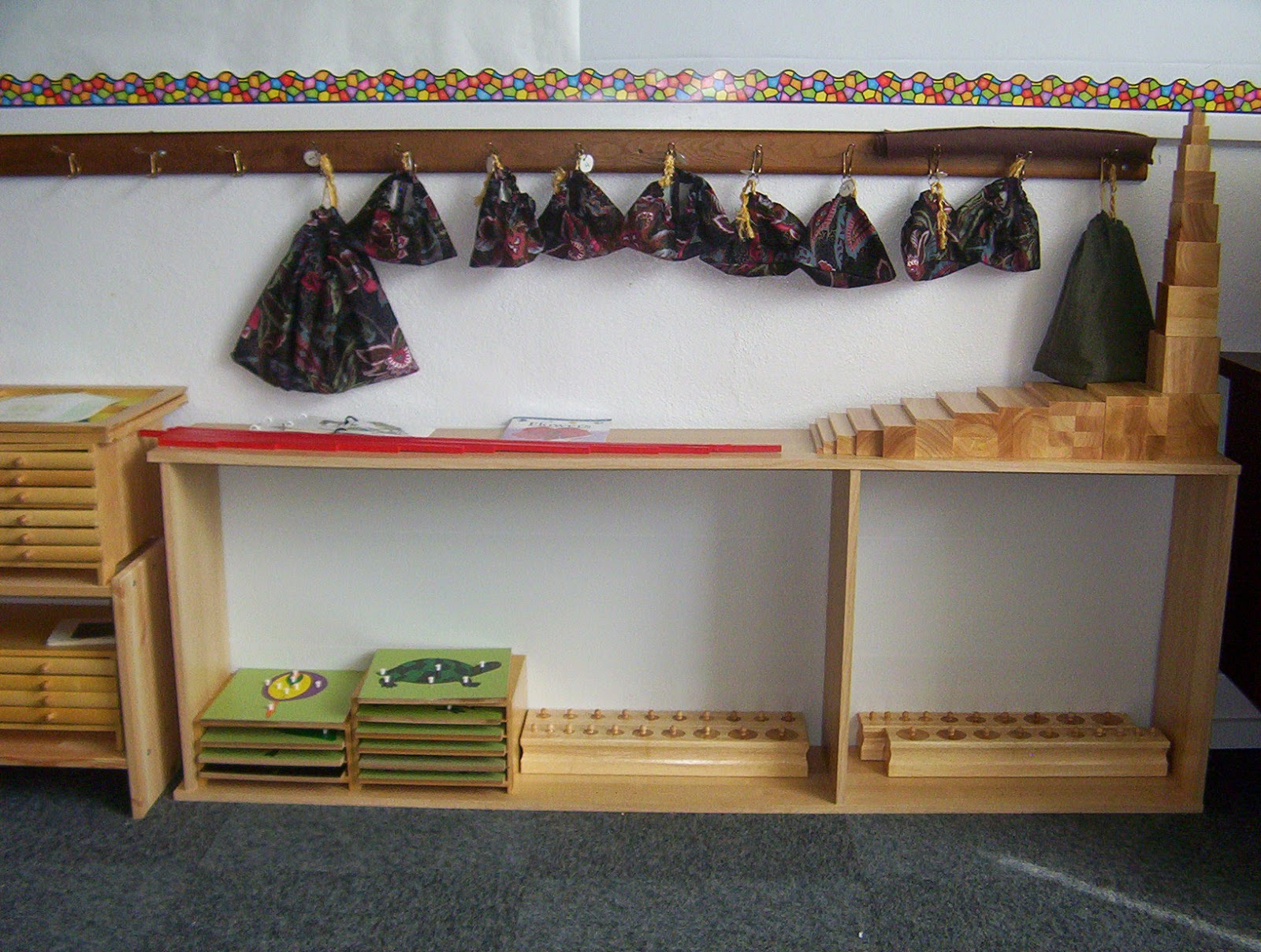
Montessori is not "on a tray".

There are SOME activities organized into a tray for the children's use; these tend to be for the very new and the very young.

They progress away from this set-up very quickly in primary; in elementary, they use empty trays to go collect all the items they need to bring back to their work space.

Even in primary, the children will need to go elsewhere in the environment to collect items to finish their work set-up (items to be polished, for example, should not be placed next to the polishing trays - the children should be polishing items from all around the environment).

THIS WORK IS ON A TRAY. 

THIS WORK IS NOT ON A TRAY! 


Neither is this on a tray: 
 Or anything around it:

None of this stuff is on a tray:
this was before I added more horizontal shelves....
even then, there was one tray, organizing some language stuff -
a basket really. It stayed on the shelf and the children took the cards they wanted. 
 No trays here:

There is a writing tray on the one desk there: aha! A TRAY!!!

MORE TRAYS! Can you spot them? They are in the back corner, so the elementary children can collect their supplies and bring them to their work area.

We do have mats.... lots of those!
Maybe Montessori is Mats.


2 trays: one with the number bead bars 1-9; the other is used for transporting golden bead materials from another shelf to the.... MAT.


NO trays! For all that math!


Wow. So few trays (most are in practical life, unpictured here, not sure where the pictures went). And this is actually a genuine Montessori environment. With so few trays?
Oh yeah! Montessori is MATS. (that is said tongue-in-cheek - Montessori is actually not mats either).


Montessori Nomenclature Cards - what are they FOR!?

Nomenclature is always REVIEW of the concept in elementary, with invitation to create one's own booklet or chart, to make the work one's own, with one's own definitions of the terms.

Nomenclature is always READING PRACTICE on FAMILIAR CONCEPTS in primary. We give vocabulary with the picture-only cards after they have had real experience with the items represented in the pictures. Then we add the words as they are learning to read, to give them familiar items to match up with the sounds they are learning (these sounds they should already be writing - remember, the child should write before reading); then we add the definitions as they become stronger readers, to give them more for reading practice on definitions they already know.

To back up a step, we are reading those definitions (via the booklets) or at least describing the terms in their context of real life experience. When the children start reading, they find familiarity in the definitions with what they already know.

Nomenclature cards are not teaching tools. They are review of concepts and reading/vocabulary practice.

Thus the child can move into whole reading rather quickly, because of a foundation of a variety of real life experiences, with sound vocabulary and other rich spoken language experiences provided from the beginning of his life, exploring the sounds of his language with the sound games and all the sandpaper letters, then the movable alphabet; freed from the tedium of step-by-step systems, he has the keys to explore his own language, other languages, and indeed the whole world around him.

Maria Montessori called the sensorial materials "keys of the world" - indeed all that observed and tested in all areas of the infant, toddler and primary (3-6, preschool and kindergarten), are keys of the world.

Montessori Without Materials !?

You can certainly do "Authentic" Montessori at home without the materials. How is that possible? Because pure Montessori is about the following concepts: 

  • *beauty, simplicity, order
  • *follow the child (the child's interests, abilities, needs)
  • *OBSERVE - and RESPOND appropriately according to the plane of development and individual needs/interests
  • *provide KEY experiences - not overwhelming with too much information, or 10 materials to teach the same concept; or even 1 material that is so busy it doesn't allow for focus
  • *routine and beauty/simplicity/order that allows for developing long periods of concentration
  • *movement integrated with learning, balanced with moments of stillness and silence. 

Not a single specifically Montessori material mentioned ;) 


and for those who do use the specifically designed Montessori materials that do provide the Keys to the World and the Keys to the Universe? They phase out, until there are almost no such materials in upper elementary. 


Montessori Albums - Curriculum - Lesson Plans


Montessori albums tell you how to present the materials, how to use the materials, provide guidance on typical best times to present that work option to your child. Your child's abilities and interest dictate the pace.

These provide the curriculum (scope and sequence), the lesson plans (how to present/use the materials), suggested ages and experience ranges.

Authentically Montessori albums should NOT provide daily lesson plans (what to present on each day - your child and you decide this based on the child's interests and abilities). They should not dictate all the follow-ups your child does. Album pages (the lesson plans that tell you how to use the materials) provide some games and extensions that are good for most/all children; and some that are suggested for most/some children. Some follow-ups the children will discover on their own, if we guide them that direction, preparing the environment and our words to encourage their own self-discovery.

Montessori Curriculum

Curriculum is the sum of the child's experiences in a particular educational setting.
Montessori is an education as an for life itself.

The Montessori curriculum is found in a blend of the Montessori albums (lesson plans are the album pages) and the needs of the particular child before. The Montessori approach provides the keys for the universal child and time/resources to follow the interests and needs of the very unique individual child before you.

For more information on the key aspects of an authentic Montessori experience, pick up a Keys of the World or Keys of the Universe primary or elementary theory album.

Why Montessori is NOT Daily Lesson Plans


Some people really want Montessori daily lesson plans. This is a contradiction of terms.


Short story: 
Montessori - Follows the Child.
Daily Lesson Plans - Don't.

Montessori albums tell you how to present the materials, how to use the materials, provide guidance on typical best times to present that work option to your child. Your child's abilities and interest dictate the pace.


Some random details/thoughts: 
There is NO curriculum publisher, NO Montessorian, NO traditional public school teacher, NOBODY can predict, pre-determine a child's interests from day to day, months or years (or even HOURS!) ahead of time.

But what is "interest"? Referring to a child before the age of 6, we are referring to sensitive periods and a lighthouse-like feature of the child's mind that can absorb deep facts and experiences when the light is shining on that particular area, while everything else is entirely ignored. Then the child's focus shifts, some things seem to be "forgotten" for a time (they are generally picked back up very quickly afterwards), and a new focus is centered on.

Referring to an elementary child, "interest" refers to the child's research, projects, and work choices, both in academics and personal life.

In both cases, we present a relatively consistent flow of new and deeper experiences, while honoring the child's need for time - time to just BE, time to explore, time to make discoveries and connections of one's own.

These interests cannot be pre-planned in any particular order. Within a particular subject, a child may jump to chapter 4 of the geography album in elementary without doing all of chapters 1, 2, or 3. Why? Because outside of the very earliest presentations, the chapters are there for the adult's organization - NOT the child's curriculum. Follow the child's interests so that we can provide a rich experience when the child is entirely prepped to do so; so we might do work of air before work of water; or vice versa. There may be "early" activities in each of the chapters for the younger children, to provide the framework and basic of the key experiences, so that the child is exposed to an array of interest-options.


Now, some people say that those lessons, those keys we give to continue their experiences, can be pre-planned. But no, they really can't either. At least on a daily or even a weekly basis. A child may move through a few presentations quickly, then need time to delve into particular ones without receiving a new presentation in that area for a short time, because interest has been centered, and the creative juices are flowing.

Thus albums are divided up by "subject" - not daily, not weekly. But some albums do have charts to show the options for possible paths, leaving leeway for each individual learner.


Montessori, using daily lesson plans, outlined by someone who does not personally know the child before you; it is hard to call that Montessori because of the number of Montessori principles that type of practice entirely ignores, the most important of which is: Follow the Child.



Albums and Environment

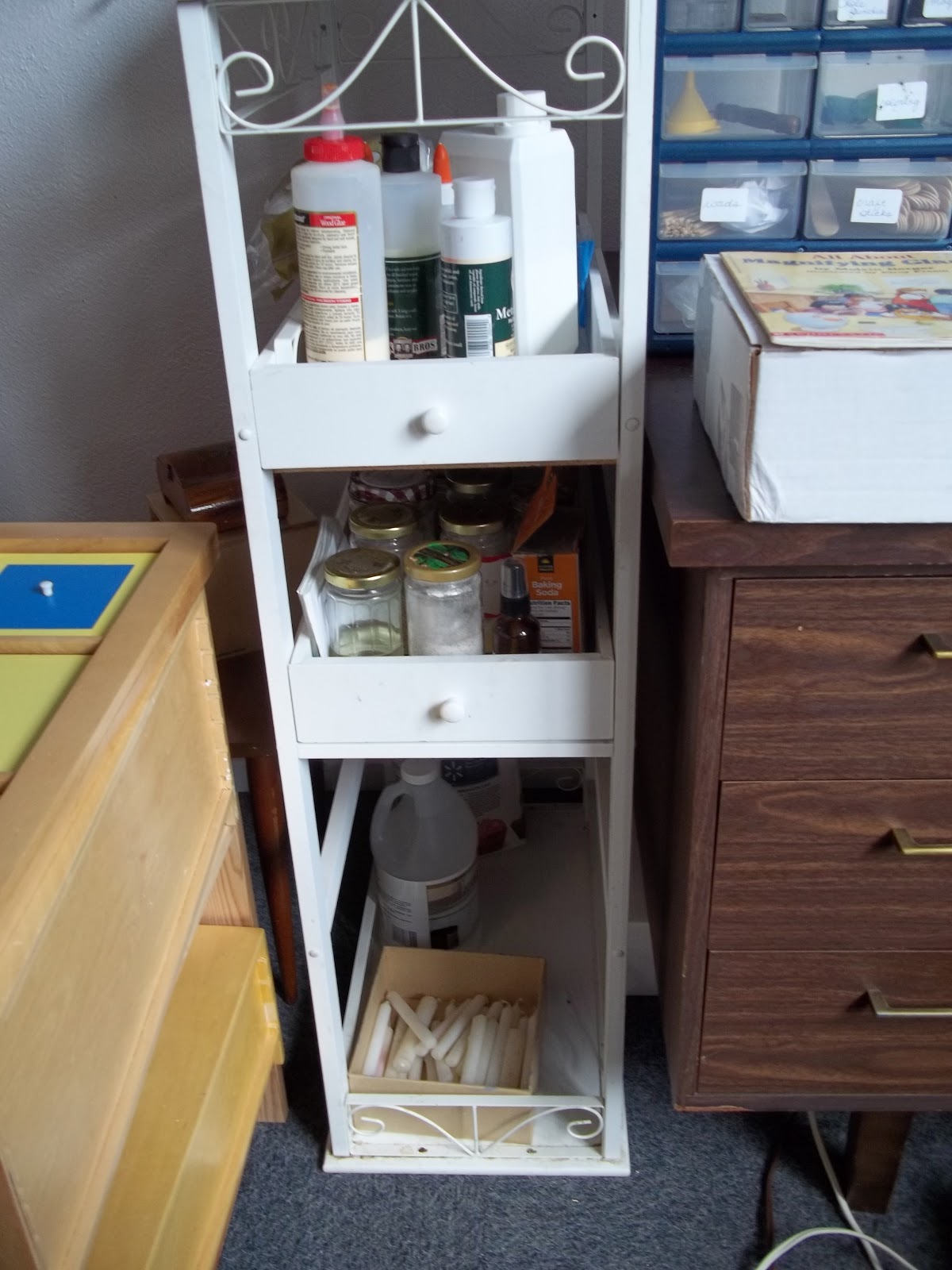
Montessori Albums are the Montessori environment in written form. 

We actually begin with the environment, and the album stems from it.

The environment should be organized according to the album, not because the album comes first, but because the album should be based on the ideal environment already.


Spelling in Montessori - Follow-Up

Another key point to add to the previous Nuggets on Spelling (click on the tag below this post to see the others):

When elementary children are delving into the origins of language, root words, etymology - those things without official album page presentations but that are listed as "work of the child" - they will come to find patterns in our language in a more interesting and enriching way to than memorizing the rules and ALL the exceptions. (yes some of those need to be learned too)

Ever notice that national spelling bee participants always ask for the etymology (among other context clues) ? Yep. They are on to something!

;)


Spelling Contents in AMI Albums


From the Tables of Contents in Primary Montessori Language and Elementary Montessori Language:

First things first: exposure to the key 40-44 sounds in your dialect (presuming English language - numbers differ in each language). This is done through a keys-based experience with the presentation in the spoken language, writing, and phonetic reading portions of the language albums.


PRIMARY ALBUM: 


Phonogram Cards

Phonogram Alphabet Exploration

Phonogram Commands

Research

Spelling

Dictionary

Personal Dictionary


Reading: Puzzle Words

Puzzle Words (primarily reading, but helps with writing too)


Reading: Function of Words

All word lists can become dictation games. 


Word Study

All Word Study lists can become dictation games. 


ELEMENTARY ALBUM


Chapter II: Grammar and Syntax

           All Word Study provides dictation exercises. 

                        Introduction to Word Study

                                    Suffixes

                                    Prefixes

                                    Compound Words

                                    Word Families

                                    Synonyms

                        Parts of Speech

                                   Each grammar box provides some spelling rules
                                      on one level or another. 


                                    Introduction to the Noun

                                    Oral Presentation of the Noun

                                    Grammar Box II: The Article

                                    Definite and Indefinite Articles

                                    Noun: Number

                                    Noun: Gender

                                    Classification of Nouns:

                                                Common and Proper

                                                Concrete and Abstract

                                                Material and Collective

                                                Classification of Abstract Nouns

                                                Classification Chart

                                    Grammar Box III: The Adjective

                                                Adjective Command Cards & Classification

                                                Comparison of Adjectives

                                    Introduction to the Verb

                                    Grammar Box IV: The Verb

                                                Verb Commands and Synonyms

                                    Other Grammar Boxes & Commands Cards - Notes

                                    Grammar Box V: The Preposition

                                    Grammar Box VI: The Adverb

                                    Grammar Box VII: The Pronoun

                                    Grammar Box VIII: The Conjunction

                                    Grammar Box IX: The Interjection

                                                Additional Grammar Symbols

                                    Personal Pronouns

                        Introduction to the Tenses of the Verb
                                practice in changing the endings with the verb tense

                                    Simple Tense: Present

                                    Simple Tense: Past

                                    Auxiliary Verbs

                                    Simple Tense: Future

                                    The Perfect Tenses

                                    The Infinitive and Moods

                                    Negative Form of the Verb


Chapter III: Written Language

            Written Language Part I & II

            The Content of Children’s Work

          Be checking for spelling issues here; develop the child's dictionary with words and needed rules from here. 


Appendix: Vendolia’s Rules for Writers

Appendix: Singular/Plural Chart


The Montessori Phonetic Approach


From the Introduction to the Language Primary Montessori Album:

We provide the keys to reading, writing and spelling and the children learn spontaneously and joyfully. While we use a phonetic approach, we do not use it in a traditional manner – we use 42 sounds where a traditional phonetics approach uses 150 or more.

So yes, Montessori uses a phonetic approach to reading, writing, and spelling - but that is a huge difference between 150 and 42! Those long series of graded readers? Simply not necessary. Children go from little/no reading to 2nd grade reading level in no time, and within weeks are 5th grade and higher. If they are not, then a crucial key was missed (or too many unnecessaries were thrown in). Or there is another influence within the child (a particular developmental need that should be met another way).


Spelling in AMI albums


When looking for spelling practice in the AMI albums, look for the following concepts:

  • phonograms (booklets, cards)
  • the word "dictation" in any follow-ups or extensions (think anything with a word list, including the phonogram cards and word study)
  • (or turn any/all word lists into dictation games)
  • function of words 
  • word study
  • let the children come up with words on their own - dictate to each other
  • note typically mis-spelled words in their writing - cover those needed rules through games or direct instruction

Doesn't feel like much, but it is powerful.

The adults are responsible for ensuring all the areas have been introduced and are being utilized.


Snake Games, Part 2


There are only THREE snake games:
As started in first post, when it says gray with red binding,
actually DO that. Everything shows up nicely on GRAY. 

  1. Addition Snake Game
  2. Subtraction Snake Game
  3. Negative Snake Game


(for the first Montessori Nugget on snake games, visit this Montessori Nugget from last June)

Addition and Subtraction are done in primary or very early elementary (can be continued through lower elementary as practice is needed).

Negative Snake Game is an elementary material when we are preparing the children to work with truly negative numbers (in a way, subtraction is already "adding a negative" but with the negative snake game, we can actually get an answer below zero).

Each Snake Game has verification steps.

The verification step 2 of the addition snake game has the child grouping his original snake by lengths of bead bars and multiplying each group to see if his golden snake matches. (details are in the album)

Presumably, you can do that work with all of the snake games in the appropriate places.

Some people are calling this a separate snake game: Multiplication Snake Game. It's not a different snake game. It's a verification method on the addition (and again, presumably the other snake games).


:)


Elementary Geography: Human Geography


There is a chapter WAAAAAY way at the end of the Elementary Montessori Geography album (AMI - I'm not sure where it is in other elementary options)

Oh, those chapters at the ENDs of the albums are sly little creatures ;) Because they almost always have something for the youngest elementary children that builds into the later more complex work for the older elementary children - and yet, we don't get to them, because, well, they're at the end of the album, and shouldn't that be for the older children?

Interesting thing - all those math skills that are allegedly missing from the albums? Many of them are found right HERE in this section! Reading maps, using graphs in various forms, some introduction to statistics.... Yep. All here ;)


There are two sections with Human Geography
1) Interdependence of Human Beings in Society
       This one could potentially begin in primary, but officially could start with the Fundamental Needs of Man and stem from there. We talk about the people in the process of making things (whereas so many other resources focus on the process of making things, but less on the people themselves). Books, videos, card material (available for purchasable download or can be teacher-designed) - the materials are simplistic enough, thus this whole area is SO easily overlooked!

NOTE! This is NOT the interdependencies from the Biology Album ecology chapter! (which should also be introduced earlier rather than later - another "back of the album - early work" chapter ;) )

2) Economic Geography
      This area include the study of natural resource, study of consumption, comparison of production and consumption, imports and exports, volume of world trade, world commerce.
Materials needed: study resources, possibly the internet, and the economic geography stamps (the linked ones correlate with the AMI albums)


From the Introduction to Human Geography: 

Here with the interdependencies is a prime place to emphasize that Montessori is not so much a method of education only – but a way of looking at life and interacting with it.

Many of the following activities seem very, very simple – and they can be easily overlooked. I urge you: DO NOT MAKE THIS MISTAKE.

Emphasize the connections between all humans – past, present and future. All those who came before us left us many gifts (and us adults will add “and many problems”). By focusing on these gifts, and passing them on, along with new gifts that have their foundation on the past gifts, we will pass fewer problems along to future generations.

Gratitude.

Respect.

Encouragement.

Joy.

We are all here together. Now. We have come from a common past that has taken many branches. Establish in your children the above listed traits, and they will have the tools they need to promote healthy relationships everywhere life takes them.

Lower Elementary: Interdependencies
Upper Elementary: Economic Geography
FOLLOW THE CHILD, regardless of age – ages are guidelines ONLY. 
       

Fifth Great Lesson: Story of Numbers


The Fifth Great Lesson is the Story of Numbers. This story does not open up a new album area so much as introduce the child to the history of mathematics through the development of number usage. It ties together the child's previous and current studies with human development, further establishing and solidifying the experience of cosmic education.

The materials are a set of 8 charts in "half-size" (assuming you are using full-classroom size charts), with various cultures and time periods represented. The charts are used during the story to highlight various aspects.

It is perhaps not as "fantastical" as the first couple of stories, but really ties together cosmic education for the children and should come early on in their elementary experience, and repeated at various times and levels with new information as the children do some of their own research. This story helps them to gain appreciation for the gifts of our ancestors, the developments of civilization and communication (even through numbers) through time, and responsibility to pass on these gifts.

We hope that the children will have a strong foundation for how mathematics (and the mathematical mind of the human being) connects us to one another: past, present and future.


  • General search for Great Lessons on Montessori Nuggets
  • God With No Hands
  • Coming of Life
  • Coming of Human Beings
  • Communication in Signs
  • Numbers