Organizing Primary Montessori Presentations

Below is just one of many possible ways to organize the primary Montessori experiences (primary being ages 2.5-6 years of age, or the developmental equivalent). Eight intervals across the 3.5-4 years of Primary Montessori (a child could potentially be in primary from the age of 2.5 until almost 6.5).

Each individual child might be ahead/behind in particular areas (i.e. sensorial language skills) but these are roughly where the pieces fit.

NOTE the mentioning of the same heading in various areas - each of these items/experiences has many layers to it. Indeed most of what is below has many layers even within a particular interval.

As defined here, an interval is approximately a 6-month span of time when a child begins at 2 1/2 years of age. If/when a child starts later, then we begin with the first interval and proceed at the child's pace (which is what we do anyway - it just means that it might be faster; or it is ok if a child does take a full 6 months).

A child entering primary at age 5 or older? Check our other Montessori Nuggets for suggestions.

Would you like to download this Primary Montessori Basic Intervals file as a Word doc? Click here.
(edited 2/22/15 - updated the link)


Primary Montessori: Suggested Order of Presentations

Follow your child’s needs and interests. Within each level (interval) provided here, there are few pre-requisites; generally any pre-reqs refer to something in the previous interval. Refer to the album pages for details how to present as well as what to present or invite work on for each age. Older children entering Montessori will move more quickly through some areas. That is fine. Or slower. That is fine too. For a typically developing 2.5 year old just beginning, these levels approximate 6-month increments, with notes of what will take longer.

Anything noted as “Cont” means “Continue into the next interval or even beyond – continue as needed for that child.” With that said, almost everything can be continued for any duration or in extension work or interests – do not be limited by this scope and sequence, but freed to focus on developmentally appropriate activities for your child, providing you time to encourage interests and family experiences.

Recall too that the practical life presentations are not limited to what is listed here. Add practical life and art and outdoor activities as are appropriate to your children. The albums you follow will have additional suggestions as well as guidelines for appropriate additions.

NOTE that these presentations each contain a series of layers (extensions, games, exercises, follow-ups) that are designed to be given in a particular sequence, at particular readiness-ages – some earlier, some later. Please refer to your album pages for the specifics.


First Interval: Entrance into Primary Montessori

EPL: Control of Movement
Walking on the Line

Spoken:Vocabulary Enrichment
Orientation Game

Spoken:Vocabulary Enrichment
Naming Objects in the Environment

Spoken:Vocabulary Enrichment
Collecting Classified Objects

Spoken:Vocabulary Enrichment
Classified Cards
Continue until reading
Spoken: Language Development
Storytelling
Cont
Spoken: Language Development
Reading and Books in the Library
Cont
Spoken: Language Development
Poems
Cont
Spoken: Language Development
Conversation
Cont
Spoken: Language Development
Conversation
Cont
Spoken: Language Development
Question Game
Cont
Spoken: Language Development
Cultural Folders
Cont
Spoken: Language Development
Extension: fictional story telling
Cont
EPL: Preliminary Exercises
How to Carry a Working Mat

EPL: Preliminary Exercises
How to Place a Pitcher

EPL: Preliminary Exercises
How to Carry a Tray

EPL: Preliminary Exercises
How to Roll a Working Mat

EPL: Preliminary Exercises
How to Put Down a Chair

EPL: Preliminary Exercises
How to Sit On a Chair at a Table

EPL: Preliminary Exercises
How to Fold Napkins

EPL: Preliminary Exercises
How to Pour Grain

EPL: Preliminary Exercises
How to Pour Water

EPL: Preliminary Exercises
How to Fold a Dust-cloth to Put Away

EPL: Preliminary Exercises
How to Fold a Dust-cloth to Dust

EPL: Care of Self
Snap Frame

EPL: Care of Self
Hook and Eye Frame

EPL: Care of the Environment
How to Dust a Table

EPL: Care of the Environment
How to Use a Dustpan and Brush

EPL: Care of the Environment
How to Sweep

EPL: Care of the Environment
How to Wipe Up a Spill

EPL: Care of the Environment
How to Dust Leaves

EPL: Care of the Environment
How to Make Lemon Water

EPL: Grace and Courtesy
How to Walk Around A Mat

EPL: Grace and Courtesy
How to Introduce Yourself

EPL: Grace and Courtesy
How to Apologize

EPL: Grace and Courtesy
How to Observe

EPL: Grace and Courtesy
How to Draw Attention

EPL: Grace and Courtesy
How to Accept a Compliment

EPL: Grace and Courtesy
How to Blow Your Nose

EPL: Grace and Courtesy
Own Grace and Courtesy

Writing
Sound Games
Cont
Language Extension
How to Teach a Song
Cont


Second Interval
Spoken:Vocabulary Enrichment
Practical Life Objects

Spoken:Vocabulary Enrichment
Parts of an Object

Spoken:Vocabulary Enrichment
Language of the Sensorial Materials
Cont
Spoken:Vocabulary Enrichment
Three Period Lesson
Cont
Spoken:Vocabulary Enrichment
Related Objects Game

Spoken:Vocabulary Enrichment
Description/Definition Game

Spoken:Vocabulary Enrichment
Stories – Biological Classifications

Spoken:Vocabulary Enrichment
Sorting Game – Biology Classifications

Spoken:Vocabulary Enrichment
Nomenclature Cards – Scientific

Spoken:Vocabulary Enrichment
Life Cycles

Spoken:Vocabulary Enrichment
Oral Language Games

Spoken: Language Development
Land and Water Form Folders
Cont
Spoken: Language Development
Land and Water Form Outline Maps
Cont
Spoken: Language Development
Biome Folders
Cont
Spoken: Language Development
Art Folders
Cont
EPL: Care of Self
How to Wash Hands

EPL: Care of Self
How to Polish Shoes

EPL: Care of Self
Button Frame

EPL: Care of Self
Buckle Frame

EPL: Care of Self
Zipper Frame

EPL: Care of the Environment
How to Polish Glass

EPL: Care of the Environment
How to Care for Plants

EPL: Care of the Environment
How to Polish Wood

EPL: Care of the Environment
How to Wash a Table

EPL: Care of the Environment
How to Wash Cloths

EPL: Care of the Environment
How to Iron

EPL: Care of the Environment
How to Arrange Flowers

EPL: Care of the Environment
How to Wash Fruits and Vegetables

EPL: Care of the Environment
How to Bake

EPL: Control of Movement
The Silence Activity
Cont
EPL: Visual Art
Rubbings (Exploration of Texture)

EPL: Visual Art
Cutting - Snipping

EPL: Visual Art
Cutting - Lines

EPL: Visual Art
Cutting and Gluing (Exploration of Space)

EPL: Visual Art
Painting (Exploration of Color)

EPL: Visual Art
Sculpting (Exploration of Form)

EPL: Visual Art
Beginning Sewing

Sensorial: Visual - Dimension
Cylinder Blocks

Sensorial: Visual - Dimension
Pink Tower

Sensorial: Visual - Dimension
Brown Stair

Sensorial: Visual - Dimension
Red Rods

Sensorial: Visual - Color
Color Tablets Box I

Sensorial: Visual - Color
Color Tablets Box II

Sensorial: Visual - Color
Color Tablets Box III

Sensorial: Visual - Shape
Geometry Cabinet
Cont
Sensorial: Visual - Combined
Binomial Cube

Sensorial: Tactile
Sensitizing Fingers

Sensorial: Tactile
Touch Boards

Sensorial: Tactile
Touch Tablets

Sensorial: Tactile
Blindfold

Sensorial: Tactile
Fabrics

Sensorial: Baric
Baric Tablets

Sensorial: Gustatory
Tasting Bottles

Sensorial: Auditory
Bells
Cont
Sensorial Aspects of the World
Sandpaper Globe

Sensorial Aspects of the World
Continents Globe

Sensorial Aspects of the World
World Puzzle Map

Sensorial Aspects of the World
Continent Puzzle Map

Sensorial Aspects of the World
United States Puzzle Map

Sensorial Aspects of the World
Land and Water Forms

Sensorial Aspects of the World
Oceans Globe
Cont
Sensorial Aspects of the World
Flags
Cont
Sensorial Aspects of the World
Climatic Zones
Cont
Writing
Sound Games
Cont
Writing
Sandpaper Letters

Writing
Sandpaper Phonograms

Writing
Metal Insets

Writing - Art of Handwriting
Book Making
Cont
Language Extension
Plant Study
Cont


Third Interval

Spoken: Language Development
Land and Water Form Outline Maps:
Cont
Spoken: Language Development
My State
Cont
EPL: Care of Self
Bow Frame
Cont
EPL: Care of Self
Lacing Frame – V Pattern
Cont
EPL: Care of Self
Lacing Frame – X Pattern
Cont
EPL: Care of Self
Lacing Frame – Linear Pattern
Cont
EPL: Care of Self
Safety Pin Frame
Cont
EPL: Care of the Environment
How to Polish Metal

EPL: Care of the Environment
How to Peel & Cut Fruits and Vegetables
Cont
EPL: Visual Art
Contour Drawing with Crayon (Exploration of Line)

EPL: Visual Art
Drawing with Colored Pencils

EPL: Visual Art
Sewing a Button

Sensorial: Visual - Dimension
Cylinder Blocks

Sensorial: Visual - Dimension
Pink Tower

Sensorial: Visual - Dimension
Brown Stair

Sensorial: Visual - Dimension
Red Rods

Sensorial: Visual - Color
Color Tablets Box III

Sensorial: Visual - Shape
Geometry Cabinet

Sensorial: Visual - Shape
Geometry Cards
Cont
Sensorial: Visual - Shape
Leaf Cabinet
Cont
Sensorial: Visual - Combined
Trinomial Cube
Cont
Sensorial: Tactile
Touch Tablets

Sensorial: Tactile
Trinomial Cube

Sensorial: Tactile
Fabrics

Sensorial: Baric
Baric Tablets

Sensorial: Thermic
Thermic Bottles
Cont
Sensorial: Thermic
Thermic Tablets

Sensorial: Gustatory
Tasting Bottles

Sensorial: Olfactory
Smelling Bottles

Sensorial: Auditory
Sound Cylinders

Sensorial: Auditory
Bells

Sensorial: Stereognostic
Geometry Solids

Sensorial: Stereognostic
Stereognostic Bags
Cont
Sensorial: Stereognostic
Mystery Bag
Cont
Sensorial Aspects of the World
Continent Puzzle Map

Sensorial Aspects of the World
United States Puzzle Map

Sensorial Aspects of the World
Climatic Zones

Sensorial Aspects of the World
Climatic Zones

Writing
Sound Games

Writing
Sandpaper Letters

Writing
Sandpaper Phonograms

Writing
Small Metal Insets


Fourth Interval

Spoken: Language Development
Land and Water Form Outline Maps
Cont
Sensorial: Visual - Shape
Geometry Cabinet
Cont
Sensorial: Visual - Shape
Geometry Cabinet Cards
Cont
Sensorial: Visual - Shape
Leaf Cabinet Cards
Cont
Sensorial: Visual - Combined
Constructive Triangles
Cont
Sensorial: Visual - Combined
Rectangular Box A
Cont
Sensorial: Visual - Combined
Rectangular Box B
Cont
Sensorial: Visual - Combined
Triangular Box
Cont
Sensorial: Visual - Combined
Large Hexagonal Box
Cont
Sensorial: Visual - Combined
Small Hexagonal Box
Cont
Sensorial: Visual - Combined
12 Blue Triangles
Cont
Sensorial: Visual - Combined
Graded Geometric Figures

Sensorial: Visual - Combined
Decanomial Square

Sensorial: Thermic
Thermic Tablets

Sensorial: Auditory
Sound Cylinders

Sensorial: Auditory
Bells
Cont
Sensorial: Stereognostic
Geometry Solids
Cont
Writing
Movable Alphabet:

Writing
Map Making
Cont
Writing - Art of Handwriting
Sand Tray
Cont
Writing - Art of Handwriting
Chalkboards

Writing - Art of Handwriting
Paper Material

Writing - Art of Handwriting
Initial Strokes

Writing - Art of Handwriting
Green Boards (Initial strokes)

Writing - Art of Handwriting
Handwriting Charts – 5
Cont
Musical Expression
Notation with the Bells
Cont
Musical Expression
Note Names with the Bells
Cont
Musical Expression
Reading Music
Cont
Language Extension
Clapping – Rhythm
Cont
Language Extension
Plant Experiments
Cont
Mathematics: Numbers 1-10
Number Rods

Mathematics: Numbers 1-10
Sandpaper Numerals (cyphers)

Mathematics: Numbers 1-10
Number Rods and Cards

Mathematics: Numbers 1-10
Spindle Boxes

Mathematics: Numbers 1-10
Zero Activity

Mathematics: Numbers 1-10
Cards and Counters

Mathematics: Numbers 1-10
Memory Game of Numbers (Chit Game)


Fifth Interval

EPL: Visual Art
Advanced Cutting

EPL: Visual Art
Advanced Sewing – Running Stitch

EPL: Visual Art
Sewing a Pillow (Student’s Own Presentation)

Sensorial: Visual - Combined
Decanomial Square
Cont
Sensorial: Visual - Combined
Decanomial Square
Cont
Sensorial: Visual - Dimension
Knobless Cylinders

Sensorial: Auditory
Bells

Writing
Movable Alphabet

Reading: Phonetic Reading
Phonetic Object Box

Reading: Phonetic Reading
Phonetic Reading Cards

Reading: Phonetic Reading
Phonetic Reading Commands

Reading: Phonetic Reading
Phonetic Booklets

Reading: Phonetic Reading
Rhyming Words

Reading: Phonograms
Phonogram Object Box and Alphabet Boxes

Reading: Phonograms
Phonogram Shadow Box

Reading: Phonograms
Phonogram Booklets -

Reading: Phonograms
Phonogram Cards

Reading: Phonograms
Phonogram Alphabet Exploration

Reading: Phonograms
Phonogram Commands

Reading: Puzzle Words
Puzzle Words

Musical Expression
Staff, Ledger Lines, G-Clef

Musical Expression
Note Names on the Numbered Staff Board

Musical Expression
Note Names on the Unmarked Staff Board

Musical Expression
Unmarked Staff Boards – Parallel Exercise 1: Matching Cards with Bells

Musical Expression
Unmarked Staff Boards – Parallel Exercise 2: Nomenclature Cards

Musical Expression
Unmarked Staff Boards – Parallel Exercise 3: Grading

Musical Expression
Composing on the Bells

Mathematics: Decimal System
Introduction to the Bead Material

Mathematics: Decimal System
Introduction to the Card Material

Mathematics: Decimal System
Formation of Numbers

Mathematics: Decimal System
Change Game

Mathematics: Decimal System
Addition with the Golden Beads

Mathematics: Decimal System
Subtraction with the Golden Beads

Mathematics: Decimal System
Multiplication with the Golden Beads

Mathematics: Decimal System
Division with the Golden Beads

Mathematics: Decimal System
Stamp Game Addition
Cont
Mathematics: Decimal System
Stamp Game Subtraction
Cont
Mathematics: Decimal System
Stamp Game Multiplication
Cont
Mathematics: Decimal System
Stamp Game Division
Cont
Mathematics: Counting
Teens Stage I: Teen Boards 11-19

Mathematics: Counting
Teens Stage II: Teen Boards 11-19

Mathematics: Counting
Teens Stage III: Teen Beads and Boards 11-99

Mathematics: Counting
Tens Stage I: Tens Boards 10-90

Mathematics: Counting
Tens Stage II: Tens Beads and Boards 10-90

Mathematics: Counting
Tens Stage III: Tens Beads and Boards 11-99


Sixth Interval

Sensorial: Visual - Shape
Geometry Cabinet Cards

Sensorial: Visual - Shape
Leaf Cabinet Cards

Sensorial: Visual - Combined
Decanomial Square

Sensorial: Auditory
Bells

Reading: Phonograms
Research
Cont
Reading: Phonograms
Spelling
Cont
Reading: Phonograms
Dictionary
Cont
Reading: Phonograms
Personal Dictionary
Cont
Reading: Puzzle Words
Puzzle Words
Cont
Reading Classification
Presentation I – Classifying the Environment
Cont
Reading Classification
Presentation II – Cards with Labels

Reading Classification
Presentation III

Reading: Function of Words
Article -

Reading: Function of Words
Adjective

Reading: Function of Words
Logical Adjective
Cont
Reading: Function of Words
Detective Adjective
Cont
Reading: Function of Words
Conjunction
Cont
Reading: Function of Words
Preposition
Cont
Reading: Function of Words
Verb
Cont
Reading: Function of Words
Adverb
Cont
Reading: Function of Words
Logical Adverb
Cont
Reading: Function of Words
Continuation of Commands
Cont
Reading: Function of Words
Symbol and Phrase Game
Cont
Reading: Word Study
Compound Words
Cont
Reading: Word Study
Suffixes
Cont
Reading: Word Study
Prefixes
Cont
Reading: Word Study
Word Families
Cont
Reading: Word Study
Adjectives
Cont
Reading: Word Study
Singular and Plural
Cont
Reading: Word Study
Synonyms
Cont
Reading: Word Study
Antonyms
Cont
Reading: Word Study
Homophones
Cont
Reading: Word Study
Homographs
Cont
Reading: Word Study
Animal Collectives
Cont
Reading: Word Study
Animals and Their Young
Cont
Reading: Word Study
Animal Sounds
Cont
Reading: Word Study
Animal Homes
Cont
Reading: Word Study
Animal Families
Cont
Reading: Word Study
Contractions
Cont
Musical Expression
Unmarked Staff Boards – Parallel Exercise 4: Descriptions/Definitions

Language Extension
Who Am I?
Cont
Mathematics: Decimal System
Dot Game

Mathematics: Decimal System
Word Problems
cont
Mathematics: Counting
Linear Counting: Stage I – Hundred Chain

Mathematics: Counting
Linear Counting: Stage II – Thousand Chain

Mathematics: Counting
Skip Counting

Mathematics: Memorization
Addition Snake Game

Mathematics: Memorization
Addition Strip Board

Mathematics: Memorization
Addition Charts

Mathematics: Memorization
Subtraction Snake Game

Mathematics: Memorization
Subtraction Strip Board

Mathematics: Memorization
Subtraction Charts

Mathematics: Memorization
Multiplication with Bead Bars

Mathematics: Memorization
Multiplication Board

Mathematics: Memorization
Multiplication Charts


Seventh Interval

Reading Analysis
Simple Sentences Stage I
Reading Analysis
Simple Sentences Stage II
Reading Analysis
Simple Sentences Stage III
Mathematics: Decimal System
Long Division with Bows
Mathematics: Memorization
Unit Division Board
Mathematics: Memorization
Division Charts
Mathematics: Fractions
Introduction to Fractions
Mathematics: Fractions
Fraction: Operations


Eighth Interval

If primary children do not get to this work, they will have appropriate elementary versions presented. Some children will get to these presentations; some will not.
M: Passage to Abstraction
Small Bead Frame
M: Passage to Abstraction
Wooden Hierarchical Material
M: Passage to Abstraction
Large Bead Frame
M: Passage to Abstraction
Division with Racks and Tubes


Montessori and Phonetic Words

More words are phonetic than just CVC words - consonant-vowel-consonant (like cat, bat, hit, bit, sit, rot, and the like). We don't need to limit the children to such words.
"Pumpkin" is phonetic - technically, so is the word "phonetic".


In Montessori, with the approach that Montessori herself discovered with the children, that Muriel Dwyer summarized in her booklet on the exploration of reading and writing with children, and that AMI and others still teach in their training programs, the children are given 40-44 "keys" to their English language (the number varies in other languages), through playing sound games thoroughly,

then they learn the written representation of those sounds through the sandpaper letters (individual letters on pink/blue backgrounds according to vowel or consonant; double/triple letters on green background - taught all together, not all individuals then all double/triple - and in cursive so the children know the entire *sound*)...

Now the children have all that they need to WRITE (an easier task than reading) - they write with the movable alphabet, while their hands are continuing to strengthen and develop writing skills with the sensorial materials, the metal insets and more. And then can write their OWN ideas. They don't need pictures or objects or adult lists of words to create. They can write what they want

Because they have been given the keys they need. And only the keys they need, include time to explore their own interests and have LOTS of real life experiences that they want to write about. To explore, to learn --- and to one day, on their own, to discover for themselves:

they can READ!


This was Montessori's experience - and this is the experience of all those who follow in her footsteps - provide the keys, follow the child's genuine needs/interests with lots of real life experiences - and observe.


Montessori IS...

Before we start, let's consider that all of the below could be "included" to a small and APPROPRIATE degree within a Montessori environment. And the Montessori approach is set to meet the needs of the individuals living IN that environment/community.

And let's move towards accuracy of our terms.


Montessori is NOT:


Montessori is not letter of the week. P is for pumpkin. Have a seasonal focus such as a focus on pumpkins and other fall produce - via practical life in drying pumpkins/gourds, decorating them, carving them, preparing snacks with their insides, etc. These are GREAT. Swap out some language experiences, especially in describing sensorial experiences with these autumn objects (taste, smell, visual, texture - lots of sensorial real life experience, lots of language, lots of practical life, even some math if you want to introduce basic graphing (how many seeds in each pumpkin/gourd), measuring using language such as height, length, width, girth, perimeter ---- AWESOME options here! All that expand on the keys provided. We call this "real life experience" ;)

Just remember that 1) pumpkin is phonetic and 2) whether phonetic or not, play the SOUND GAME with it ;)
Pumpkin is also for p, uh, m, another p, ck, ih, n
What are ALL the sounds you hear in the word pumpkin? What other words do we know with "uh" in the middle? with "n" at the end? Any words that rhyme with pumpkin?
(this leads into not focusing on CVC words (consonant-vowel-consonant) - but providing experiences exploring ALL of language --- another topic, for another day)

Montessori is not "work on trays". We do have some work on trays.

Montessori is also not "work on mats" though this practice is more prevalent than trays ;)

Montessori is not worksheets, however cute. In homeschools, we find these slip in from time to time.

Montessori is not hands-on learning. Well, it IS hands-on learning, but just because it is a hands-on activity doesn't mean it is actually Montessori or even Montessori inspired. Some hands-on activities available via internet and dubbed as Montessori are still adult-directed, not developmentally needed activities.

Montessori is NOT free-for-all - only do what the child wants to do and absolutely nothing else. The adult sets the environment; the child constructs himself from it. The adult is a guide for the child through that environment, and the adult carefully observes the child, has conversations with him, and gets to know each child very well so as to know what is the next appropriate step for the child, then present new material as such. The adult should also be presenting some new material at varying times regardless of interest, so as to expand the children's horizons, provide additional work choices, ignite potential interest either in the moment or down the road, the child will know there is a suitable work choice already available to him when he is ready.

Montessori is not unit studies. The teacher/adult/parent might have some seasonal experiences for the children, and there may be some rotation of a very few materials. Within a homeschool setting, there can be unit studies of course; just know that these are part of your home experience. It is a slippery slope to have "Montessori units" because it becomes adult led and directed, and not keys-based, interest/need-driven. Unit studies centered around a family interest and planned/modified as a group are GREAT. Thus, they have a place, but are let's call it "outcomes" based on interests/needs/keys, not what we go into Montessori with.


Montessori IS:

Montessori IS real life experiences in the context of real life, with some time spent each day focusing on specific keys to the world (below age 6) or keys to the universe (above age 6) - height, weight, numbers, specific practical life skills. Each of these experiences and skill-keys are developmental in that the child takes these experiences and these keys and constructs (develops) himself with them. We follow the child in his developmental needs and his personal interests, sometimes providing something he needs but doesn't know that he needs, through a new presentation, a conversation, a real life experience.


Montessori Albums - Curriculum and Discovery


We do not use the albums as a curriculum but only as a guide. We want the child to discover all that we don’t show him. This discovery versus direct teaching allows the children to be truly inspired – the doors are opened for them and they make the discoveries on their own so that the learning becomes truly theirs and they are enticed and inspired to further exploration.


Montessori believed that too much regulation can lead to rebellion, while too much freedom can lead to chaos. It is important to balance the two.[1]   “The first thing her education demands is the provision of an environment in which he can develop the powers given her by nature. This does not mean just to amuse her and let her do as she likes. But it does mean that we have to adjust our minds to doing a work of collaboration with nature, to being obedient to one of her laws, the law which decrees that development comes from environmental experience.”[2]


[1] Dr. Montessori, Maria. (1949).  The Absorbent Mind, Kalakshetra Publications, 12th Edition
[2] Dr. Montessori, Maria. (1949).  The Absorbent Mind, p94, Kalakshetra Publications, 12th Edition

Montessori Changes with Age


Montessori at preschool/kindergarten is NOT the same as Montessori at elementary or Montessori at adolescence.


But it is the same.

Same:

  • Respect for the development of the child in that moment.
  • Provide keys; time/material to explore interests.
  • Development of child's innate human capabilities through human needs and tendencies.

Different:

  • Primary (preschool/kindergarten) is keys to the WORLD; elementary is keys to the UNIVERSE; adolescence is keys to ONESELF and one's place in the cosmic plan.
  • Primary we have movement and words separate - in elementary and adolescence we can give words with the actions.
  • Primary (and infant/toddler) is the absorbent mind; elementary is the reasoning mind.
  • Primary gets some work already prepared for them on trays or on a shelf; elementary, they collect the items they need from their natural locations or supply shelves (planning through what they need so they don't have to stop their work and get another item).
  • Adolescence we are giving them the keys they need to live an adult life. They are not adults yet, but we start practicing those skills, so they don't entirely flounder later. Indeed we set them up for success.

Montessori Work - What is it? Is it trays?

Montessori is not "on a tray".

There are SOME activities organized into a tray for the children's use; these tend to be for the very new and the very young.

They progress away from this set-up very quickly in primary; in elementary, they use empty trays to go collect all the items they need to bring back to their work space.

Even in primary, the children will need to go elsewhere in the environment to collect items to finish their work set-up (items to be polished, for example, should not be placed next to the polishing trays - the children should be polishing items from all around the environment).

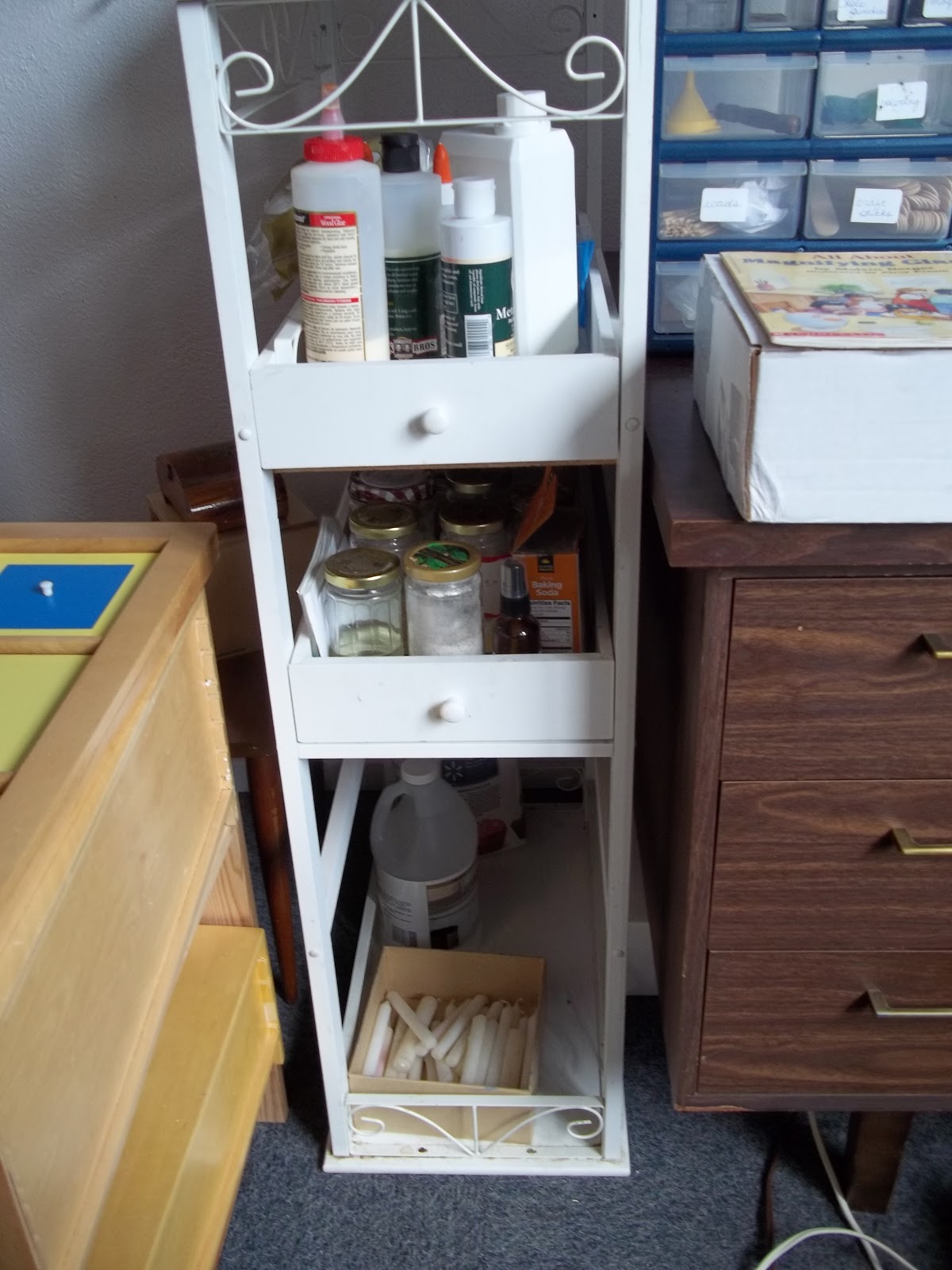
THIS WORK IS ON A TRAY. 

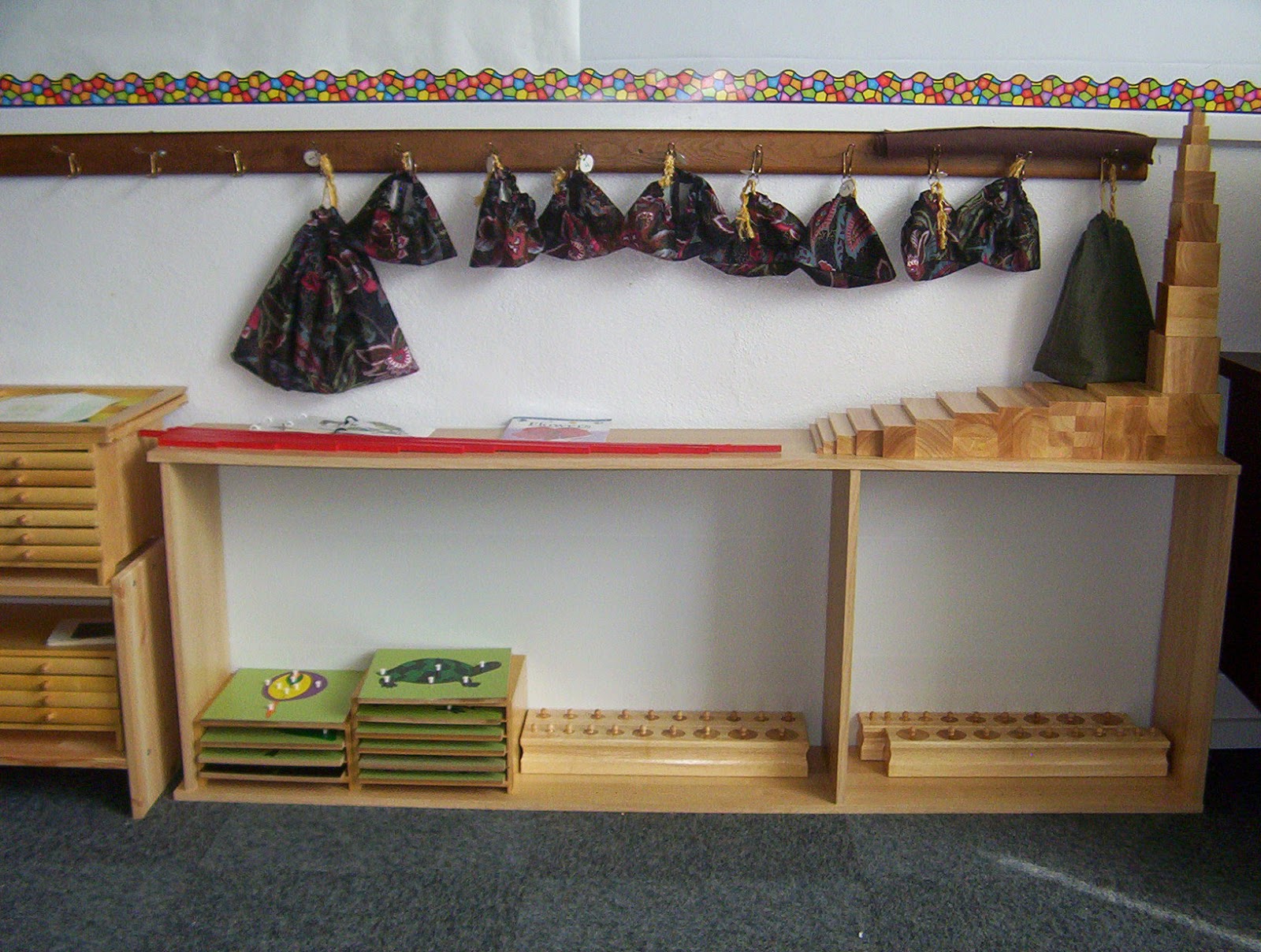
THIS WORK IS NOT ON A TRAY! 


Neither is this on a tray: 
 Or anything around it:

None of this stuff is on a tray:
this was before I added more horizontal shelves....
even then, there was one tray, organizing some language stuff -
a basket really. It stayed on the shelf and the children took the cards they wanted. 
 No trays here:

There is a writing tray on the one desk there: aha! A TRAY!!!

MORE TRAYS! Can you spot them? They are in the back corner, so the elementary children can collect their supplies and bring them to their work area.

We do have mats.... lots of those!
Maybe Montessori is Mats.


2 trays: one with the number bead bars 1-9; the other is used for transporting golden bead materials from another shelf to the.... MAT.


NO trays! For all that math!


Wow. So few trays (most are in practical life, unpictured here, not sure where the pictures went). And this is actually a genuine Montessori environment. With so few trays?
Oh yeah! Montessori is MATS. (that is said tongue-in-cheek - Montessori is actually not mats either).


Montessori Nomenclature Cards - what are they FOR!?

Nomenclature is always REVIEW of the concept in elementary, with invitation to create one's own booklet or chart, to make the work one's own, with one's own definitions of the terms.

Nomenclature is always READING PRACTICE on FAMILIAR CONCEPTS in primary. We give vocabulary with the picture-only cards after they have had real experience with the items represented in the pictures. Then we add the words as they are learning to read, to give them familiar items to match up with the sounds they are learning (these sounds they should already be writing - remember, the child should write before reading); then we add the definitions as they become stronger readers, to give them more for reading practice on definitions they already know.

To back up a step, we are reading those definitions (via the booklets) or at least describing the terms in their context of real life experience. When the children start reading, they find familiarity in the definitions with what they already know.

Nomenclature cards are not teaching tools. They are review of concepts and reading/vocabulary practice.

Thus the child can move into whole reading rather quickly, because of a foundation of a variety of real life experiences, with sound vocabulary and other rich spoken language experiences provided from the beginning of his life, exploring the sounds of his language with the sound games and all the sandpaper letters, then the movable alphabet; freed from the tedium of step-by-step systems, he has the keys to explore his own language, other languages, and indeed the whole world around him.

Maria Montessori called the sensorial materials "keys of the world" - indeed all that observed and tested in all areas of the infant, toddler and primary (3-6, preschool and kindergarten), are keys of the world.

Montessori Without Materials !?

You can certainly do "Authentic" Montessori at home without the materials. How is that possible? Because pure Montessori is about the following concepts: 

  • *beauty, simplicity, order
  • *follow the child (the child's interests, abilities, needs)
  • *OBSERVE - and RESPOND appropriately according to the plane of development and individual needs/interests
  • *provide KEY experiences - not overwhelming with too much information, or 10 materials to teach the same concept; or even 1 material that is so busy it doesn't allow for focus
  • *routine and beauty/simplicity/order that allows for developing long periods of concentration
  • *movement integrated with learning, balanced with moments of stillness and silence. 

Not a single specifically Montessori material mentioned ;) 


and for those who do use the specifically designed Montessori materials that do provide the Keys to the World and the Keys to the Universe? They phase out, until there are almost no such materials in upper elementary. 


Montessori Albums - Curriculum - Lesson Plans


Montessori albums tell you how to present the materials, how to use the materials, provide guidance on typical best times to present that work option to your child. Your child's abilities and interest dictate the pace.

These provide the curriculum (scope and sequence), the lesson plans (how to present/use the materials), suggested ages and experience ranges.

Authentically Montessori albums should NOT provide daily lesson plans (what to present on each day - your child and you decide this based on the child's interests and abilities). They should not dictate all the follow-ups your child does. Album pages (the lesson plans that tell you how to use the materials) provide some games and extensions that are good for most/all children; and some that are suggested for most/some children. Some follow-ups the children will discover on their own, if we guide them that direction, preparing the environment and our words to encourage their own self-discovery.

Montessori Curriculum

Curriculum is the sum of the child's experiences in a particular educational setting.
Montessori is an education as an for life itself.

The Montessori curriculum is found in a blend of the Montessori albums (lesson plans are the album pages) and the needs of the particular child before. The Montessori approach provides the keys for the universal child and time/resources to follow the interests and needs of the very unique individual child before you.

For more information on the key aspects of an authentic Montessori experience, pick up a Keys of the World or Keys of the Universe primary or elementary theory album.

Why Montessori is NOT Daily Lesson Plans


Some people really want Montessori daily lesson plans. This is a contradiction of terms.


Short story: 
Montessori - Follows the Child.
Daily Lesson Plans - Don't.

Montessori albums tell you how to present the materials, how to use the materials, provide guidance on typical best times to present that work option to your child. Your child's abilities and interest dictate the pace.


Some random details/thoughts: 
There is NO curriculum publisher, NO Montessorian, NO traditional public school teacher, NOBODY can predict, pre-determine a child's interests from day to day, months or years (or even HOURS!) ahead of time.

But what is "interest"? Referring to a child before the age of 6, we are referring to sensitive periods and a lighthouse-like feature of the child's mind that can absorb deep facts and experiences when the light is shining on that particular area, while everything else is entirely ignored. Then the child's focus shifts, some things seem to be "forgotten" for a time (they are generally picked back up very quickly afterwards), and a new focus is centered on.

Referring to an elementary child, "interest" refers to the child's research, projects, and work choices, both in academics and personal life.

In both cases, we present a relatively consistent flow of new and deeper experiences, while honoring the child's need for time - time to just BE, time to explore, time to make discoveries and connections of one's own.

These interests cannot be pre-planned in any particular order. Within a particular subject, a child may jump to chapter 4 of the geography album in elementary without doing all of chapters 1, 2, or 3. Why? Because outside of the very earliest presentations, the chapters are there for the adult's organization - NOT the child's curriculum. Follow the child's interests so that we can provide a rich experience when the child is entirely prepped to do so; so we might do work of air before work of water; or vice versa. There may be "early" activities in each of the chapters for the younger children, to provide the framework and basic of the key experiences, so that the child is exposed to an array of interest-options.


Now, some people say that those lessons, those keys we give to continue their experiences, can be pre-planned. But no, they really can't either. At least on a daily or even a weekly basis. A child may move through a few presentations quickly, then need time to delve into particular ones without receiving a new presentation in that area for a short time, because interest has been centered, and the creative juices are flowing.

Thus albums are divided up by "subject" - not daily, not weekly. But some albums do have charts to show the options for possible paths, leaving leeway for each individual learner.


Montessori, using daily lesson plans, outlined by someone who does not personally know the child before you; it is hard to call that Montessori because of the number of Montessori principles that type of practice entirely ignores, the most important of which is: Follow the Child.


Albums and Environment

Montessori Albums are the Montessori environment in written form. 

We actually begin with the environment, and the album stems from it.

The environment should be organized according to the album, not because the album comes first, but because the album should be based on the ideal environment already.


Spelling in Montessori - Follow-Up

Another key point to add to the previous Nuggets on Spelling (click on the tag below this post to see the others):

When elementary children are delving into the origins of language, root words, etymology - those things without official album page presentations but that are listed as "work of the child" - they will come to find patterns in our language in a more interesting and enriching way to than memorizing the rules and ALL the exceptions. (yes some of those need to be learned too)

Ever notice that national spelling bee participants always ask for the etymology (among other context clues) ? Yep. They are on to something!

;)


Spelling Contents in AMI Albums


From the Tables of Contents in Primary Montessori Language and Elementary Montessori Language:

First things first: exposure to the key 40-44 sounds in your dialect (presuming English language - numbers differ in each language). This is done through a keys-based experience with the presentation in the spoken language, writing, and phonetic reading portions of the language albums.


PRIMARY ALBUM: 


Phonogram Cards

Phonogram Alphabet Exploration

Phonogram Commands

Research

Spelling

Dictionary

Personal Dictionary


Reading: Puzzle Words

Puzzle Words (primarily reading, but helps with writing too)


Reading: Function of Words

All word lists can become dictation games. 


Word Study

All Word Study lists can become dictation games. 


ELEMENTARY ALBUM


Chapter II: Grammar and Syntax

           All Word Study provides dictation exercises. 

                        Introduction to Word Study

                                    Suffixes

                                    Prefixes

                                    Compound Words

                                    Word Families

                                    Synonyms

                        Parts of Speech

                                   Each grammar box provides some spelling rules
                                      on one level or another. 


                                    Introduction to the Noun

                                    Oral Presentation of the Noun

                                    Grammar Box II: The Article

                                    Definite and Indefinite Articles

                                    Noun: Number

                                    Noun: Gender

                                    Classification of Nouns:

                                                Common and Proper

                                                Concrete and Abstract

                                                Material and Collective

                                                Classification of Abstract Nouns

                                                Classification Chart

                                    Grammar Box III: The Adjective

                                                Adjective Command Cards & Classification

                                                Comparison of Adjectives

                                    Introduction to the Verb

                                    Grammar Box IV: The Verb

                                                Verb Commands and Synonyms

                                    Other Grammar Boxes & Commands Cards - Notes

                                    Grammar Box V: The Preposition

                                    Grammar Box VI: The Adverb

                                    Grammar Box VII: The Pronoun

                                    Grammar Box VIII: The Conjunction

                                    Grammar Box IX: The Interjection

                                                Additional Grammar Symbols

                                    Personal Pronouns

                        Introduction to the Tenses of the Verb
                                practice in changing the endings with the verb tense

                                    Simple Tense: Present

                                    Simple Tense: Past

                                    Auxiliary Verbs

                                    Simple Tense: Future

                                    The Perfect Tenses

                                    The Infinitive and Moods

                                    Negative Form of the Verb


Chapter III: Written Language

            Written Language Part I & II

            The Content of Children’s Work

          Be checking for spelling issues here; develop the child's dictionary with words and needed rules from here. 


Appendix: Vendolia’s Rules for Writers

Appendix: Singular/Plural Chart